West
High-speed Los Angeles police chase ends in dramatic crash, video shows

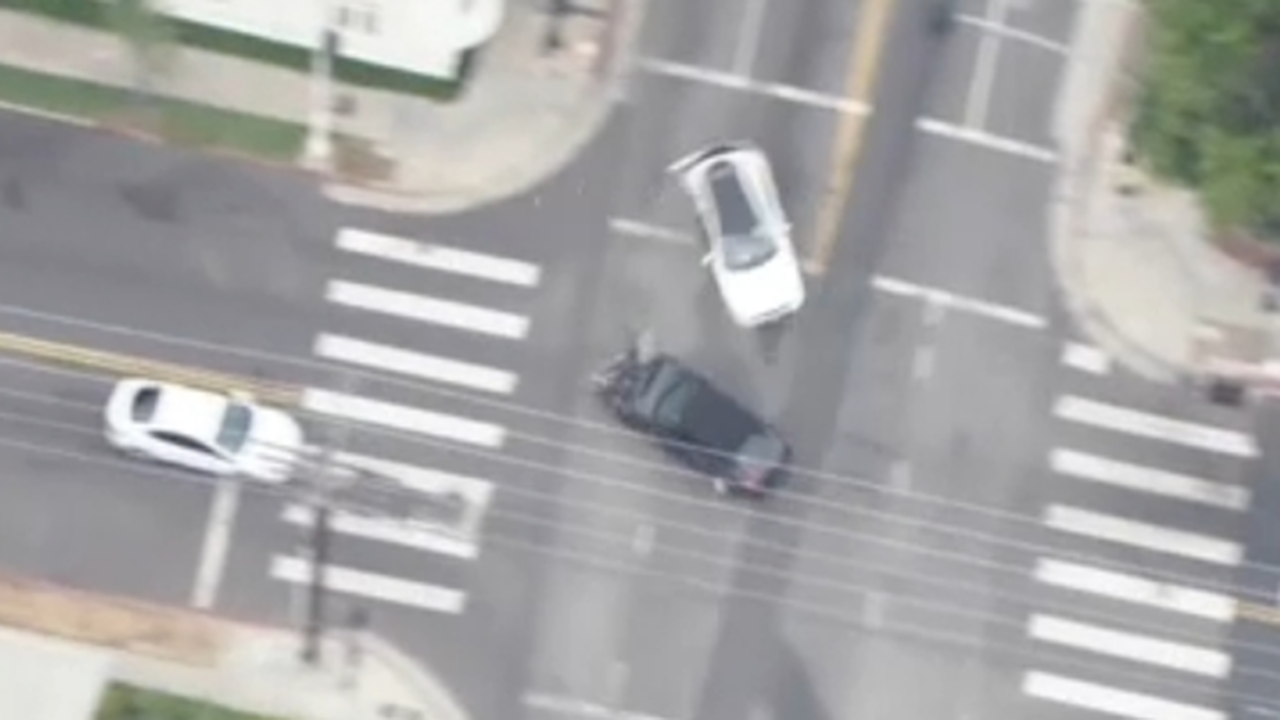
A video has captured a high-speed police chase in Los Angeles ending with a dramatic crash.
Footage taken by a helicopter flown by Fox 11 Los Angeles on Thursday showed a vehicle traveling at speeds of more than 80 mph through city streets before it slammed into an SUV while passing through an intersection in the Koreatown neighborhood.
The SUV could be seen spinning around before stopping against a building, while the vehicle involved in the pursuit struck a tree in the immediate aftermath of the collision.
An individual from that vehicle then escaped on foot and ran towards a residential building.
SON OF ANGELINA JOLIE, BRAD PITT INJURED IN E-BIKE ACCIDENT IN LOS ANGELES
An SUV is seen spinning around on Thursday, Aug. 1, after being hit at an intersection by a vehicle fleeing from police. (KTTV)
Up to three people allegedly involved in the chase were eventually taken into custody by police, according to Fox 11 Los Angeles.
The station reports that the police chase began after an armed robbery.
VICTIMS OF ANTISEMITIC RIOT OUTSIDE LOS ANGELES SYNAGOGUE SUE RADICAL GROUPS BEHIND ‘SHOCKING’ VIOLENCE
An individual is seen escaping on foot following the crash on Thursday in Los Angeles. (KTTV)
“They were approached while they were in their vehicle or outside their vehicle. The suspect pointed some kind of firearm at them and took some of their belongings. I think it was like a purse or wallet and possibly a cell phone,” Los Angeles Sheriff’s Department Sgt. Luis Zamorano was quoted as saying.
The vehicle involved in the chase is believed to have been stolen, according to Fox 11 Los Angeles.
A dramatic high-speed chase in Los Angeles ended Thursday after an vehicle collided with an SUV at an intersection. (KTTV)
The station also reports that a rifle was recovered by law enforcement at the crash scene.
Read the full article from Here

Hawaii
Hawaii displays historic photos of Martin Luther King Jr. wearing flower lei during Selma march

HONOLULU — Photographs of the Rev. Martin Luther King Jr. adorned with flower lei from Hawaii residents who traveled to Selma, Alabama, to join him on a pivotal Civil Rights march went on public display Tuesday in the state Capitol in Honolulu.
The Selma-to-Montgomery marches galvanized passage of the Voting Rights Act of 1965, which did away with most barriers such as poll taxes and other forms of voter discrimination targeting Black Americans in the Deep South.
A delegation of five people brought dozens of flower lei with them from Hawaii to Alabama in March 1965. Images of King wearing lei, garlands that are synonymous with Hawaiian culture, have been previously published — but most of the photos displayed in Hawaii’s new exhibit have never been seen before. Some photos have subtle variations, while others include figures who may have been deemed unimportant at the time. The exhibit runs through July 7.
One of the lei-bearers was Charles Campbell, a high school teacher and chairman of the Hawaii Civil Rights Conference, who a March 20, 1965 article in The Honolulu Advertiser quoted as saying: “Selma has the capability of becoming a real sore that could affect the entire nation.”
King was photographed wearing lei about two weeks after the event known as Bloody Sunday when state troopers violently attacked Civil Rights marchers on the Edmund Pettus Bridge in Selma on March 7, 1965.
The photos were taken by Civil Rights photographer Matt Herron, whose widow donated them to Hawaii’s Department of Accounting and General Services for the state’s archives.
After the photos were unveiled, Steven Springel stared at a photo of his mother, Nona Ferdon, who was a divorced mother of two children and a graduate student when she traveled to Selma.
This photo provided by Jeannine Herron shows Charles Campbell, who traveled to Alabama for the march from Selma to Montgomery, placing a lei on Dr. Martin Luther King, Jr. at Brown Chapel AME in Selma, Ala., March 21, 1965. Credit: AP/Matt Herron
Springel remembers he was just about to turn 7 and only realized as an adult how important her trip was. Growing up in Hawaii, “we never experienced segregation or racial inequality,” he said of his and his sister’s childhood. Ferdon died in 2021.
The exhibit, part of Hawaii’s programming to mark the 250th anniversary of the United States, is a reminder people from the Aloha State participated in an important event in history, said Keith Regan, who oversees the department as the state’s comptroller and presided over the photo unveiling as acting governor while Gov. Josh Green is out of state.
The small delegation traveled thousands of miles “to be a part of the Civil Rights movement, to show ‘aloha’ to the world that Hawaii was there holding hands with our fellow brothers and sisters to ensure equality and justice were heard throughout the nation,” he said.
The Hawaii members also wore lei during first day of the 50-mile (80.46-kilometer) march. Mothers of Kawaiahaʻo Church in Honolulu strung together fragrant plumeria plucked from church grounds to assemble the lei.
This photo provided by Jeannine Herron shows Nona Ferdon, a graduate student who accompanied the Hawaii delegation that traveled to Alabama in 1965 for the march for voting rights, attends the march in Selma, Ala., March 21, 1965. Credit: AP/Matt Herron

Giving lei, a word that is both singular and plural in the Hawaiian language, continues to be a way to share the “aloha” spirit. People in Hawaii give and receive lei for all kinds of reasons, including to celebrate birthdays and promotions, or to show appreciation or recognition.
Tomi Knaefler, who had traveled with the delegation as a reporter with the Honolulu Star-Bulletin, planned to attend Tuesday’s news conference. But at 96 years old, she wasn’t feeling up to it, said her daughter, Pamela MacDonald, who did attend.
MacDonald said she was 14 when her mother went on the assignment, “the one that she holds dearest to her heart.”
The exhibit comes at the end of the U.S. Supreme Court’s 2026 term, which included a ruling gutting the remaining piece of the Voting Rights Act, setting off a wave of partisan gerrymandering in states in the South and endangering generations of gains in Black political representation.

BOISE, Idaho (CBS2) — The firing squad will become the primary method of execution in the State of Idaho starting July 1, 2026. Those in support of the change argue it’s a more humane and efficient method, while some are more skeptical.
Idaho is now one of five states to authorize the firing squad as a means of execution. Other states include Mississippi, Oklahoma, Utah and South Carolina. Where Idaho differs, it’s the only state to make it the primary method.
The death penalty in Idaho
In 1977, the Supreme Court of the United States reinstated use of the death penalty in the case Gregg v. Georgia. Leading to states updating their death penalty statutes and procedure.
Since then, Idaho has successfully carried out three executions through lethal injection. In 1994, 2011 and 2012.
The last attempted execution was in February of 2024. Thomas Creech, the longest serving inmate on death row in Idaho, received the death penalty after beating another inmate to death in 1981.
On the day of Creech’s scheduled execution, the execution team failed after eight attempts to find a vain to set the IV that would administer the lethal injection.
Rep. Bruce Skaug co-sponsored House Bill 803 in the 2026 legislative session. The bill made the firing squad the primary method as well as added new provisions to protect parts of execution procedure from review.
He said in an interview that the lethal injection has the possibility to fail about six or seven percent of the time.
“We needed something that was sure and humane, and firing squad is humane because it is sudden, it is quick and it is certain,” Skaug, R-Nampa said.
The firing squad
Since capital punishment was reinstated, there have been six firing squad executions according to the Death Penalty Information Center. Three of those six took place in South Carolina in 2025.
Robin Maher, the executive director for the Death Penalty Information Center, told IdahoNews.com that two of those three in South Carolina “went badly.”
“One of them, only two bullets were found in the prisoner. The third bullet didn’t even hit him and neither of those bullets hit his heart,” Maher said. “So it tells you that the firing squad is not a fool proof method.”
An idea to carry out the firing squad through a remote controlled firing mechanism was considered in Idaho, ultimately being scrapped for a traditional three-member firing squad. Each member of the firing squad team will receive one live round of ammunition and on the call to “fire” will simultaneously discharge their weapons.
The Idaho Department of Corrections has detailed a series of qualifications and requirements to be considered as a possible member of the firing squad, since it operates on a volunteer basis.
Volunteers must hold a Peace Officers Standards and Training, or POST, certification for a minimum of three years, have no disciplinary action in the past 12 months relating to firearms or use of force and be able to demonstrate a proficiency in firearms.
Volunteers must pass a test in which they:
- Fire each IDOC provided firearm with 100% accuracy from at least 21 feet.
- Hit a target of the same size, shape and height as will be used in an actual execution
- A volunteer fails the test if they are unable to hit the target with one round from each of the firearms
The volunteers also cannot have any blood or legal relation to the victim, victim’s family, the prisoner and prisoner’s family.
Maher believes the firing squad fell out of favor due to the method being “graphic” and “bloody.” Leading to the public with a want to move away from the method.
Public opinion of the death penalty
According to a Gallup poll, public support for the death penalty is at a five decade low. While 52% of people still support capital punishment, the amount of people not in favor has steadily grown since the mid 1990’s.
“There are rising concerns about the evidence of bias and of error, the accuracy and whether the death penalty even works, keeps [people] safer,” Maher said.
Are you in favor of the death penalty for a person convicted of murder (Gallup)
Skaug told IdahoNews.com that in Idaho, favor for the death penalty isn’t losing any support. That he has heard from constituents voicing their support for both the death penalty as a whole and the firing squad specifically. Saying some have even expressed a “too eager” desire to be on the firing squad.
“We go through a lot of time and expense to get someone on death row and then ultimately to carry out the justice for the victims and their families,” Skaug said.
The cost of the death penalty
As part of approving the firing squad, IDOC needed to retrofit the execution chamber at F-Block at the Idaho Maximum Security Institution to accommodate the change. Originally being appropriated $750,000 from the legislature in 2023.
For phase two of the update, IDOC estimates the cost at about $910,802.
Skaug said he doesn’t like the up-front cost to retrofit F-Block, but he said “it needed to be done.” He also said it will be easier to acquire ammunition and firearms than it is to acquire the drugs needed for lethal injection. Saying that a manufacturer offered to donate ammunition to the state which was refused.

Exterior of IMSI (Courtesy Idaho Department of Corrections)
Maher said many people are shocked to hear the cost to carry out the death penalty is higher than expected.
“As soon as the prosecutor decides to seek death, the price tag goes up,” Maher said referring to a long series of appeals and security costs required.
As the new procedure is set to take effect July 1, Skaug says that they are ready to carry out the firing squad. There are currently eight people on Idaho’s death row.

HELENA, Mont. — The Department of Veteran Affairs appointed a new healthcare system director.
Kimberly Adkins is responsible for 21 sites of care statewide including a medical center at Fork Harrison, a health care center in Billings, 13 community-based outpatient clinics and oversees delivery of health care services covering 1447,000 square miles in Montana.
Adkins has been a federal employee since May 1989 when she began as a GS-3 clerk-typist with the U.S. Department of Housing and Urban Development.
Officials say she brings experience overseeing emergency management, fiscal, facilities management, safety, strategic planning, supply chain management, police, privacy, human resource, contacting and more.
The Department of Veteran Affairs provided the information in the following press release:
The Department of Veterans Affairs (VA) is pleased to announce the appointment of Ms. Kimberly Adkins, as the new director of Montana VA Health Care System (MTVAHCS). Ms. Adkins is responsible for 21 sites of care statewide including: a Medical Center at Fort Harrison, a Health Care Center (HCC) in Billings, 13 Community Based Outpatient Clinics, and oversees delivery of health care services covering 147,000 square miles within the state of Montana.
“We are excited to bring Ms. Adkins on board as the new director of the VA Montana Health Care System,” said Sunaina Kumar-Giebel, Veterans Integrated Service Network (VISN) 19 Director. “Her sound leadership qualities and proven experience will be valuable assets for the facility, the employees and volunteers, and most importantly, for the Veterans we are honored to serve.”
Mrs. Adkins has been a Federal employee since May of 1989 when she began her career as a GS-3 clerk-typist with the US Department of Housing and Urban Development. She has more than 29 years of Federal service. She brings experience overseeing emergency management, fiscal, facilities management, safety, strategic planning, supply chain management, police, privacy, human resources, contracting, and more.
The Montana VA Health Care System provides essential services is a Joint Commission accredited, level two complexity facility serving Veterans across Montana; the largest catchment area in the lower 48 states (about 147,000 square miles) and operates on a budget of over $612 million. MTVAHCS has approximately 47,300 enrolled Veterans and has capacity to provide services to the estimated 65,000 eligible Veterans in Montana. MTVAHCS has 21 sites of care statewide including: a Medical Center at Fort Harrison, a Health Care Center (HCC) in Billings, 13 Community Based Outpatient Clinics (Bozeman, Butte, Browning, Cut Bank, Glasgow, Glendive, Great Falls, Hamilton, Havre, Kalispell, Lewistown, Miles City, Missoula), a Primary Telehealth Outpatient Clinic in Plentywood, a 14-bed Community Living Center in Miles City, a nationally accredited Sleep Disorders Center in Helena, and ATLAS telehealth sites in Eureka, Bozeman and Missoula. Fort Harrison VA Medical Center has 29 authorized/18 operational acute care medical/surgical beds; which includes six Intensive Care Unit (ICU) beds offering a broad range of acute, chronic, and specialized inpatient and outpatient services for Veterans. Fort Harrison operates a 24-bed residential rehabilitation unit offering 2 tracks: the treatment of Veterans with PTSD and the treatment of Veterans with substance abuse. Billings Health Care Center (HCC) provides Primary Care, Mental Health, Specialty Care services, as well as Dental, Laboratory, Pharmacy, Physical Therapy, Diagnostic Imaging, and outpatient specialty procedures and surgical interventions for the largest metropolitan area in Montana and vast rural area of the eastern half of Montana. Billing’s secondary service area includes northern Wyoming. Telehealth services are available at all sites of care.
-

 Connecticut57 seconds ago
US Supreme Court to consider challenge to Connecticut assault weapons ban
-

 Delaware8 minutes ago
Delaware Fire Marshal Urges Fireworks Caution Ahead of July 4th – 47abc
-

 Florida11 minutes ago
New details in deadly Florida alligator attack
-

 Georgia16 minutes ago
Friends of Georgia Radio Reveals HOF Class – Radio World
-
Hawaii23 minutes ago
Hawaii displays historic photos of Martin Luther King Jr. wearing flower lei during Selma march
-

 Idaho26 minutes ago
Firing squad set to become primary method of execution in Idaho
-

 Illinois38 minutes ago
U.S. Supreme Court rejects effort to end birthright citizenship; Illinois advocates relieved
-

 Indiana41 minutes ago
Officials urge water safety amid ‘alarming’ number of drownings


