A Louisiana prison committed one of the most obvious violations of a man’s religious liberty that has ever made its way to the Supreme Court.
Louisiana
Double shooting in Addis Sunday evening; police searching for suspect


ADDIS, La. (WAFB) – Two people were shot in Addis Sunday evening and the suspect has not yet been apprehended, according to authorities.
One male was pronounced dead at the scene and a second male is in critical condition, investigators said.
The suspect allegedly fled on foot before officers arrived on the scene. He is described as an unknown male wearing a face mask.
The shooting happened at an apartment complex on Chad Drive, just east of Highway One in West Baton Rouge Parish. All through traffic to Chad Drive has been blocked.
No other details are available at this time. This is a developing story.
Click here to report a typo.
Copyright 2024 WAFB. All rights reserved.

Continue Reading
Louisiana
Q&A: Louisiana U.S. Senate candidates sound off on important issues ahead of primary runoff

Louisiana heads to the polls again on Saturday, June 27, as both Republicans and Democrats will hold party primary run-offs for Bill Cassidy’s U.S. Senate seat. Polls open at 7 a.m. and close at 8 p.m.
Republican voters will choose between Congresswoman Julia Letlow and state Treasurer John Fleming, while Democratic voters will choose between Jamie Davis, the state party’s endorsed candidate in the race, and Gary Crockett, who faces Davis after Nick Albares ended his campaign in late May.
Below is a list of questions WRKF sent to the four candidates and their responses. The responses have been edited and condensed for clarity.
Louisiana’s primary is this Saturday, May 16. See what’s on the ballot.
Gary Crockett (Democrat)
Photo courtesy of Gary Crockett
On abortion:
I am Moderate/pro-choice. I support legal abortion in some circumstances. I oppose total abortion bans. I absolutely support exceptions for rape, incest, and threats to the mother’s life. I am in favor of preserving access but totally against 3rd trimester abortions unless the woman’s life is in jeopardy.
On the death penalty:
I’m a moderate when it comes to the death penalty, and my view is to “keep it for the worst offenders” and allow for conclusive DNA testing for all who are sentenced to death.
On President Donald Trump:
I have strong opposition to Trump because his policies don’t work for the people who work.
The working-class people are suffering economically because Trump’s policies only benefit billionaires and large corporations.
Trump should spend more time focusing on economic and governance issues rather than filling the pockets of himself and his family.
On ‘The Epstein Files’
I call for the immediate release of non-sensitive records consistent with the law.
I support the investigation of wrongdoing regardless of political affiliation or person, including videos and files implicating the president.
I call for equal justice under the law with no actions or procedures to protect powerful individuals.
On carbon sequestration
I do not support research and deployment of carbon-capture technologies.
I reject the idea and any rhetoric that presents carbon sequestration as the only climate solution.
On DEI (Diversity, Equity, and Inclusion)
America has many mountains to climb in the areas of equal opportunity and anti-discrimination efforts.
Despite emphasizing merit, skills, and fairness, the current Secretary of Defense and this administration have discriminated against members of our own forces for promotions, even after passing several boards in which their counterparts took the same testing and were evaluated equally, but only minorities were refused promotions.
I want mandates ensuring everyone has a fair chance while maintaining standards.
What are your proudest accomplishments?
I am most proud of my 20+ years of military service and being a father of 4 great children.
What will be your top three priorities in office?
The economy, which includes increasing the minimum wage, creating opportunities, both economic and social, for our next generation of young people, and a better and more robust healthcare system for all — especially the rural areas of America.
Jamie Davis (Democrat)

Greg LaRose
/
Louisiana Illuminator
On abortion:
We flattened all of women’s healthcare into one issue, and it made many women less safe.
Politicians and laws shouldn’t be in the room with a woman and her doctor.
Since the Supreme Court struck down Roe, women have died on operating tables because doctors have been afraid to help.
We should restore women’s right to healthcare, trust them as the mothers to make important family and personal decisions, codify Roe, and keep the government out of their business.
On the death penalty:
It is not up to us to decide whether someone lives or dies. There is no moral justification. We are not the most high.
I agree with punishments that fit the crime, but when did we become the judges of whose lives we take vs. who we allow to live?
On President Donald Trump:
He’s the president for two more years, and here’s what I know.
A lot of Louisiana voters believed in him, and I think he’s let them down and left them with empty promises.
On ‘The Epstein Files’
They need to be released, and people should face consequences.
There are too many distractions flying around D.C., but if I’m elected, I’ll be another voice advocating for justice for the survivors.
On carbon sequestration
Decisions about our land, water, and future should not be made solely at the state or federal level without local consent.
Communities deserve the final say when projects threaten their property rights, safety, and quality of life.
I oppose CCS by way of eminent domain to seize private property for carbon pipelines.
No family should be forced to give up their land so corporations can profit from taxpayer-backed projects.
I also support repealing the federal 45Q tax credit, which has subsidized CCS projects while shifting the risks onto local communities.
Instead of spending taxpayer dollars on carbon capture schemes, we should invest in clean energy, infrastructure, and economic development that create good-paying jobs without putting Louisiana communities in harm’s way.
On DEI (Diversity, Equity, and Inclusion)
According to President Trump and the U.S. Supreme Court, DEI is over with.
We need to get serious and focus on ensuring everyone has a fair shot at making a living.
What are your proudest accomplishments?
I was the first person in my immediate family to graduate from high school, something that meant a great deal to my parents and opened doors for me that they never had.
In my early 20s, my father had to undergo back surgery during the farming season. Successfully managing the farm and bringing in the crop while he recovered gave me confidence and taught me the value of responsibility, hard work, and perseverance.
I am also proud of my service to my community. When I was elected to the Tensas Parish Police Jury, I unseated the longest-serving police juror in the State of Louisiana, proving that hard work, determination, and a willingness to listen to people can bring about meaningful change.
Through each of these experiences, my faith, family, and commitment to service have guided me and continue to shape the way I approach leadership today.
Above all, I am proud of my family. Becoming a husband, father, and grandfather has been the greatest blessing of my life.
What will be your top three priorities in office?
My top three priorities are affordability, healthcare, and opportunity.
First, I will work to lower the cost of living by addressing the rising costs of housing, insurance, utilities, and everyday necessities while supporting family farms, small businesses, and good-paying jobs.
Second, I will fight to protect healthcare by defending Medicaid, strengthening rural hospitals at risk of closing, lowering prescription drug costs, and protecting Social Security and Medicare and the subsidies that keep premiums affordable.
I will address opportunity in a few ways:
- First, invest in education, higher federal minimum wages, and workforce development, so that every Louisianan has the opportunity to succeed and build a future here at home.
- I will also push for a national ban on partisan gerrymandering so that we get elected officials away from drawing maps and back to solving problems and working together. Every American deserves fair representation and a voice that matters. They also deserve to know their elected official is accountable to them, not scheming to draw voters they don’t like into another district.
- Lastly, I will fight for a strong Farm Bill that supports family farmers, improves and expands SNAP benefits, strengthens rural communities, improves crop insurance and safety nets, and ensures that those who feed our country can continue to make a living on the land.
My goal is simple: to help create a Louisiana we can all afford and an economy that works for everyone.
State Treasurer John Fleming (Republican)

Photo courtesy of John Fleming
On abortion:
100% opposed to abortion. I have a 100% voting record in opposition to abortion.
On the death penalty:
I support the death penalty, especially in capital cases.
On President Donald Trump:
I fully support President Trump
On ‘The Epstein Files’
I support full release and disclosure
On carbon sequestration
I am totally opposed and never voted for Carbon Sequestration
On DEI (Diversity, Equity, and Inclusion)
Totally opposed and never voted for DEI.
Legislation you are most proud of and why?
- Amtrak Secure Transportation of Firearms Act of 2009. The bill required Amtrak to permit passengers to safely transport unloaded firearms and ammunition in declared, locked, hard-sided containers within checked baggage
- Federal Duck Stamp Act of 2014, which increased the price of the federal Migratory Bird Hunting and Conservation Stamp (Duck Stamp) from $15 to $25 to generate critical funding for wetland conservation
- Passed an amendment to the annual NDAA to prevent atheists from being hired in the military as chaplains.
How do you feel your record is viewed in Congress?
- The most conservative of any congressman in Louisiana, according to voting scorecards.
- One of the nine original founders of the House Freedom Caucus.
- Led the fight against the Affordable Care Act, which has driven healthcare costs to twice the rate of inflation.
What are your proudest accomplishments?
Fighting against abortion and ultimately reducing the rates of abortion as well as getting the right justices to make abortion a state issue, not a federal right.
What will be your top three priorities in office?
- Repeal the 45Q tax credits to end Carbon Sequestration.
- Reform healthcare to bring back competition and price transparency so that costs go down while quality of care improves.
- Serve on the Senate Armed Services Committee to support our national defense and defend our two major military bases in Louisiana.
Congresswoman Julia Letlow (Republican)
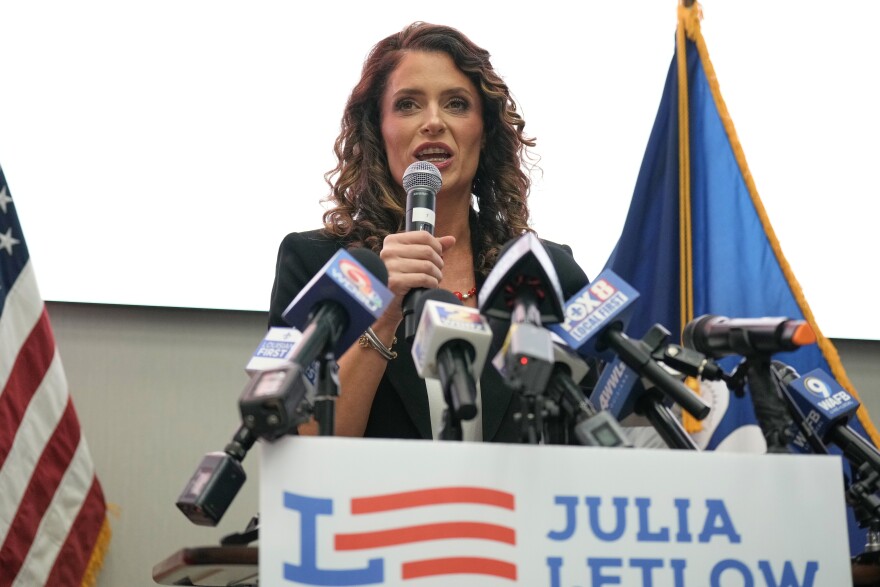
Matthew Hinton
/
AP Photo
On abortion:
I am unapologetically pro-life. As a mother, I believe every life is precious and worth protecting.
In Congress, I have consistently opposed taxpayer funding for abortion and supported legislation that defends the unborn.
In the Senate, I will continue to be a strong, unwavering pro-life voice for Louisiana families.
On the death penalty:
I support the death penalty for the most heinous crimes. There are evil acts so horrific that the ultimate punishment is justified.
I also believe victims and their families deserve justice, and I will always stand with law enforcement and those who work to keep our communities safe.
On President Donald Trump:
President Trump called on me to run for this Senate seat because he knows I’m conservative to my core and will always have his back.
I was honored to earn his complete and total endorsement, and I look forward to being his partner in the Senate to secure the border, unleash American energy, protect our values and finish the America First agenda.
On ‘The Epstein Files’
The American people deserve transparency and accountability. Anyone who committed crimes should be prosecuted to the fullest extent of the law.
The Department of Justice should follow the facts wherever they lead and ensure justice is served.
On carbon sequestration
I support Gov. Landry’s moratorium on new CCS permits.
My position is simple: if a project is not safe, not transparent, and does not have local buy-in, it should not move forward.
This is a state issue, and I trust Gov. Landry and our legislature to put the right protections in place for Louisiana communities.
On DEI (Diversity, Equity, and Inclusion)
Like many Americans, I initially saw DEI being presented as a way for students to achieve the American dream. But the radical left turned it into a system of division, indoctrination, and holding people down.
In Congress, I have fought against it every single day by authoring the Parents’ Bill of Rights to strip DEI from our K-12 programs, supporting the End Woke in Higher Education Act, and voting to remove DEI programs from the military.
I will continue to fight against DEI in the U.S. Senate.
Legislation You Are Most Proud Of and Why?
The legislation I’m most proud of is the Parents’ Bill of Rights.
As a mother and former educator, I believe parents should have a seat at the table when it comes to their children’s education.
The bill gives parents greater transparency into curriculum, school budgets, and what is happening in their children’s classrooms. It puts families back in charge and protects children from political agendas that don’t belong in schools.
How Do You Feel Your Record Is Viewed in Congress?
I think my record is viewed as one of someone who shows up, does the work and delivers results.
I’ve served on the Appropriations Committee, brought hundreds of millions of dollars back to Louisiana communities, fought for parents, supported our farmers and law enforcement officers and stood with President Trump.
I’ve earned a reputation as a conservative who gets things done and listens to the people whom I serve.
What Are Your Proudest Accomplishments?
I’m proud of the Parents’ Bill of Rights.
I’m proud of the work we’ve done to support Louisiana agriculture, including getting legislation I authored included in the Farm Bill.
I’m proud of the resources I’ve helped deliver to Louisiana communities for infrastructure, healthcare, and public safety.
And most importantly, I’m proud to have earned the trust of the people of Louisiana and President Trump.
What Will Be Your Top Three Priorities in Office?
First, border security and public safety. We must make President Trump’s border policies permanent, deport criminal illegal aliens, stop fentanyl and support law enforcement.
Second, growing Louisiana’s economy. That means unleashing American energy, cutting wasteful spending, lowering costs, supporting our farmers and fishermen and creating more good-paying jobs.
Third, education and families. I’ll continue fighting for school choice, parents’ rights, transparency in education and protecting girls’ sports and opportunities for the next generation.
Those three priorities all come back to one goal: making Louisiana safer, stronger, and more prosperous for our children and grandchildren.

MONROE, La. (KNOE) – The Federal Emergency Management Agency (FEMA) announced that federal funding for hazard mitigation projects is available to address flood, earthquake and wildfire threats. This funding will allow states to take proactive steps to protecting their communities from future disasters.
The funding for these projects has been made available through FEMA’s Pre-Disaster Mitigation grant program, with 40 states and one Tribal Nation expected to receive more than $189 million in federal funding for 125 projects.
Identified projects in FEMA Region 6 include:
- $6 million for I-20 South Frontage Road drainage improvements for the Ouachita Parish Police Jury
- $900,000 for the pump station for the town of Lake Arthur
- $1.5 million to the Department of Homeland Security and Emergency Management for portable backup generators and water support
- $750,000 for the Boyd Lining Project in the city of Bloomfield
- $262,000 for emergency siren warning system upgrades for Roosevelt County, Texas
- $1.5 million for a high hazard dam project in the city of Gladewater
- $1.1 million for emergency disaster energy hubs for the city of Austin
- $1.1 million for the Cypress Ditch Improvement Project in the city of Bellaire
- $1.1 million for the Alberta Avenue storm and domestic water improvements project for the El Paso County Hospital District
- $1.1 million for Tributary C116-00-00 conveyance and drainage improvements for the Harris County Flood Control District
- $827,000 for the underpass flooding early warning system improvements in the city of Beaumont
Before funds are awarded, these communities must submit an application by July 22, 2026, by 5 p.m. Eastern time.
Nationwide, FEMA expects to distribute $189M for 125 projects
Applications must be submitted through FEMA Grants Outcomes (FEMA GO), the agency’s grants management system. For more information, review the Notice of Funding Opportunity on Grants.gov.
Copyright 2026 KNOE. All rights reserved.

Damon Landor is a Rastafari who, for religious reasons, does not cut his hair — according to his lawyers, he kept this vow for more than two decades, until his dreadlocks grew nearly long enough to reach his knees. But then, in 2020, while he was serving a five-month sentence for a drug-related offense, prison officials handcuffed him to a chair, held him down, and shaved his head.
Incredibly, when Landor was transferred to the prison where this forced shaving occurred, he brought with him a copy of a federal appeals court decision, which held that it violates federal religious liberty law for Louisiana prisons to cut the hair of Rastafari prisoners, at least when those prisoners wish to keep it long for religious reasons. But, when Landor presented this decision to prison guards, they threw it in the trash and shaved his head anyway.
And yet, in its 6-3 decision in Landor v. Louisiana Department of Corrections and Public Safety, which the Supreme Court handed down on Tuesday, the Court’s Republican majority held that Landor has no remedy against these prison officials, despite their clear cut violation of federal religious liberty law.
The Court’s Republican majority is normally very sympathetic to religious liberty plaintiffs, especially when those plaintiffs are Christian. So Landor is a break from this Court’s broader efforts to read religious liberty law expansively. It’s unclear why the Republican justices broke from their ordinary pattern of favoring religious plaintiffs, though one explanation is that Landor could undermine civil rights and public health statutes that Republicans oppose.
Justice Neil Gorsuch’s decision for himself and his fellow Republicans rests on a hypertechnical distinction between how the federal law at issue in this case, the Religious Land Use and Institutionalized Persons Act of 2000 (RLUIPA), was actually drafted, and how it could have been drafted to protect people like Landor. In theory, Landor does little to limit Congress’s ability to protect religious liberty — or any other right. But it requires Congress to write laws in the way that Gorsuch prefers.
Indeed, it’s not even clear that Gorsuch’s opinion is wrong. Numerous federal appeals courts agree with Gorsuch’s approach to this case. Thus, one of the most baffling questions embedded in the Landor decision is why the Court decided to hear this lawsuit to begin with. Why take a case involving truly egregious facts, if all the justices planned to do was reaffirm existing law? They could have just let the lower court’s decision, which also ended in a loss for Landor, stand.
Instead, the justices decided to put their own prestige behind the shocking, if legally defensible, decision in Landor. The question is why.
One possible explanation is that the Court’s Landor decision most likely resolves an ongoing dispute about whether women in red states may receive emergency abortions, if one is necessary to save their life or to ward off serious health consequences. Although federal law requires hospitals to perform these emergency abortions, Gorsuch’s opinion in Landor could nullify that law — at least in states where abortion is illegal.
The Court’s Republican majority often reads the law in ways that are inconsistent with its precedents when doing so will shut down access to abortion. Additionally, Justice Ketanji Brown Jackson’s dissent in Landor lists other federal statutes, including one protecting nursing home residents, that could be undermined by Gorsuch’s opinion.
In any event, the immediate effect of the Court’s most recent decision is that Landor has no remedy, despite the fact that his religious liberty rights were clearly violated.
So what is the specific legal dispute in Landor?
As Gorsuch concedes, RLUIPA prohibits state prison systems that receive federal funding from “imposing ‘substantial burden[s] on the religious exercise[s]’ of state prisoners outside exceptional circumstances.” There’s little doubt that, by forcibly shaving Landor’s head, Louisiana’s prison system violated RLUIPA.
But Landor sought more than a mere judicial declaration that his rights were violated; he sued the prison officials who actually shaved his head, arguing that they should personally be liable to him. Gorsuch’s opinion holds that these officials are immune from paying money damages to Landor.
To reach this result, Gorsuch fixates on the fact that RLUIPA does not directly regulate prisons or prison guards. Instead, it imposes a condition on state prisons that accept federal grants. Those prisons are free to turn away that money if they wish, but if they take that money, they are required to comply with RLUIPA’s religious liberty protections.
This arrangement, Gorsuch argues, is similar to a contract, and thus can only bind the parties that agree to it. While the state prison where Landor was incarcerated agreed to comply with RLUIPA, Gorsuch claims, the employees of that prison did not. And thus they cannot be personally sued for violating RLUIPA.
On the surface, this is a narrow holding, because Gorsuch also writes that Congress could have made the prison guards liable to people like Landor if it had written RLUIPA slightly differently. “Congress,” Gorsuch writes, “could have said that, as a condition of federal funding to LDOC, its officers had to agree to enter separate contracts with the federal government consenting to answer suits under RLUIPA.” Or it “might have conditioned its funds on Louisiana’s agreement” to enact a state law permitting prisoners to sue prison guards who violate RLUIPA.
If the United States had a functioning Congress, it could fix RLUIPA tomorrow.
Indeed, Gorsuch draws such a fine distinction that Justice Ketanji Brown Jackson spends much of her dissent arguing that her Republican colleagues should have cut Congress more slack. “The Court’s ruling apparently boils down to dissatisfaction with the precise way Congress structured RLUIPA,” Jackson writes for herself and her fellow Democrats. She adds that this “hairsplitting undervalues Congress’s lawmaking prerogative; we ought not substitute our rigid contract-based preferences for Congress’s considered statutory design.”
Yet, for what it is worth, lower court judges have largely preferred Gorsuch’s formalism to Jackson’s more pragmatic approach. As Louisiana pointed out in its brief to the justices, many federal appeals courts have agreed that prisoners like Landor are not allowed to sue prison officials for money damages. So, while the Landor decision may shock nonlawyers, it is not really a surprise to anyone who has followed this case closely.
Landor will probably have very bad consequences for women who need an abortion to save their life
Given this consensus among lower courts, it’s very odd that the Court decided to hear this case at all. If the Court had turned Landor’s petition asking the justices to review his case aside, the lower court’s ruling against him would have stood, but the Republican justices would have avoided the embarrassment of having to sign their names to such a seemingly unjust result.
One possible explanation for the Court’s decision to take up Landor, however, is that it potentially allows them to dodge an ongoing dispute about an even more contentious issue: abortion.
The federal Emergency Medical Treatment and Labor Act (EMTALA), requires hospitals that accept Medicare funding (which is nearly every hospital in the US) to provide “such treatment as may be required to stabilize the medical condition” of “any individual” who arrives at the hospital’s ER with an “emergency medical condition.”
EMTALA contains no exception for abortion. So, under EMTALA’s text, federal law unambiguously requires hospitals to perform emergency abortions. EMTALA also says that state and local laws are superseded by EMTALA’s provisions “to the extent that the [state law] directly conflicts with a requirement of this section.” Red states, in other words, may not prohibit hospitals from performing emergency abortions that are required by federal law.
Nevertheless, Idaho refused to comply with EMTALA, and a dispute over whether Idaho’s broad abortion ban could restrict emergency abortions reached the Supreme Court in Moyle v. United States (2024).
Though a majority of the justices voted to dismiss the Moyle case without deciding it, Justice Samuel Alito wrote a dissenting opinion that closely resembles Gorsuch’s opinion in Landor. (Gorsuch joined most of Alito’s dissent.)
Alito argued that, much like RLUIPA, EMTALA operates like a contract — hospitals receive federal funding, and in return they agree to perform certain medical procedures. But the state of Idaho, Alito claimed, is not a party to this agreement much as the prison guards in Landor did not agree to be bound by RLUIPA’s provisions. And thus the state did not agree to have its broad ban on abortions limited by EMTALA’s provisions.
After Landor, it’s now fairly clear that Alito’s position should control Moyle. Indeed, after Landor, lower courts are likely to reject attempts to enforce EMTALA against red states, thus saving the Republican justices the trouble of having to nullify EMTALA’s protections for women who need emergency abortions themselves.
And thus, thereafter, women in red states who need emergency abortions to save their life will simply die.
-
News9 minutes ago
Federal judge bars Trump from implementing proof of citizenship requirement to vote
-

 Los Angeles, Ca1 hour ago
Clue may identify SUV in Long Beach hit-and-run that left woman injured
-

 Detroit, MI2 hours ago
Ilitch Companies creates gaming platform, expands beyond Detroit
-

 San Francisco, CA2 hours ago
First of its kind queer museum in San Francisco Chinatown amplifies Chinese LGBTQ artists
-

 Dallas, TX2 hours ago
These children were sold for sex. Then the system failed them again
-

 Miami, FL2 hours ago
Hard Rock Cafe lets Downtown Miami lease lapse after 30-plus years
-

 Boston, MA2 hours ago
Federal judge in Boston bars Trump from implementing proof of citizenship requirement to vote – The Boston Globe
-

 Denver, CO2 hours ago
Denver Broncos Foundation launches extension of ‘ALL IN. ALL COVERED.’ emphasizing youth football participation


