Austin, TX
Texas teen shares battle with rare digestive condition

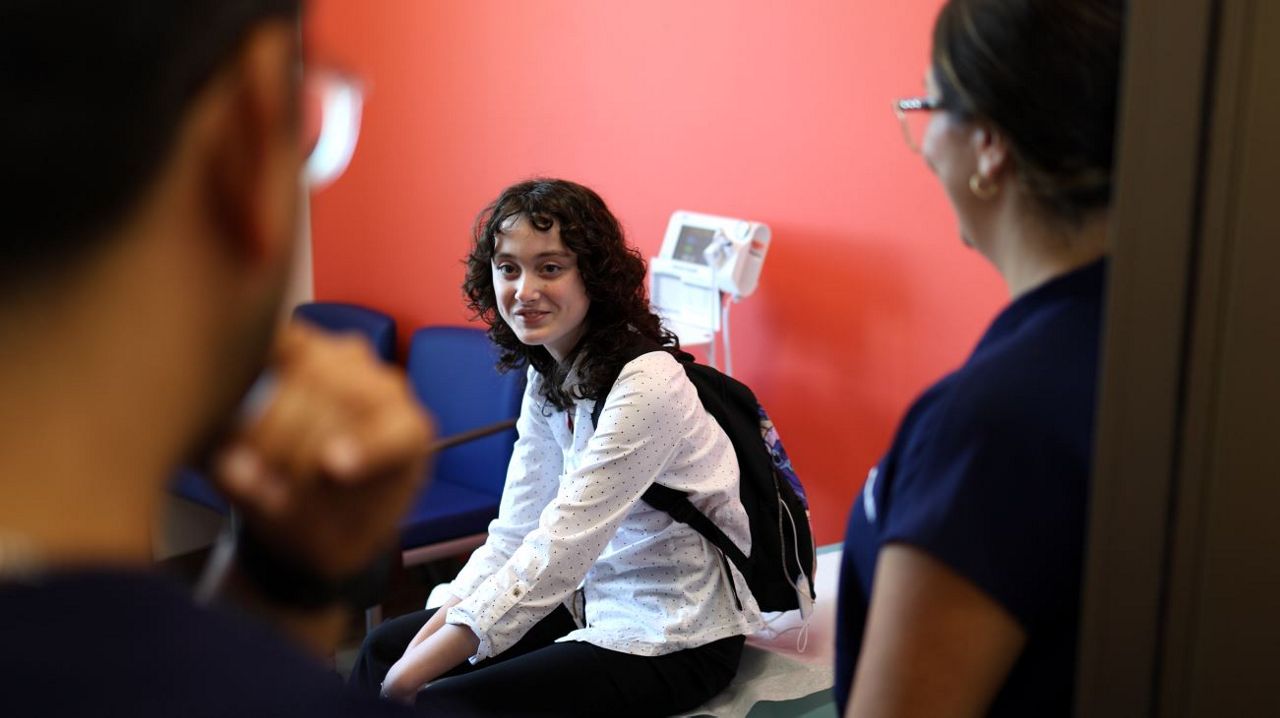
AUSTIN, Texas — Camilla Latshaw loves food, but she can’t enjoy a normal meal like most people.
“I’ve cried because I want to eat so bad,” Camilla said.
She says her family and doctors knew something was wrong ever since she was a baby.
“I remember being like six or seven waking up in the middle of the night throwing up and having pain in my stomach at school,” she said.
That was usually after eating a meal.
Camilla remembers the pain was sharp and nagging, but as she’s aged, it’s become more of a diaphragm pressure and fullness with stabbing pain episodes.
She says doctors would dismiss it as a stomachache.
“I’ve seen so many (doctors),” Camilla said. “They always thought it was anxiety, or that I was a teenager that didn’t want to eat.”
Things took a turn in 2020. She remembers eating a chicken sandwich. The experience was so bad she turned to eating things like crackers with broth or macaroni and cheese.
She became so weak she ended up in the emergency room. She was given nausea and acid reflux medications and sent on her way.
In 2021, Camilla says another doctor gave up on her, which led her to a dark place mentally.
“I honestly thought that was it for me or something,” Camilla said.
She started art therapy to cope with what had been a long journey, with no answers.
“It’s just been a long time,” Camilla said, holding back tears. “All I ask from doctors is that I just wanted my normal life back.”
As her tears dry, she can tell you today what has been causing her pain all this time.
“Superior Mesenteric Artery Syndrome is a really rare disease and has a 33% mortality rate,” Camilla said.
Camilla was diagnosed with Superior Mesenteric Artery Syndrome or SMAS with the help of Dr. Edgar Navarro Garza and his team at Harbor Health.
“I say all the time I wouldn’t be alive if it weren’t for him,” she said.
SMAS is a digestive condition that happens when a portion of the intestine that’s connected to the stomach is squeezed by blood vessels. The blockage can cause pain, fullness, nausea, vomiting and weight loss.
0.3% of the world population is estimated to have SMAS, according to smasyndrom.org.
“It’s that case that you’re going to see once in your life as a clinician,” Navarro Garza said.
The pediatrician worked with many medical specialists to come to Camilla’s rare diagnosis.
“As a clinician, you need to be humble enough to know when you need to redirect the care of a patient to someone else,” Navarro Garza said.
Harbor Health is helping Camilla manage her condition. She has undergone surgery and is on Total Parental Nutrition or IV nutrition. Camilla tries to eat every day but says it’s only for taste. She still can’t tolerate food, so it drains out through a tube.
“We should have the best interests of our patients, trust in what our patients tell us, and advocating for them, especially in the pediatric world,” Navarro Garza said. “It’s a lot of advocating for patients and their families.”
Camilla also receives emotional support through a health coach.
“I stepped in to do a lot of care coordination, referrals, check in on Camilla when Dr. Navarro is busy with other patients,” Karla Jurado said.
Camilla sees Jurado differently, acknowledging that seeing her in person is like seeing a friend for the first time.
Their communication is primarily virtual.
Camilla remains under evaluation for other possible medical issues and is still looking for answers for her SMAS diagnosis. The 2024 high school graduate is now looking towards a brighter future.
“My dream is to be in the medical field because I would love to help other kids like me,” Camilla said.



AUSTIN (KXAN) — A report released by the think tank Texas 2036 claims that ten state laws implemented between 2019 and 2025 led to “one of the nation’s most comprehensive strategies for connecting education to careers.”
The report is titled “The Next Generation of the Texas Miracle.” It can be read below.
Mary Lynn Pruneda, Texas 2036’s director of education and workforce policy, said in an announcement accompanying the report that the reforms have been steps in the right direction.
“Texas has a bright economic future ahead of it, but we have to make sure that Texas students are equipped to share in this prosperity,” she said. “Texas needs to double down on improving and investing in high-quality career pathways so that all Texas students can take part in the Texas Miracle. Thankfully, due to the Legislature’s great work over the past four sessions, we are on our way to that critical goal.”
The report gives several data points, such as a 532% increase in high schoolers earning “post-secondary credentials” since 2018, or that community colleges awarded 140,000 “credentials of value” in 2024.
It paints a rosy picture of the future Texas economy, but doesn’t source its data or explain how it reached these conclusions. It’s apparent that the think tank wants further laws related to Texas’ workforce and education.
“Texas 2036 is actively engaged in that process, pushing for data modernization and interoperability reforms that would allow the state to track whether credentials are meeting real employer needs in communities across the state,” said the think tank in its announcement.
Grace Atkins, policy advisor of postsecondary education for Texas 2036, called the think tank’s report “encouraging.”
“The early results are encouraging: more students are earning credentials that can help them move into good jobs, and that is real progress,” she said. “For students and families, these pathways can be the difference between getting by and getting ahead. The next step is making sure more Texans can earn credentials that lead to strong wages, real career options and greater economic mobility.”

AUSTIN, Texas — After Senator Charles Perry vowed to introduce another bill to ban THC in Texas next legislative session, an Austin cannabis shop owner is urging lawmakers to find a middle ground.
Estella Castro owns Austinite Cannabis Co., a family-owned shop that makes and sells cannabis and hemp products.
Austinite Cannabis Co. (Photo: CBS Austin/Audrey Wong)
Her business has faced a potential THC ban before. During the 2025 legislative session, Senate Bill 3 attempted to enact a broad ban on all cannabinoids except CBD and CBG.
Castro says she was most worried for her customers. “It was a big initial hit of like, what are we gonna do? How are we gonna pivot? How are we gonna keep the doors open for everybody to keep their jobs?” she said.
RELATED | Texas state senator plans to introduce new THC ban bill in upcoming session
That bill passed, but was later vetoed by Governor Greg Abbott. Similar legislation failed to pass during the subsequent special session.
However, the possibility of a total ban bill being introduced and passed next session could spell trouble for Austinite Cannabis.
During a hearing Tuesday, July 7, Senator Charles Perry vowed to present such a bill next session as public officials, medical experts, and others discussed THC’s medical uses, effects on minors, and regulation.
Castro says over half of the store’s revenue comes from products that contain THC.
“I would say it’s about a 60/40 split: 60% THC and 40 CBD… So feel like it is a huge number that affects my store in so many ways,” she said.
ALSO | Texas French Bread reopens dining room four years after fire
She feels that a total ban on THC would negatively affect multiple parties.
“Banning it is just hurting the consumer,” she said. “Making the consumer go and find a street dealer… killing any dispensaries… it’s gonna hurt your small business owner.”
If another THC ban bill is written, it will be introduced during the next legislative session, which begins in January 2027.
In the meantime, Castro’s two stores will continue to operate as normal. She hopes lawmakers will think twice about instituting a complete ban on THC.
“I feel like we’re better than that, you know, we’re Texas,” she said. “We need to find some middle ground where it’s not a complete ban, and we can still be able to come together.”

AUSTIN (KXAN) – Trevor Goosby is a projected first-round pick in the upcoming 2027 NFL Draft. The Texas offensive lineman anchors the group up front for one of the best teams in the country and was named a preseason All-American by Walter Camp.
But his football career felt in jeopardy when he was in high school.
“That was kind of my biggest question,” said Goosby. “I was really nervous because would I be the same football player coming back?”
Goosby was born with a congenital heart defect and had open-heart surgery when he was just 16 years old. He wasn’t sure how this would change his everyday life, including his football career.
“Definitely a lot of nerves just because you’re getting your ribs cracked open essentially and getting your heart worked on…It was a scary moment. I remember driving up to the hospital super nervous.”
Goosby was able to recover and become a great football player. He said not only has he become a person in learning to fight through adversity, but it helped him as a player as well with improved endurance.
Now, the star Longhorn is giving back as much as possible.
Goosby hosted a camp in Austin to benefit the Children’s Heart Foundation. The organization works to fund research on congenital heart defects.

The offensive tackle is matching all donations up to $20,000 made to the Children’s Heart Foundation through the event and campaign.
“It means a lot to me just because of the heart condition I did have back when I was 16. That just kind of changed my life. I just want to bring awareness to that.”
The camp was at Hyde Park High School in Northwest Austin. Goosby spoke about what he hopes the young campers took away from the event.
“I think it’s just more than football. Football is a big part of what I do but it’s not who I am…I just want to show all these kids that I’m just another great guy and just someone they can look up to.”
-
 Maine2 minutes ago
Meet 16 obscure Maine Democrats shaping Graham Platner’s replacement
-

 Maryland5 minutes ago
Justice Department sues Maryland over immigration policies
-

 Michigan10 minutes ago
How two Michigan stamping plants power Stellantis turnaround plan
-

 Massachusetts17 minutes ago
3 hospitalized after vehicle crashes into Danvers business
-

 Minnesota20 minutes ago
Minnesota voter registration review finds county record errors
-

 Mississippi25 minutes ago
Mississippi Highway Patrol deployed to Goodman after viral gun video, leaders explain goals
-
Missouri32 minutes ago
Missouri Lottery Pick 3, Pick 4 winning numbers for July 9, 2026
-
Montana35 minutes ago
Montana Lottery Big Sky Bonus, Millionaire for Life results for July 9, 2026

