Midwest
Michigan block party shooting kills 2, injures 19 over July 4th weekend

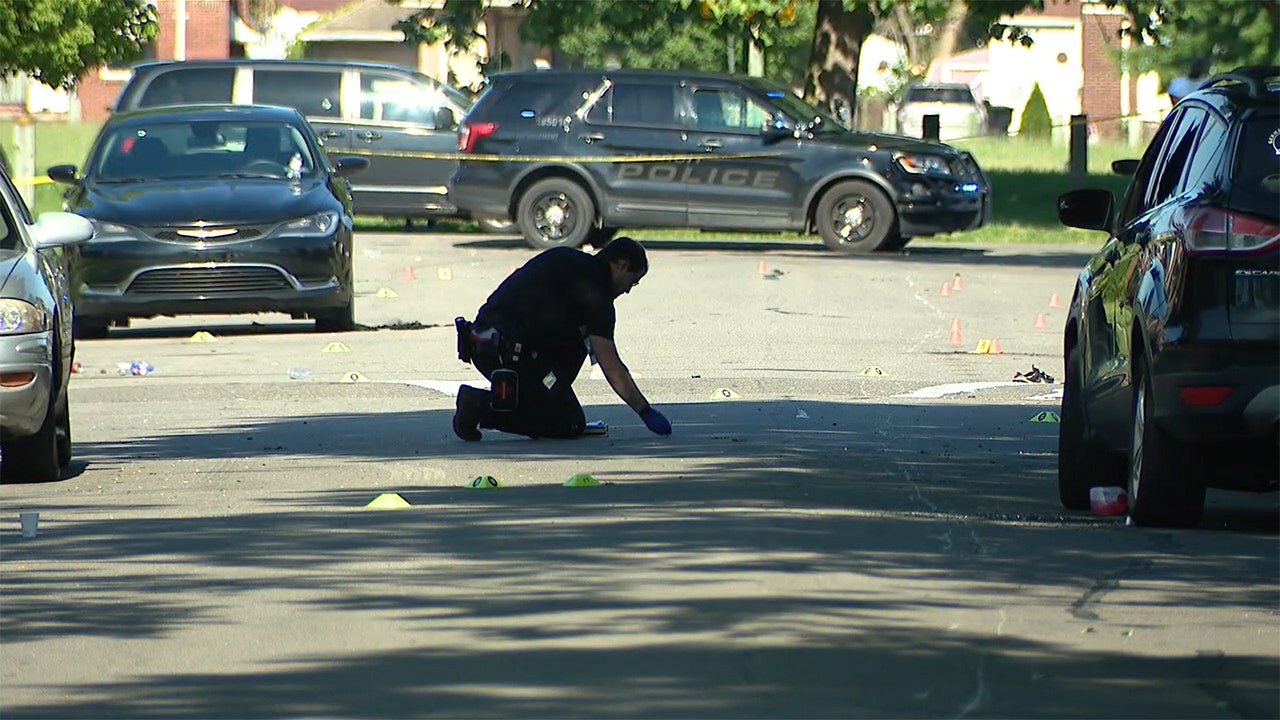
A Detroit block party took a horrific turn when gunfire broke out on Sunday, killing two and leaving 19 young people injured, police said.
Revelers ranging in age from 17 to 27 were hit by bullets around 2:30 a.m. in the Mohican Regent neighborhood on the 13000 block of Rossini near Gratiot Avenue, police told Fox 2 Detroit.
The victims who lost their lives were a 21-year-old man and a 21-year-old woman. One person was in critical condition Monday, while other victims are expected to recover from their injuries.
Detroit Police Chief James White said at a press conference Monday that police are investigating and no arrests have been made.
MISSING MICHIGAN TEEN FOUND IN MIAMI AFTER BEING SPOTTED ON LIVESTREAMED VIDEO
A Detroit police officer gathered evidence at the scene of a Detroit block party where two were killed and 19 were injured over the weekend. (WJBK)
The shooting is the latest to strike the community in recent weeks.
“This is not normal,” area activist Sandra Turner Handy said of Sunday’s attack, Fox 2 reported. “We have to be proactive in this. We have to be in the community to get residents up and out to fight against this type of violence.”
SEARCH FOR LAKE MICHIGAN BOATERS TURNS TO RECOVERY MISSION
Detroit police are pictured gathering evidence at the crime scene. (WJBK)
Detroit City Council President Mary Sheffield called Sunday’s incident an “unspeakable tragedy” and “another reminder that gun violence is an epidemic in Detroit and across the nation.”
“We must chart a new course of action and I’m calling for an all-hands-on-deck approach to ending the senseless killings and destruction of families in our community,” she wrote in a statement. “My heart and prayers go out to the victims and their loved ones.”
MICHIGAN OFFICIALS PROPOSE NEW HUNTING REGULATIONS AS RESIDENTS GRAPPLE WITH DEER OVERPOPULATION
Two people were killed and 19 injured at a Detroit block party. (WJBK)
CLICK TO GET THE FOX NEWS APP
U.S. Rep Rashida Tlaib, a Michigan Democrat, took to X to address the shooting.
“Another senseless shooting today, leaving families in our community shattered,” she wrote. “We owe it to our families to address this crisis with urgency. We need to save lives now.”
Read the full article from Here

The South Dakota Lottery offers multiple draw games for those aiming to win big.
Here’s a look at July 17, 2026, results for each game:
Winning Mega Millions numbers from July 17 drawing
22-34-45-48-55, Mega Ball: 14
Check Mega Millions payouts and previous drawings here.
Winning Millionaire for Life numbers from July 17 drawing
03-19-38-48-58, Bonus: 01
Check Millionaire for Life payouts and previous drawings here.
Feeling lucky? Explore the latest lottery news & results
Are you a winner? Here’s how to claim your prize
- Prizes of $100 or less: Can be claimed at any South Dakota Lottery retailer.
- Prizes of $101 or more: Must be claimed from the Lottery. By mail, send a claim form and a signed winning ticket to the Lottery at 711 E. Wells Avenue, Pierre, SD 57501.
- Any jackpot-winning ticket for Dakota Cash or Lotto America, top prize-winning ticket for Lucky for Life, or for the second prizes for Powerball and Mega Millions must be presented in person at a Lottery office. A jackpot-winning Powerball or Mega Millions ticket must be presented in person at the Lottery office in Pierre.
When are the South Dakota Lottery drawings held?
- Powerball: 9:59 p.m. CT on Monday, Wednesday, and Saturday.
- Mega Millions: 10 p.m. CT on Tuesday and Friday.
- Lucky for Life: 9:38 p.m. CT daily.
- Lotto America: 9:15 p.m. CT on Monday, Wednesday and Saturday.
- Dakota Cash: 9 p.m. CT on Wednesday and Saturday.
- Millionaire for Life: 10:15 p.m. CT daily.
This results page was generated automatically using information from TinBu and a template written and reviewed by a South Dakota editor. You can send feedback using this form.


Manuel Franco claims his $768 million Powerball jackpot
Manuel Franco, 24, of West Allis was revealed Tuesday as the winner of the $768.4 million Powerball jackpot.
Mark Hoffman, Milwaukee Journal Sentinel
The Wisconsin Lottery offers multiple draw games for those aiming to win big.
Here’s a look at July 17, 2026, results for each game:
Winning Mega Millions numbers from July 17 drawing
22-34-45-48-55, Mega Ball: 14
Check Mega Millions payouts and previous drawings here.
Winning Pick 3 numbers from July 17 drawing
Midday: 2-5-2
Evening: 8-9-4
Check Pick 3 payouts and previous drawings here.
Winning Pick 4 numbers from July 17 drawing
Midday: 7-7-7-1
Evening: 7-1-5-1
Check Pick 4 payouts and previous drawings here.
Winning All or Nothing numbers from July 17 drawing
Midday: 03-06-07-08-09-10-13-17-18-21-22
Evening: 02-04-06-12-13-17-18-19-20-21-22
Check All or Nothing payouts and previous drawings here.
Winning Badger 5 numbers from July 17 drawing
03-04-22-23-26
Check Badger 5 payouts and previous drawings here.
Winning SuperCash numbers from July 17 drawing
12-23-24-25-26-33, Doubler: N
Check SuperCash payouts and previous drawings here.
Feeling lucky? Explore the latest lottery news & results
Are you a winner? Here’s how to claim your lottery prize
- Prizes up to $599: Can be claimed at any Wisconsin Lottery retailer.
- Prizes from $600 to $199,999: Can be claimed in person at a Lottery Office. By mail, send the signed ticket and a completed claim form available on the Wisconsin Lottery claim page to: Prizes, PO Box 777 Madison, WI 53774.
- Prizes of $200,000 or more: Must be claimed in person at the Madison Lottery office. Call the Lottery office prior to your visit: 608-261-4916.
Can Wisconsin lottery winners remain anonymous?
No, according to the Wisconsin Lottery. Due to the state’s open records laws, the lottery must, upon request, release the name and city of the winner. Other information about the winner is released only with the winner’s consent.
When are the Wisconsin Lottery drawings held?
- Powerball: 9:59 p.m. CT on Monday, Wednesday, and Saturday.
- Mega Millions: 10:00 p.m. CT on Tuesday and Friday.
- Super Cash: 9:00 p.m. CT daily.
- Pick 3 (Day): 1:30 p.m. CT daily.
- Pick 3 (Evening): 9:00 p.m. CT daily.
- Pick 4 (Day): 1:30 p.m. CT daily.
- Pick 4 (Evening): 9:00 p.m. CT daily.
- All or Nothing (Day): 1:30 p.m. CT daily.
- All or Nothing (Evening): 9 p.m. CT daily.
- Megabucks: 9:00 p.m. CT on Wednesday and Saturday.
- Badger 5: 9:00 p.m. CT daily.
That lucky feeling: Peek at the past week’s winning numbers.
Feeling lucky? WI man wins $768 million Powerball jackpot **
WI Lottery history: Top 10 Powerball and Mega Million jackpots
This results page was generated automatically using information from TinBu and a template written and reviewed by a Wisconsin editor. You can send feedback using this form.

Gunfire erupted Friday during a funeral on Detroit’s west side, leaving five people injured, including the suspect.
At about 5:48 p.m., a physical fight broke out during a funeral at Greater Love Tabernacle Church on Plymouth Road, south of Interstate 96 on the city’s west side, authorities said.
During the fight, one suspect produced a handgun and fired into the crowd, striking multiple people, authorities said.
Officers were already stationed in the area, assigned to assist at a separate visitation at a nearby funeral home after police received threats of violence during that event. One officer who responded to the church in response to the fight saw the shooting and returned fire, striking the shooter.
“I want to thank the Detroit Police Department for the officer’s quick and courageous action, which prevented further harm,” Mayor Mary Sheffield said in a statement late Friday. “This was an act of senseless violence, and it has no place in our city.”
In total, five people were struck, including the suspect, police said. All were hit in the lower part of their body and were hospitalized with non-life-threatening injuries.
Police called the shooting an “isolated incident” and said there was no ongoing threat to the public.
Authorities said four of the injured parties were in their mid-20s, including the suspect. The other victim was in their mid-30s.
Sheffield said the funeral was for a young man who had died in a car crash.
“My thoughts are with them, their families, and everyone affected. I am grateful that all of the victims are expected to survive,” the mayor said.
The suspect was taken into police custody and police recovered the firearm, authorities said.
Police were not sure why the combatants were initially fighting at the church.
Anyone with information is asked to contact Detroit Crime Stoppers at 1-800-SPEAK-UP.
mreinhart@detroitnews.com
-

 South-Carolina5 minutes ago
Non-native blue land crab sightings across the South Carolina coast
-
South Dakota11 minutes ago
SD Lottery Mega Millions, Millionaire for Life winning numbers for July 17, 2026
-

 Tennessee17 minutes ago
Tennessee woman arrested after allegedly trying to drown one of her children in backyard pool
-

 Texas23 minutes ago
How a man once ordered to pay libel damages helped launch an investigation into Islamic private schools
-

 Utah29 minutes ago
Utah Jazz vs Portland Trail Blazers Summer League recap and final score
-
Vermont35 minutes ago
VT Lottery Mega Millions, Gimme 5 results for July 17, 2026
-

 Virginia41 minutes ago
Maryland, Virginia elections officials push back on Trump assertion that system is ‘broken’ – WTOP News
-

 Wisconsin53 minutes ago
Wisconsin Lottery Mega Millions, Pick 3 results for July 17, 2026

