Entertainment
'MaXXXine' is Ti West's Hollywood horror story. The real-life locations are even scarier

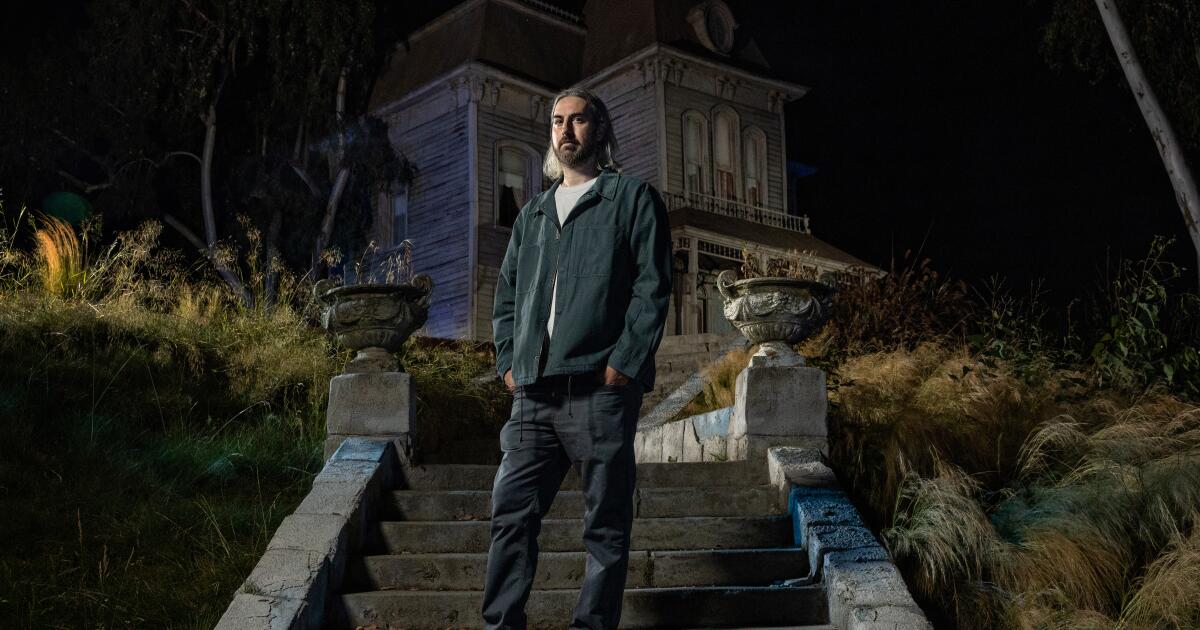
Horror filmmaker Ti West steps out of the blackness behind the Bates Motel hours after the last tourist tram has made it to safety. Behind him looms the “Psycho” house where Mrs. Bates lurked in the window monitoring the movements of Janet Leigh’s Marion Crane — a shot West references in his 2022 slasher “X,” set in 1979, about an elderly farm wife named Pearl who becomes murderously inflamed by a troupe of adult actors shooting a skin flick in her barn. Pearl, an aspiring performer herself, got her own movie the following year in West’s eponymous prequel that rewinds to 1918, when the psychotic failed starlet fed her rival to an alligator named Theda Bara.
Now, West is releasing the third chiller in the series, “MaXXXine,” which finds Maxine Minx, the sole survivor of the first film’s “Texas porn star massacre,” hellbent on becoming a legitimate movie star in 1980s Los Angeles. After six years of sex work, Maxine, played ferociously by Mia Goth, has finally landed her first mainstream role in a sequel called “The Puritan 2.” But her past is still in pursuit, with one chase scene sending Maxine fleeing for her life across the Universal Studios backlot, through the Old West facades to the New York stoops, eventually scampering up the jagged “Psycho” stairs right behind him.
“It’s a weird thing to point a camera at if you’re not making ‘Psycho,’” says West, 43, as he heads farther into the darkness, lighted only by a handful of eerie red lanterns. He calls his trilogy “movie-flavored movies” — artifice and dreams are the top notes. “X” is about scrappy strivers trying to break into the business; “Pearl,” about the dangers of buying into the fantasies onscreen. “MaXXXine,” the highest-profile film of West’s career, wrestles with accepting that Hollywood isn’t quite what one hopes.
Mia Goth in the movie “MaXXXine,” her third with West. “It was the first time I had that dynamic between me and a director where it felt there was something really intimate to it,” she says.
(A24)
“He was ready to deal with this kind of scale, and it’s definitely something he was hungry for,” Goth says, chiming in over Zoom. In addition to playing multiple roles across this mini-franchise, Goth co-wrote “Pearl” and executive-produced the last two films. “We just kind of manifested it,” she continues, “built this entire trilogy into existence. And it’s been incredible to see it unfold.”
West, however, tends to be scrupulously anti-hype. “It is not lost on me that there is a meta thing happening with these movies and me and Mia, and that’s gratifying and strange,” he says. “And it’s also something that we’ve never taken any time to stop and talk about. We were too busy making movies.”
While the marketing team at A24 is all in on “MaXXXine” — “I’ve never had a billboard before,” the director beams — West has been a legitimate filmmaker for well over a decade. His resume of well-regarded independent movies includes the 2016 cowboy vengeance drama “In a Valley of Violence” with Ethan Hawke and John Travolta, plus a string of festival hits like 2009’s “The House of the Devil,” which disposed of a pre-celeb Greta Gerwig early on in a marvelously nasty Hitchcock-esque shock.
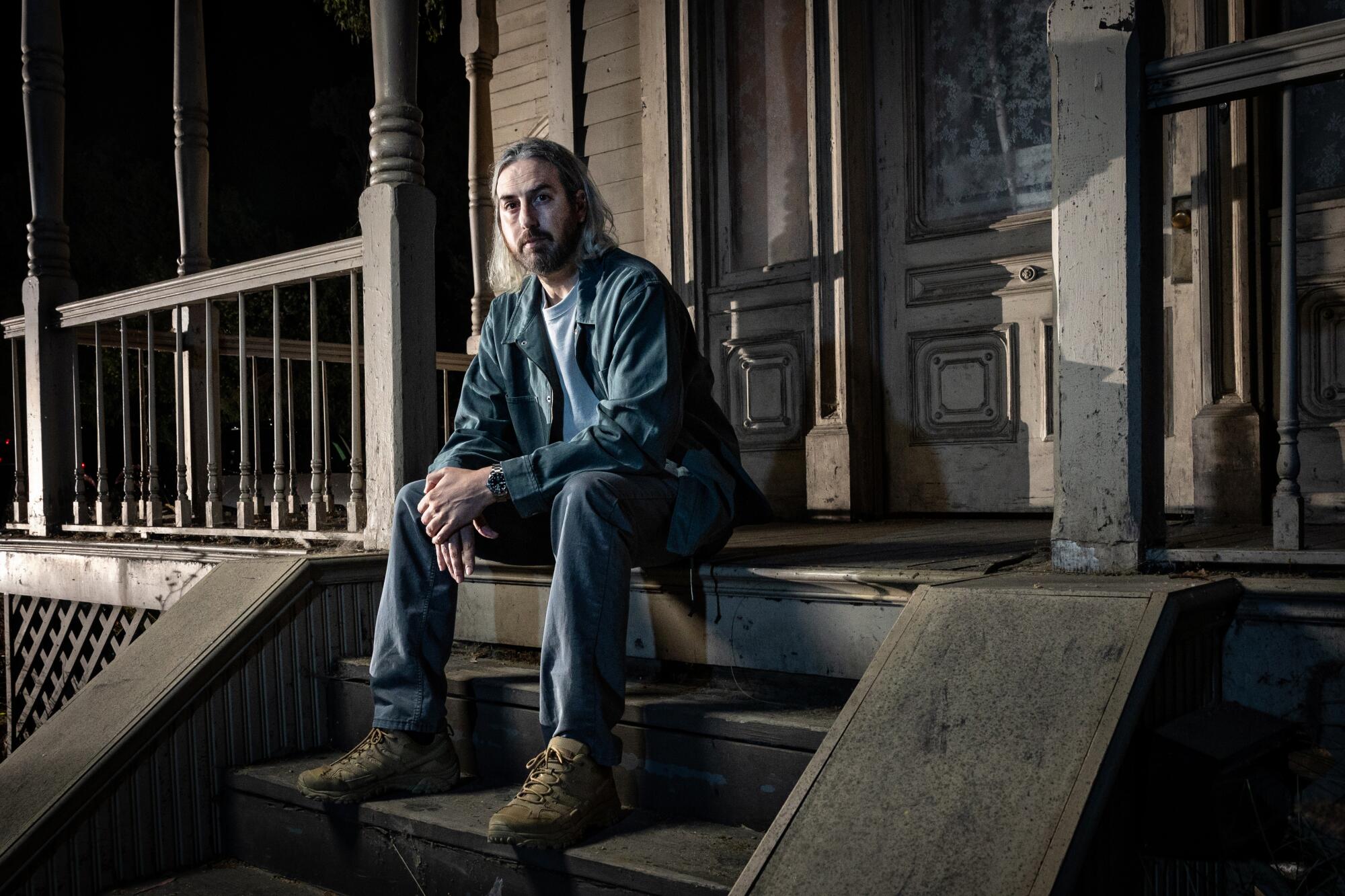
“It hasn’t lost its mystique,” West says of the “Psycho” house, a “MaXXXine” location. “Even tonight it’s still like: What a rare opportunity to actually walk up the steps.”
(Jason Armond / Los Angeles Times)
Still, he’s come a long way since his first trip to the Bates Motel. When he was in middle school, he and his family vacationed at Universal Studios Florida, which had just wrapped “Psycho IV” on its own copy of the set. As a promotional tie-in, the park launched an attraction that taught fans the camera tricks behind the famous shower scene. One volunteer got to brandish a rubber knife and learn how to stab a Marion Crane scream-a-like. West wasn’t chosen, but he went back home with a pair of Bates Motel souvenir slippers and an appreciation for film craft.
“Now that’s all gone, and it’s a Shrek ride or something,” he shrugs. “No offense to Shrek.”
West spent the rest of his youth in Wilmington, Del., renting five VHS tapes for $5 on Fridays at his local video store. One weekend, he rented “Habit,” a grungy but brilliant microbudget vampire flick made by filmmaker Larry Fessenden. Shortly after, he moved to New York and took a film class taught by director Kelly Reichardt, who’d played a cameo in the film. Reichardt introduced the two and Fessenden became West’s mentor, eventually producing his debut feature, “The Roost,” shot exactly 20 years ago with more moxie than money.
“Apparently, now we’re mentioned on the tour,” West adds of his upgraded circumstances, in mild disbelief. “I feel a little bit like I’ve made it.” Filming on the lot took Herculean coordination. Some theme-park trams were rerouted, others couldn’t be. Shots were hastily filmed in the gaps between gawkers. Once, the timing went awry and a few dozen tourists interrupted a take. Cameras out, the visitors snapped away at Goth and Elizabeth Debicki like they were tigers in a zoo.
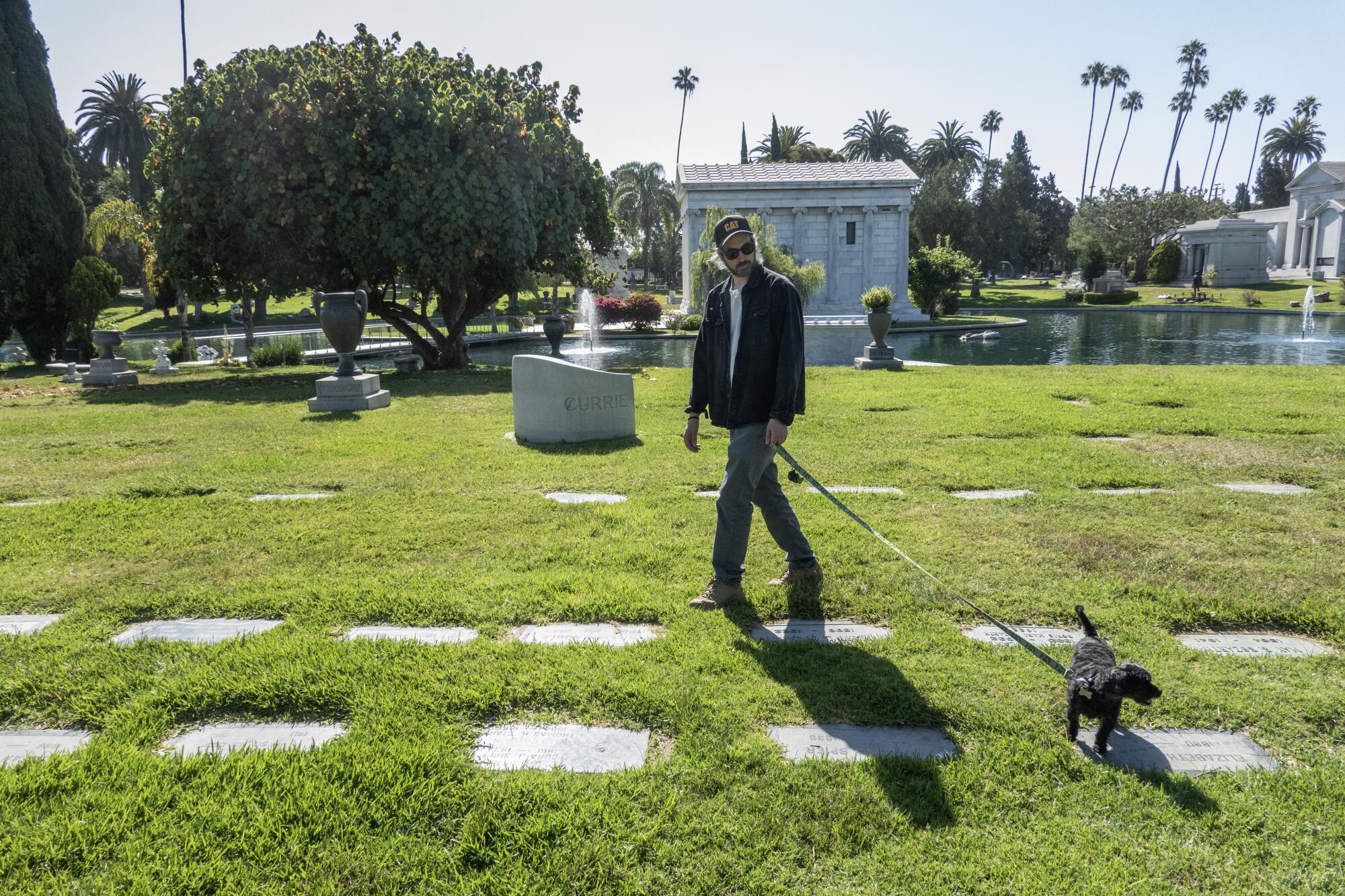
West and his dog, Molly, visit Hollywood Forever Cemetery, one of the filming locations for “MaXXXine.”
(Myung J. Chun / Los Angeles Times)
If West is now a Hollywood animal himself, the only affectation he’s adopted is a tiny 12-pound black dog named Molly who accompanies him everywhere. During this night stroll, she’s quietly tucked into a sling around his hips. On set, Molly had her own chair that read “Executive Paw-ducer.” The next morning, as our personal tour of “MaXXXine’s” locations continues, she’s wearing an A24-branded leash and trying to sneak sips of West’s iced oat-milk latte.
Today, he and Molly and a photographer are piled into an SUV that stops at Hollywood Forever Cemetery, the location where two of the film’s detectives, played by Michelle Monaghan and Bobby Cannavale, make a grisly discovery. (Molly insists on relieving herself in a spot without any graves — she’s a professional.) The fictional corpses planted here by the production were mutilated in the manner of Richard Ramirez, popularly known as the Night Stalker, the real-life L.A. serial killer who murdered at least 13 people during the ’80s. That paranoia is the film’s terrifying backdrop, just as the Spanish flu pandemic leaves scars on “Pearl.”
But this isn’t a Night Stalker story — there’s already half a dozen of those. “MaXXXine,” like West’s “The House of the Devil” before it, vibrates with the tension of Reagan-era Satanic panic, a moment of media-hyped conspiracy that manages to feel both old-fashioned and contemporary.
“When I was growing up, you could get arrested for skateboarding, and now it’s going to be in the Olympics,” West says. But grandstanding moralists stay the same, even if A24 had to hire faux protesters to wave placards that read, “Honor God, End Smut.”
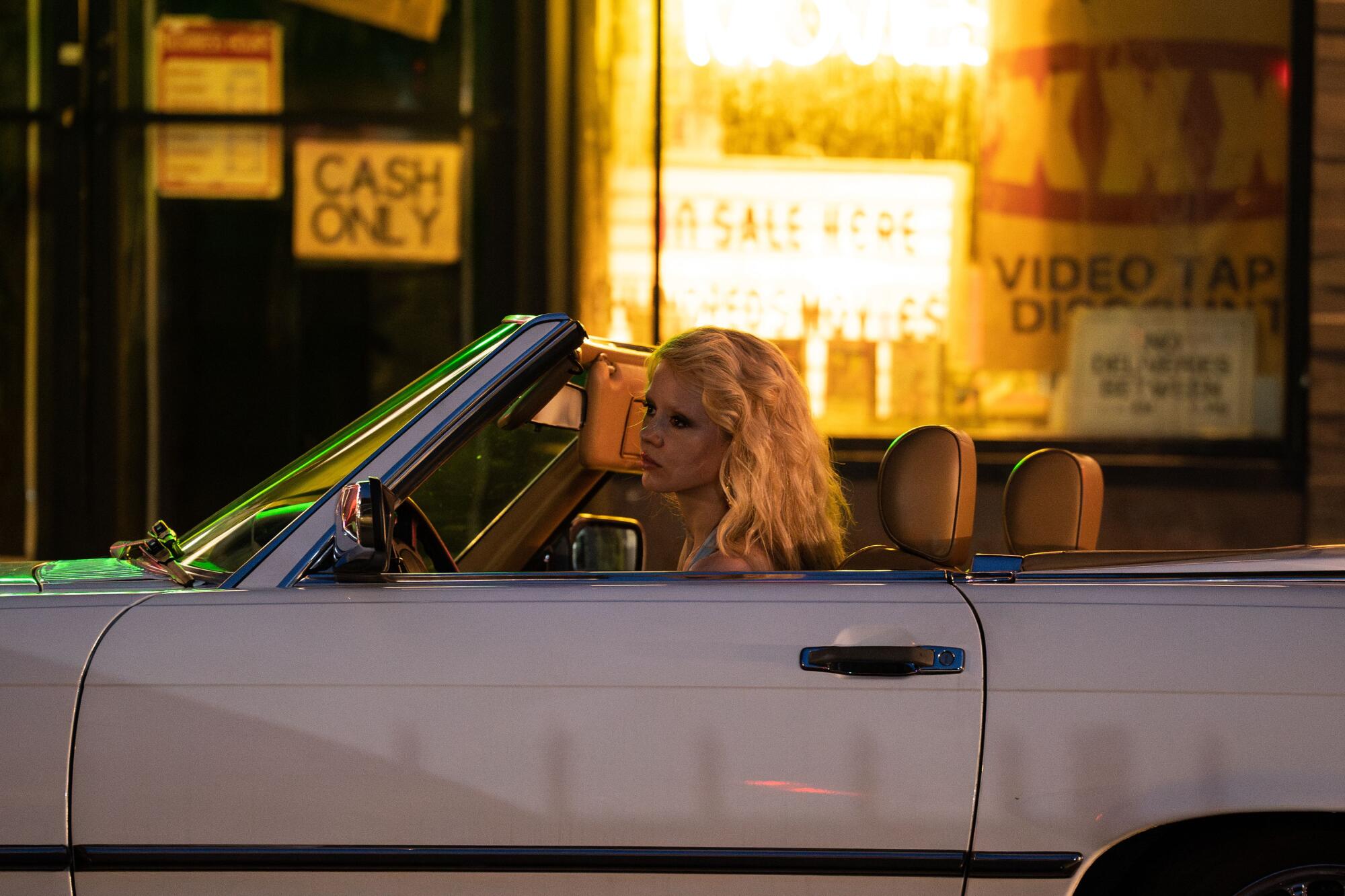
“I’m hopeful that this October there are people that are going to dress up as her from all three movies,” West says of Goth’s many incarnations, including “MaXXXine,” pictured. “That’ll be really strange.”
(A24)
West puts a lot of emphasis on making the past look real, not cartoonish. No ridiculous zebra prints, no suburban mall pastels. Authenticity is baked into everything, from the camera techniques and practical effects to Maxine’s fried split ends.
The “MaXXXine” review embargo has just broken as our car arrives at Hollywood Boulevard and Wilcox Avenue, but West barely glances at his phone. “It’ll be the appropriate mixture of ‘best movie of the three,’ ‘worst movie ever,’” he says calmly. So far, the critics like it, but West seems more fulfilled by the act of making, promoting and releasing three films in four years with barely a day off. During that same time span, he also met his fiancée, DJ Alison Wonderland, and welcomed his first child, who was born two weeks after the trilogy wrapped. (Wonderland, nine months pregnant at the time, cameos in the film spinning records at a nightclub.)
“Weirdly enough, my first place in Los Angeles was also on Hollywood Boulevard,” West says, crossing the street toward Maxine’s second-story dump, which usually houses overstock from the Hollywood Suit Outlet next door.
He moved to L.A. in 2005 after wrapping “The Roost,” figuring the natural progression of things was to head west and write another script. Relocation was daunting. “There’s no real sense of where you’re supposed to live and who to send the script to,” he laughs. His first spot was quieter — “a little garden apartment, very L.A.” — but it amused him to get mail addressed to Ti West, Hollywood Blvd.
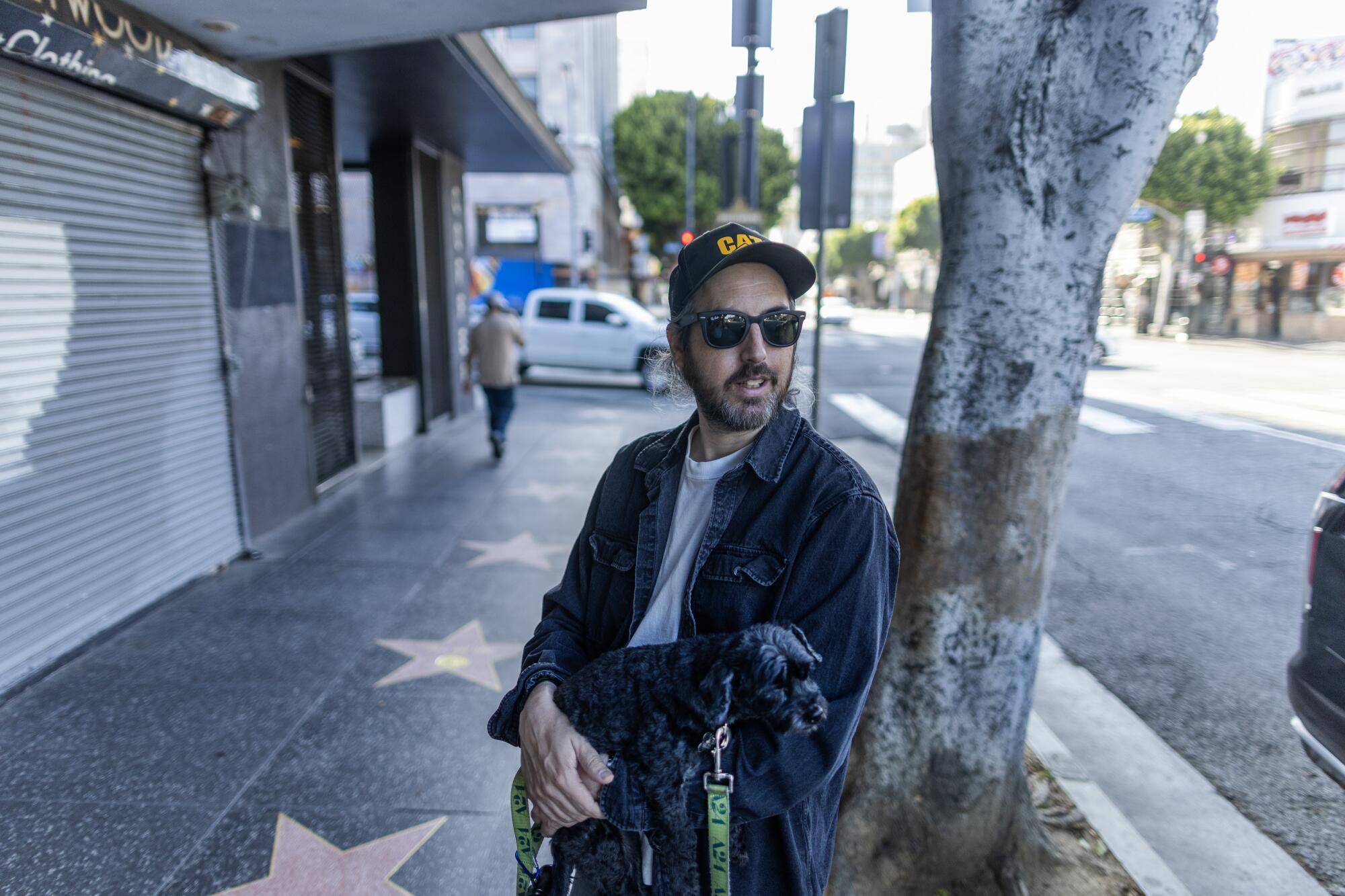
“I didn’t have an interest in telling that ‘Hollywood chews you up and spits you out’ story,” says West, on Hollywood Boulevard where the movie was shot.
(Myung J. Chun / Los Angeles Times)
Nearly two decades later, he’s lived and worked here for so long that he pokes fun at being that naive kid who hoped he’d be instantly handed the keys to the city. In truth, his ascent has been a grind. West kept at it, as did colleagues Joe Swanberg and Andrew Bujalski and the Duplass Brothers, who also premiered films alongside “The Roost” at the South by Southwest Festival in Austin, Texas, the year that mumblecore became a movement.
They were all “making very tiny movies,” West remembers. “I think that’s where the chip on your shoulder comes from: Why doesn’t someone just realize all the work I’ve been putting in? Why don’t they know that I’m up 19 hours a day, seven days a week, working on this thing?” He describes those lean, exhausting years like someone who’s scaled his share of mountains.
“But I came of age in the ’90s, when making independent movies was cool,” he continues. “Are the 25-year-olds sleeping on floors doing that now? Or do they want to be making influencer content? Probably I would have wanted to do that too because if it goes viral, you just jump ahead. If you’re trying to change your life, that’s a quicker path.”
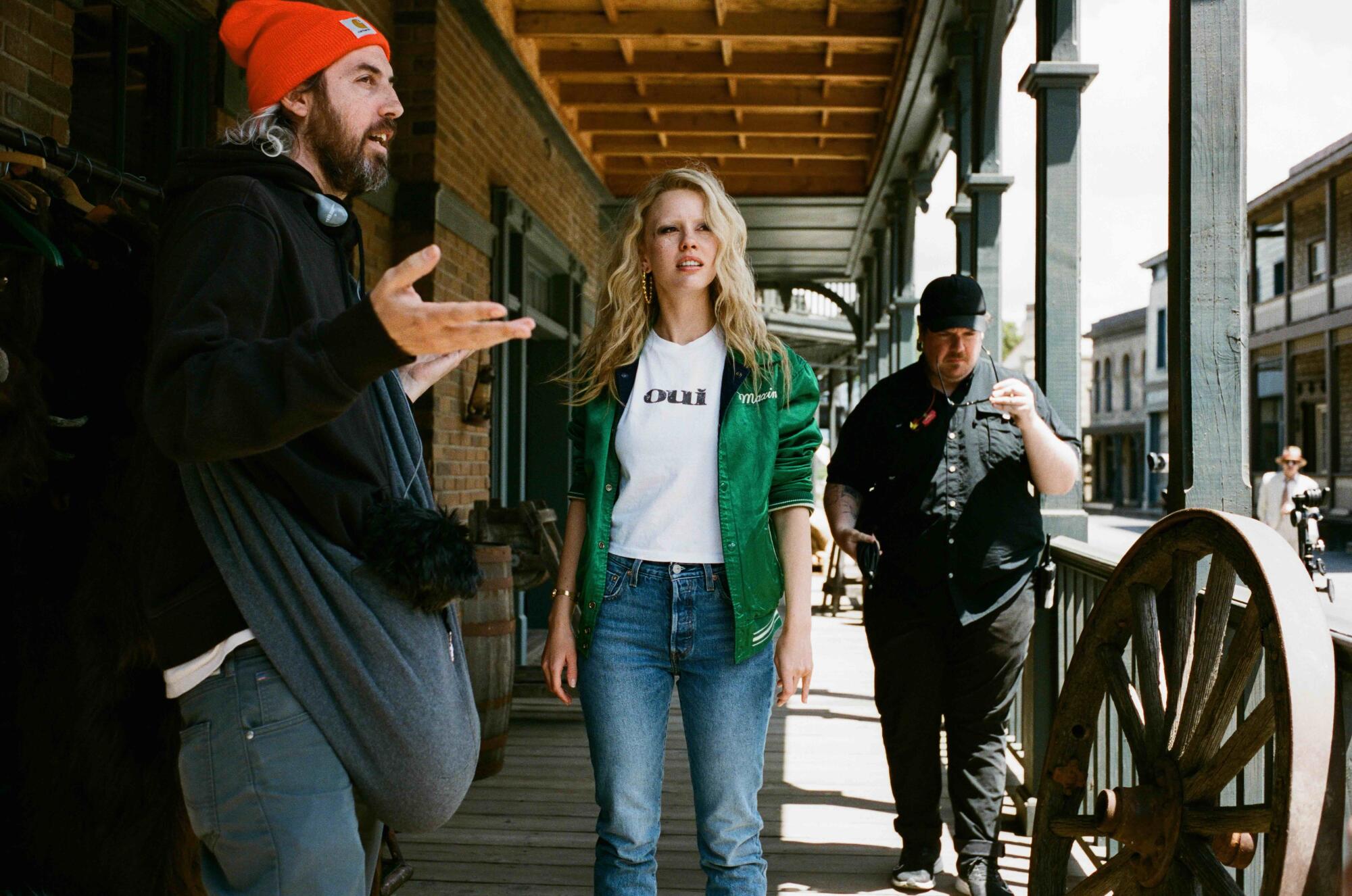
“We were in the Old West town and I was like, ‘Ti, this is the coolest job in the world,’” says Goth. “And he looked at me like, ‘I know.’ And we were just so giddy.”
(A24)
West’s first climb when he arrived in town was a hike up to the Hollywood sign before more fences and alarms were erected around it. “I had to do it,” he recalls. “I just thought, ‘Are they really going to arrest me?’” He hesitates, then chuckles. “Maybe the answer’s yes.” But he got away with it and was permitted to legally return while scouting for “MaXXXine” as he wanted to stage a showdown under the letters. For practical reasons, he was forced to rebuild the sign nearly to scale in Santa Clarita. Even so, the shoot was so tight on time and money that he had just eight hours to film at the duplicate site, including a lunch break and the commute up and down the hill.
“PTSD,” West mutters, flashing back to the hectic pace as he continues down Hollywood Boulevard and turns into the alleyway where Maxine gets menaced by a Buster Keaton clone. Every scene shot on the busy street — and there are a lot of them — had to be completed in four days, with the vintage store fronts mostly erected the morning-of to make sure the sets weren’t destroyed. When the film’s phony video shop went up, West’s phone buzzed with texts from friends who’d happened to drive by. A few asked if he was behind the fake signage; others mistakenly celebrated it as real.
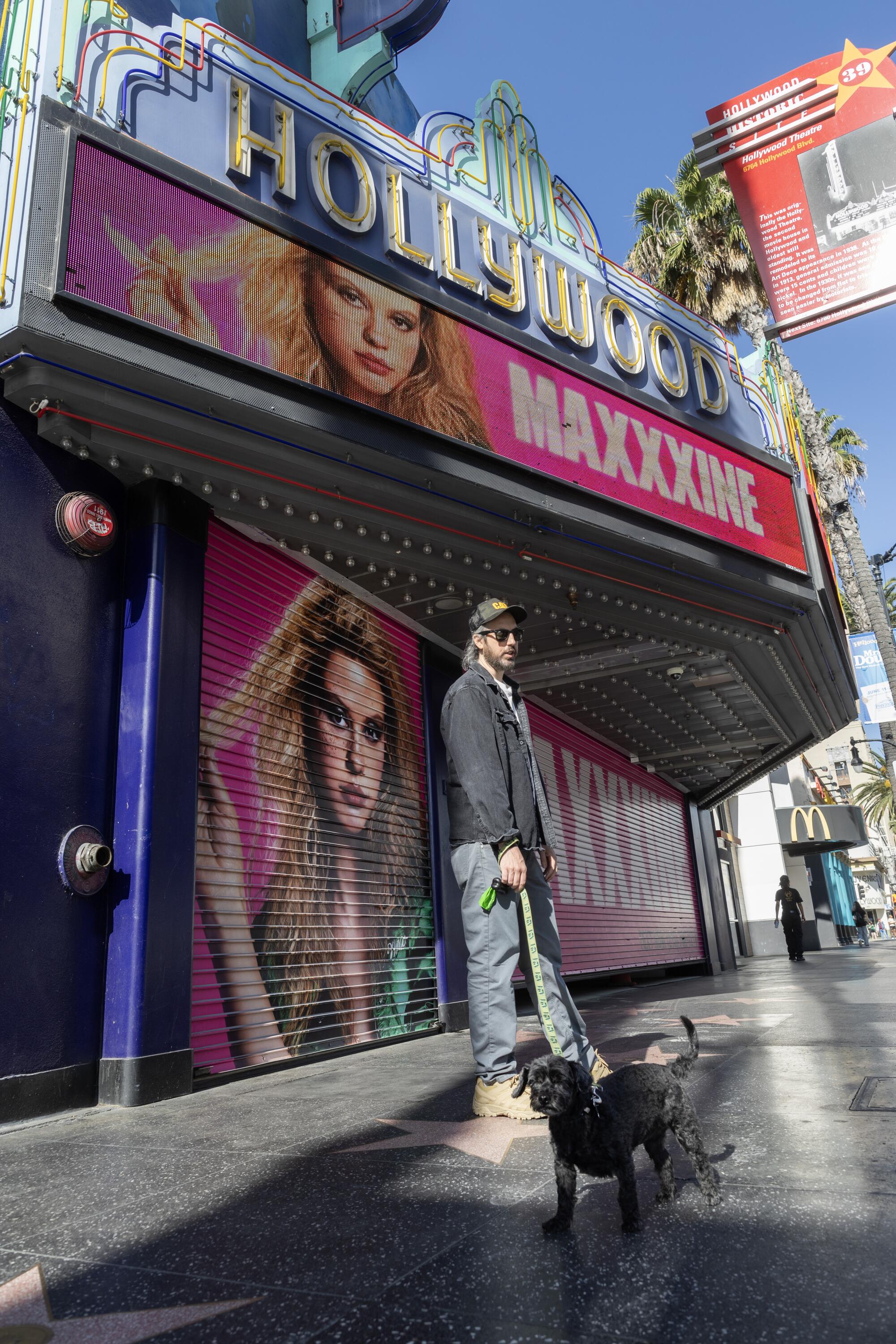
“It’s just a circus at all times and nobody really cares that you’re shooting a movie,” says West, in front of the Hollywood Theatre.
(Myung J. Chun / Los Angeles Times)
“To turn this all into an X-rated area was a very big project, lots of neon,” West says. As he gestures toward the marquees of the Déjà Vu gentlemen’s club and the Vine Theatre (both seen in “MaXXXine”), a bus pulls up and unloads 50 or so Scientologists in matching navy skirts and trousers who politely ignore his descriptions of sin as they head into the L. Ron Hubbard Life Exhibition. West is also unfazed. “We had to be out here in the chaos of it all. It shows in the movie.”
Some days, he got lucky. West wanted an insert shot of Theda Bara’s star on the Walk of Fame as a nod to Pearl’s pet gator, and, magically, it was just steps from the Déjà Vu. Kevin Bacon, playing one of “MaXXXine’s” heavies, has his own star across the intersection, while Giancarlo Esposito, cast in a memorable role as Maxine’s agent, is embedded three streets to the east.
But this is also the block where an angry driver smashed through the barricades and crashed into a parked car in the middle of filming. The cops who were hired to guard the set had to abandon their posts in pursuit. West and the cast and crew held their positions and finished the scene.
“From making a movie here, I realize it’s difficult to get permits because the neighborhoods just don’t want movies shooting,” West says. “But it’s Hollywood. If there’s ever a reason to be in traffic, it should be because Will Smith is flipping a car in the middle of the street. Every other reason to be stuck in traffic sucks.”
West hopes to stage his next movie in a more controlled environment. He’s 40 pages into that script — “It will not be a trilogy, I assure you of that” — and already imagining the comforts of constructing a set that’s “meticulous and complicated.” He’s challenging himself to surprise audiences and top all three Maxine films combined. “That’s the goal: You put in the reps and you keep getting better.”
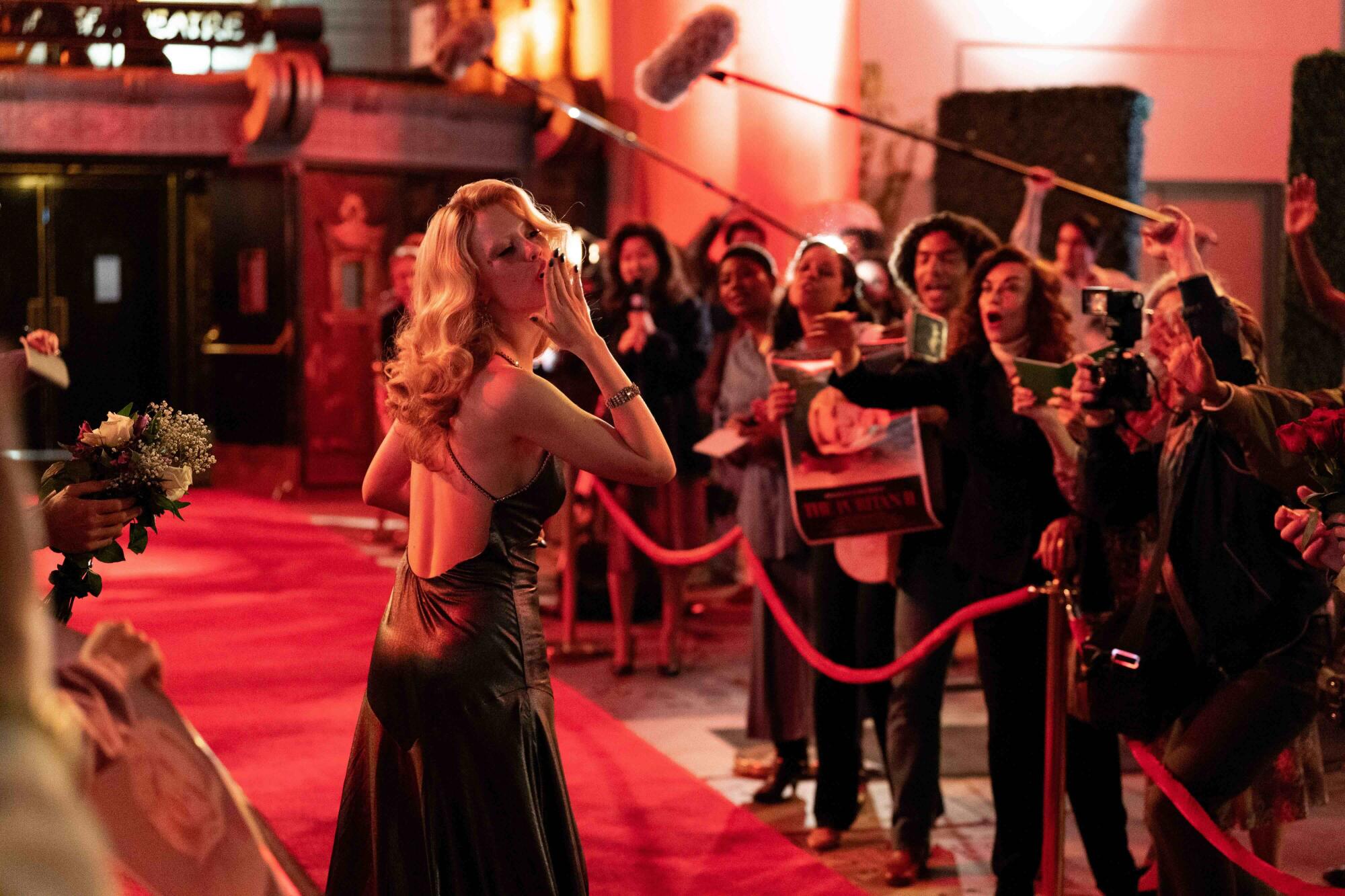
“She’s not trying to work for UNICEF,” West says of Goth’s Maxine Minx, “but I’m just trying to put you on her side in the movie so that by the end of ‘MaXXXine,’ you’re like, ‘I’m just glad she made it.’”
(A24)
But for now, he’s focused on getting people to root for the trials and tribulations of his marvelously wicked Maxine Minx. Right after the car crash, West and Goth hustled to film a scene of Maxine strutting the red carpet at Mann’s Chinese.
Eventually, “MaXXXine” itself will debut there too: an ’80s-chic world premiere with Angelyne parked outside in her pink Corvette and attendees dressed like Gordon Gekko and Sunset Strip metal heads. West wears a white suit jacket — “very ‘Miami Vice,’” he says — while his toddler sports “Risky Business”-style sunglasses and charms paparazzi by giving them a let’s-do-lunch-babe finger point.
That was a couple days ago and West is back with us at the Chinese’s autographed concrete, still finding his footing in the surreality of it all. He nods approvingly that the town hasn’t swapped out its shoe prints of classic stars for, well, Shrek.
“The movies aren’t going anywhere, because telling stories is how people communicate,” he says. Tenacious creatives like Maxine and Pearl and yes, even he and Goth, are now part of Hollywood lore. West exhales. “Maybe someday, someone will say, ‘I really like those old movies — like ‘MaXXXine.’”


Sam Raimi‘s Evil Dead films and TV series are a fine example of creativity within constraints, playfulness, self-awareness and outright slapstick comedy. The Evil Dead series after Raimi is very, very different. Starting with 2013’s Evil Dead by Fede Álvarez, followed by Evil Dead Rise by Lee Cronin, the new series takes itself more seriously and emphasises pure horror, violence and gore. Some have considered this praiseworthy as it avoids being a mere retread of the old films, but the reception has been mixed.
In Sébastien Vanicek’s Evil Dead Burn, Alice (Souheila Yacoub) loses her abusive husband (George Pullar) to a motor accident. When she goes home to stay with his family, the consequences of the work of their dead grandfather researching the Necronomicon and the Deadites manifest in terrible ways. One by one, the family are turned into the Evil Dead.
Horror is a genre that depends on you relating to the protagonists so you care what happens to them. In the case of Evil Dead Burn, Yacoub does a decent job with the character she’s given, but the gonzo horror elements manifest so early in the film that she may as well be collateral damage in the onslaught, especially as the film’s early point of view is that of her brother-in-law (Hunter Doohan).
Fans of gory violence will get their money’s worth here, but there’s not a lot going on besides that. The film is a descent into madness and carnage that is so resolutely unpleasant that, after some of the early kills, it becomes numbing. It’s hard to gather what the tone is supposed to be, with lots of callbacks to the early films’ style by setting up inevitable kills with Chekhov’s weed trimmer, Chekhov’s fork and every other potentially dangerous prop the camera lingers on. The family are all deeply unpleasant at some level and so their deaths register as meaningless. Yes, the film has the obligatory something to say about how our tendency to ignore domestic abuse creates demons that destroy families, but then absolutely panders to bloodlust by absolutely revelling in some of the most extreme violence imaginable between family members (and a pet). To say this is not a film for the sensitive is to understate things considerably. This is a film that absolutely earns its content guidance warnings.
Is there any comedy? Some, but it feels out of place given the absolute brutality inflicted on the cast. While most of the other films were self-aware about setting up a ludicrously grisly end for a villain as a payoff, in Evil Dead Burn,the kills have very little flair. It’s also hard to know what the rules for getting rid of a Deadite are, as some of them are still upright and chatty after losing most of the contents of their skull and some are dispatched by the repeated application of a blunt object to the head. Towards the end, a McGuffin is added to make the kills final, but before that, who knows?
Should you watch Evil Dead Burn,? It certainly gets vocal reactions from audiences in a cinema, and if you’re a gorehound you’ll be in for a ride. If you’re a horror fan, it’s certainly a horror film, but violent instead of scary. If you’re just a fan of cinema who likes good films whether or not they’re horror films, then this will be an alienating watch. In Evil Dead Rise the decay of the family was more than background noise and factored into the circumstances of the individual deaths, but not here. It has slight pretences of being a film with Themes and Ideas, but in the end it just feels like an excuse to serve up limbs being mutilated, skulls being crushed and any number of stabbings, slicings and gougings rendered with psychopathic visual fidelity. If that’s what you’re after, that’s what it’s got.
Entertainment
‘Children of Blood and Bone’ author won’t see film after feud with star Amandla Stenberg

Tomi Adeyemi, the author of the bestselling fantasy “Children of Blood and Bone,” isn’t planning to see the forthcoming film adaptation — even though she co-wrote it.
Over the weekend, the Nigerian American author posted a video on TikTok addressing fans who have been asking her the same question, “Why don’t you post about the adaptation of your first film adaptation anymore?”
“There is a reason I will not post anything about the adaptation of my work,” the author wrote in what appear to be screenshots of a group chat. “I have not seen the film, and I will not watch it.”
The adaptation of the first installment of Adeyemi’s “Legacy of Orïsha” fantasy trilogy is slated to hit theaters in January 2027. Gina Prince-Bythewood — who wrote and directed “Love & Basketball” and helmed “The Woman King” — is directing. The film stars Amandla Stenberg, Thuso Mbedu, Tosin Cole, Damson Idris, Cynthia Erivo, Lashana Lynch, Regina King, Idris Elba, Chiwetel Ejiofor and Viola Davis.
Alongside the screenshots of her comments in the group chat, she shared a February 2025 exchange with Stenberg that shows the author severing ties with the actor.
Adeyemi shared only her final message to Stenberg, which reads, “Do not ever use my name in an interview or video again. Do not text me. Do not call me.” That exchange is followed by a notification that she blocked Stenberg, who plays Princess Amari in the upcoming fantasy flick.
The message from Stenberg that preceded Adeyemi’s reply is not shown in full.
Stenberg, who played Rue in “Hunger Games,” Starr Carter in “The Hate U Give” and, recently, Verosha “Osha” Aniseya and Mae-ho “Mae” Aniseya in Disney’s “Star Wars” series “The Acolyte,” had been getting flack from readers of the series, who claimed colorism was an issue while casting the movie.
In February 2025, Stenberg posted a since-deleted nine-minute TikTok addressing the controversy and told followers that Adeyemi had given the actor her blessing when cast as the series’ princess.
“I am four months into training for ‘Children of Blood and Bone’ and I am getting my ass whooped,” Stenberg joked in the video, per BET.
“This year was mostly defined for me, honestly, by contending with what it felt like to receive racist death threats just for existing in the ‘Star Wars’ universe, and that was a really difficult thing for me to move through,” she continued. “But honestly, it feels so much more painful for me to feel like I’m at odds with my own community.”
Stenberg said that she considers her skin tone when navigating her career choices and would “never go after a role” she didn’t feel well suited for. “I know that colorism is an insidious system that relentlessly impacts every facet of entertainment.”
The actor continued that it was actually a meeting with the “Children of Blood and Bone” author that gave her the confidence to pursue the role.
“I had the opportunity to meet Tomi, the novelist, for the first time. … And she goes, ‘Amandla, I want you to know that when you were a little girl and you were cast as Rue in “The Hunger Games,” and people said that Rue’s death wouldn’t be as sad because you’re a Black girl — that inspired me to write this series so that Black girls like you and Black girls of all shades could have a story written about them,’” Stenberg said in the video. “We started crying, and I said to myself, ‘God wants me here.’”
Representatives for Stenberg, Adeyemi and Prince-Bythewood did not immediately respond to The Times’ request for comment.
Movie Reviews
‘Night Nurse’ Review: A Caretaker Explores Her Kink for Elder Abuse in the Year’s Strangest Erotic Thriller

There are any number of erotic thrillers in which rich old men are robbed blind and/or left for dead, but Georgia Bernstein’s admirably bizarre “Night Nurse” might be the first movie of its kind where elder abuse is the source — and possible subject— of its erotic thrills. If there are others, I’m not sure I want to know.
But this woozy debut feature doesn’t rely on its audience being turned on by the relationship between a nubile caretaker and her dementia-addled patient. Their psychosexual bond, meanwhile, hinges on cold-calling vulnerable old people under the guise of a grandchild in financial distress. (“I’m in trouble, nana, send me $10,000 or I’ll be left to rot in jail!” That sort of thing). With its slim wisp of a premise stretched into a Strickland-esque dreamscape that substitutes kink for conflict, the film itself hardly seems convinced by its own wrinkled lust — all desperate kisses and non-touching poses of subservience. More important to Bernstein is what that lust reveals about her characters’ deepest needs, specifically how their need to care and be cared for can be as easily perverted as any other form of desire.

As moody and weightless as the noir-accented score that blows through the movie like a curlicue gust of wind in an old cartoon (credit to musicians Sam Clapp and Steven Jackson), “Night Nurse” lacks the pulse required for its stray feelings to come alive. Still, the film ambiently taps into the latent eroticism of teasing out the distance between how you see yourself and who you really are. Bernstein plays with that distance like a telephone cord wrapped around her fingers, and Eleni — played by the excellent newcomer Cemre Paksoy, powerfully helpless — only frays even more as the receiver is brought near the hook. “Everything I did before today wasn’t me,” the nurse tells co-worker Mona (Eleonore Hendricks) after starting a new job at an Illinois retirement home. “It was somebody else.”
What she did before today remains unexplored (specifically, what she did to get herself fired from her last gig), but I’m guessing she’s probably changed less than she thought. There’s a faraway flicker in her eyes the moment she catches the vibe between Mona and Douglas (a ribald and elusive Bruce McKenzie), a white-haired seventysomething who shows early signs of dementia but still commands an undiminished sexual energy. “I’m not an invalid,” he coos as Mona bathes him in the tub, to which she replies, “yes, you are,” in a supplicant tone that hints at a rich history of power games between them.
Later that same night, Douglas will force Eleni to call a stranger, pretend that she’s their granddaughter, and ask for money — he’ll wrap the phone cord around the nurse’s body as she talks and shove her against the wall as they kiss. She’s into it. So into it that he has to clarify the terms of his whole deal: “If you’re looking for a pogo stick, I’m really not your guy.” But Eleni isn’t looking for anything to bounce on. She just wants to be needed, and maybe to need someone in return. Someone who will see her for who she really is and allow her the fantasy of pretending she isn’t being herself when she cons vulnerable strangers out of their money — when she exploits how enthralled those strangers are by the care they have for their loved ones.
“Night Nurse” doesn’t belabor the psychology, as Bernstein prefers to express her story through heavy-lidded suggestion. Somnambulating from the moment it starts, the film moves through a series of beautifully arranged poses that stretch their latent meaning thin across the surface (Lidia Nikonova’s cinematography lacquers every shot with a seductive dreaminess). We see Douglas smoking in a lawn chair with Mona and Eleni curled around his feet. Eleni riding in the backseat of a convertible as the wind blows through her curls. The full staff of nurses — all of them under Douglas’ sway — stumbling around his condo in a state of zonked out bliss as they roll on the prescription drugs they’ve stolen from the residents.
Once you’ve seen one shot of this movie, you’ve practically seen them all, at least until things escalate during a rushed and unsatisfying third act that forces Eleni into an honest confrontation with herself. People will do just about anything to feel needed — they’ll give whatever degree of care allows them to receive it in return. “Night Nurse” understands that desire, but remains far too numb to treat it.
Grade: C+
The Independent Film Company will relase “Night Nurse” in theaters on Friday, July 10.
-
 Sports19 seconds ago
Commentary: ‘I don’t want any handouts.’ Amid the Angels’ drought, a starry homecoming for Mike Trout
-

 World10 minutes ago
Does more World Cup history beckon for Norway? England stand in their way
-
 News37 minutes ago
Waymo called the cops on teen riders, raising privacy concerns
-

 Los Angeles, Ca2 hours ago
O.C. police prep for beach, theme park ‘takeovers’ promoted on social media
-

 Detroit, MI2 hours ago
Detroit city leaders to DHS: Stop ICE pursuits which endanger the community
-

 San Francisco, CA3 hours ago
SF Supervisor Jackie Fielder hosts listening session after medical leave
-

 Dallas, TX3 hours ago
The Stewpot artists find healing, purpose and income through art in Dallas
-

 Miami, FL3 hours ago
Can Jason Marshall push for a starting spot – The Splash Zone 7/10/26

