Arizona
Arizona legislature passes contentious budget in face of $1.3 billion deficit


Neither Democratic nor Republican lawmakers were very happy Saturday after spending more than 12 hours voting, passing the state’s budget just two weeks shy of the end of the fiscal year.
Arizona has a $1.3 billion budget deficit looming in the 2024 and 2025 fiscal years and legislators had to figure out a fix by the end of the 2024 fiscal year on June 30.
The 2025 budget, at $16.1 billion, includes significant reductions from 2024’s $17.2 billion. A number of Democratic members and Republicans voted no, saying that they did not have enough time to review the budget or decrying the cuts that were made.
“I feel like this year’s budget seems more focused on getting it done then doing it right,” Rep. Matt Gress, R-Phoenix, said when voting no on the budget Saturday. “I think many of us feel like this does not reflect the shared priorities of Arizonans. I believe this budget is a fiscal tragedy both in terms of process and policy.”
“Our budget is a moral document,” Rep. Mariana Sandoval, D-Yuma, said when explaining her no vote. “I’m sad to see that in the $16 billion budget, our communities are getting crumbs. Those are the wins my colleagues are talking about, crumbs.”
Most of the budget bills barely passed in each chamber.
“Arizonans can rest assured that their state has a balanced budget. I’m thankful for members of the legislature who came together, compromised, and passed this bipartisan agreement,” Gov. Katie Hobbs said in a statement after the passage of the budget. “But I know we still have more work to do.”
Hobbs has not signaled when she intends to sign the budget.
Among the issues Democratic legislators objected to is the inclusion of a plan to allocate $75 million of state opioid settlement funds to the Department of Corrections. That money, which the state got through a lawsuit against pharmaceutical companies in the wake of the opioid crisis, has restrictions on how it should be used. Democratic Attorney General Kris Mayes has threatened to sue the governor and lawmakers if the proposal makes it into the final version of the budget.
Mayes believes that using the money to “backfill holes” in the Department of Corrections operating budget would put the $1.4 billion the state is set to receive in the settlement at risk of legal challenges. However, Mayes’ office has previously described transfers to the DOC as a qualified usage of the settlement money.
The AG’s Office did not respond to a request for comment Saturday night.
K-12 public education
The budget provides modest increases in funding to public district and charter schools, as well as to cover student transportation costs, but Beth Lewis, executive director of Save Our Schools Arizona, said it wasn’t enough to keep up with inflation.
SOS Arizona is a public education advocacy group focused on opposing the expansion of private school vouchers, known as Empowerment Scholarship Accounts.
As part of their final day of session, lawmakers also passed a measure that lifts the “Aggregate Expenditure Limit” for Arizona schools for the next fiscal year. Education advocates had been asking the legislature to make that a permanent lift, yet once again lawmakers lifted the AEL temporarily.
The AEL, placed in the state constitution by voters in 1980, means that without a legislative waiver, schools would have been forced to make massive cuts to their budgets. Now that has been temporarily averted, public school advocates are turning their attention to a more lasting fix so the legislature does not have to scramble to issue a waiver every year.
The budget also includes an additional $29 million in one-time additional assistance to public schools.
GET THE MORNING HEADLINES DELIVERED TO YOUR INBOX
Empowerment Scholarship Accounts
Some Democratic members were pleased that the budget places new regulations on the ESA program, including requiring fingerprinting for staff who work unsupervised around children. Other Democrats argued that the new regulations didn’t go far enough. They said the fingerprinting requirement, for example, is not as stringent as that for public school teachers.
“While this bipartisan budget delivers reforms to the ESA program, they are not enough,” Hobbs said in her post-passage statement. “I stand committed to bringing much needed accountability and transparency to the unsustainable ESA program that significantly contributes to the state’s budget deficit.”
Many Republicans decried the new rules as government interference in private schools.
Arizona recently expanded universal Empowerment Scholarship Accounts to allow all K-12 students in the state to attend private school or to be educated at home using public money, even if that student’s parents were already paying for them to attend private school before a voucher was available.
Critics of the expanded program — which has gone from around 12,000 participants to more than 75,000 — have repeatedly called for it to be capped or nixed all together, calling it a subsidy for the wealthy at the expense of everyday Arizonans.
While proponents of the program, like Mesa Republican Rep. Barbara Parker, claim that it saves the state money, that isn’t the case. A recent report from the nonpartisan Grand Canyon Institute found that the expanded universal portion of the program cost Arizona $332 million in the 2024 fiscal year, a number expected to grow to $429 million next year.
In budget discussions on Thursday, Democratic critics of the program repeatedly pointed out that they could wipe out a big chunk of the state’s budget deficit by eliminating or scaling back the universal expansion.
“We could easily solve this deficit by reining that in,” said Democratic Sen. Anna Hernandez, of Phoenix, later calling cuts to other important programs, but not to ESAs, “fiscally irresponsible.”
Public education advocates argue that vouchers take money away from public schools, when Arizona public schools are some of the worst funded in the nation.
The new budget doesn’t eliminate or put a cap on the ESA program, but it would stop public school students from using ESA funding for educational purposes over summer break, for a modest savings of $2.5 million annually.
It also calls for annual audits of a random sample of ESA accounts to ensure parents comply with the rules of the program, but Democratic Sen. Priya Sundareshan said during a Senate Appropriations Committee meeting on Thursday that the new guardrails for ESAs were far from sufficient. She pointed out that a single student’s account could not be selected for review more than once in a five-year period.
Road construction projects
Lawmakers delayed many road construction projects set to begin in the next few years, causing consternation for municipal leaders who were counting on the highway and street improvements.
Katy Proctor, intergovernmental affairs director with the city of Maricopa, told lawmakers during a Senate Appropriations Committee meeting on Thursday that the city was extremely disappointed about the delay in funding for construction of an overpass at the intersection of State Road 347 and Riggs Road. More than 57,000 vehicles travel through that intersection daily, she said, and it’s ranked as the fourth-most dangerous intersection in the state highway system. Most accidents that happen there involve rear-end crashes and left turns, which she said would be eliminated by the project.
Also pushed back to 2028 is a $108 million project that was set to widen Interstate 10 between State Road 85 and Citrus Road. The budget also reduces funding to the Arizona Department of Transportation for pavement rehabilitation by $41 million.
Some projects did make it into the state’s budget.
Those projects include $10 million for a traffic interchange between Interstate 10 and Cortaro Road in Tucson; $8.2 million for work on a road between the Douglas port of entry and State Route 80; $35.5 million for an emergency evacuation bridge in Lake Havasu City; and $18 million for improvements to an intersection on Route 347 and Casa Blanca Road near Casa Grande.
Water policy
The budget eliminates the entire $333 million budget meant to be allocated in 2025 to the Water Infrastructure Finance Authority of Arizona, a fund created in 2022 with broad bipartisan support to help shore up Arizona’s water future by bringing in water from out of state.
Arizona leaders, along with the heads of other southwestern states that are in the throes of a decades-long drought, are concerned about the area’s water future, but Republican Rep. Alexander Kolodin, of Scottsdale, told the Arizona Mirror in December that he believed WIFA funding was a good place to cut.
Kolodin said that there are so many restrictions placed on the money that “there are no good projects to fund.”
Opioid settlement
One of the sticking points in the budget — especially for Democrats — was a plan to use $75 million in funds that the state received from a lawsuit against the makers of opioids who were found partially at fault for the opioid crisis.
Democratic Attorney General Kris Mayes previously told the Mirror that this use of money was illegal and could “put Arizona’s entire $1.4 billion in opioid funds in legal jeopardy.”
The funds are meant to be used to combat the fentanyl crisis, not backfill the Department of Corrections’ operations budget, Mayes said during an interview this week with 12 News.
“That’s illegal. I will fight it,” Mayes said. “If I have to go to court to fight it, I will do that and we will win. And, by the way, I am not giving that money to them. It’s in my bank account at the Attorney General’s Office. It is not going anywhere.”
Mayes went on to say that if she had to, she would sue Democratic Gov. Katie Hobbs to stop the state from using that money improperly.
Higher and adult education
Arizona’s colleges and universities will see significant cuts to their budgets.
Arizona State University will see $10.9 million in cuts; Northern Arizona University will lose around $4 million; and University of Arizona’s state funding will be cut by around $6.5 million.
The state’s community colleges will see a cut of around $54 million.
The budget would also eliminate programs, beginning in 2026, that were meant to help Arizona’s workers, including the Continuing High School and Workforce Training Program, Adult Workforce Diploma Program and the Community College Adult Education Workforce Development Program.
Infighting
Saturday was full of long breaks between voting as Republicans and Democratic members tried to round up the votes needed to pass the budget.
Even with some of the changes, members of both parties voiced their displeasure with the process and with the items included in the budget that were meant to get buy-in from both parties.
“This budget was a trainwreck. This process was a trainwreck. It has bastardized the way the legislative process is supposed to work and I vote hell no!” Kolodin said, after noting that rank and file Republicans were given a “thousand page” budget document only three days ago.
Democratic members voiced similar concerns Saturday.
“Yes, some of us were included in many discussions and some of us were not and I was able to see that,” Rep. Betty Villegas, D-Tucson, said, adding that the state’s Low Income Housing Tax Credit program lost funds in this year’s budget. “So it really isn’t a win.”
Others focused on the “wins” they did get in the budget and emphasized that lawmakers are working in a divided government.
“There are plenty of things I am unhappy with in it, there are several things I am happy about and deserve recognition in this process,” Rep. Judy Schwiebert, D-Phoenix, said. The Phoenix Democrat touted $4 million for school lunches, $2 million to the Arts Commission, money for adult education programs, the AEL extension and a $15 million deposit to the state’s Housing Trust Fund as major wins.
That still did not stop a number of Democratic lawmakers from voting no along with some of their Republican colleagues.
Online, lawmakers began taking shots at each other and casting blame for what they saw as a bad budget.
The far-right Arizona Freedom Caucus took to X, formerly Twitter, to claim that the “swamp” and “establishment Republicans” were blaming them for the budget.
“The reality is that this is what happens when weak Republicans negotiate a budget in secret with Democrats,” the post said, adding that they brought their ideas to leadership, who “rejected the changes instantly without considering them, and then spent the rest of the day attacking, defaming and insulting members of the Freedom Caucus for not just blindly following orders.”



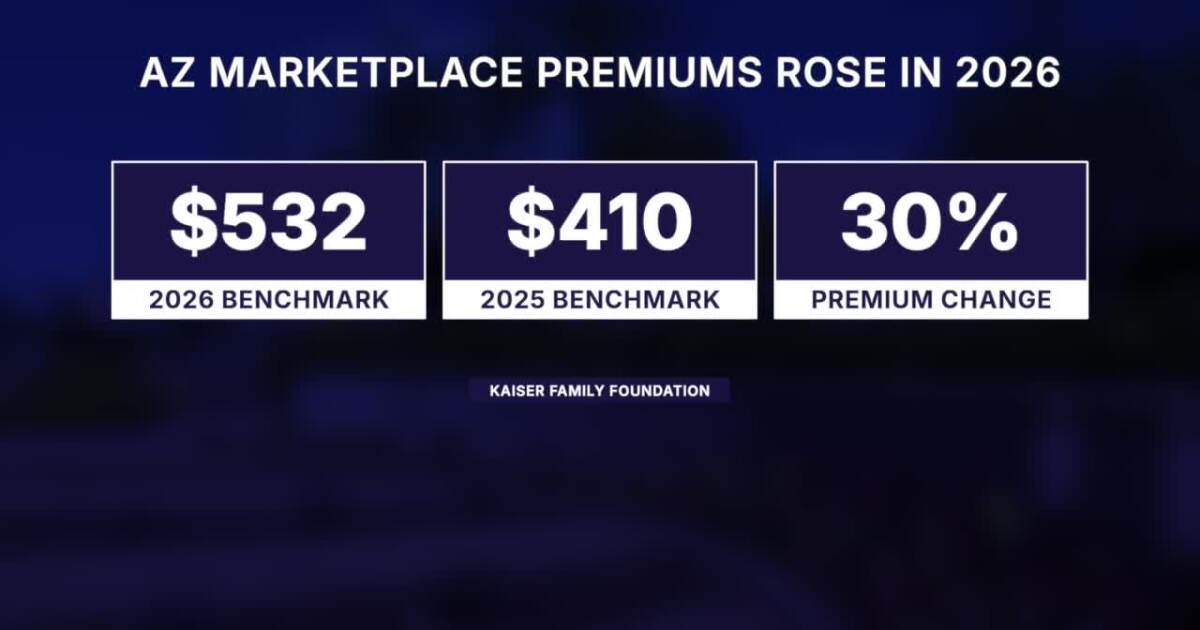
PHOENIX — Arizona’s ACA marketplace enrollment fell from 363,000 to just over 255,000 in a single year — a nearly 30% decline and the third-largest annual drop in the country.
Rising premiums and expired tax credits are driving the trend, with the average benchmark plan premium in Arizona now at $532 — up 30% from 2025.
In the player above, ABC15 Data Analyst Garrett Archer takes a look inside the numbers on how healthcare premiums are impacting health insurance enrollment.
This story was reported on-air by a journalist and has been converted to this platform with the assistance of AI. Our editorial team verifies all reporting on all platforms for fairness and accuracy.
Want more news in your community? Add ABC15 as a preferred source on Google below:

Arizona
Arizona man pleads guilty after illegally living in forest for years among ‘1,000lbs of trash’

A man in Arizona has pleaded guilty to violating federal fire restrictions and unlawfully residing in a national forest, after authorities said he spent years living at a makeshift campsite surrounded by what officials described as “approximately 1,000 pounds of trash”.
Mark Aaron Gatz was arrested on 25 June at his illegal campsite in Arizona’s Tonto national forest, according to court records. A United States Forest Service (USFS) officer wrote in documents submitted to court that Gatz had been operating an “illegal campsite” with a “hot wood burning campfire” despite fire restrictions and that he had told investigators that he had been living in the forest for about eight years.
The officer wrote that a records check found that Gatz had previously received multiple citations and was the subject of six outstanding federal arrest warrants for earlier violations, including for building fires during fire restrictions, constructing on national forest service lands, unsanitary conditions and occupying national forest as a residence.
Gatz “said that he knew about current fire restrictions but had to have fire to eat”, authorities said. The documents show that USFS officers made contact with Gatz multiple times over the last year or so, and issued him warnings as well as a violation notice for having campfires during fire restrictions.
Notes from officers’ previous encounters with Gatz earlier this year, submitted into the court docket, state that authorities observed “trash such as clothing, pans, tools, and plastic cups scattered throughout the campsite along with a structure that was four feet in height build using wood panels”.
During an encounter with Gatz in May, officers reported observing “approximately 1,000 pounds of trash” at the site, which they said included tires, plastic bags, trash bags, aluminum cans and other items. They also wrote that they found that the campfire site had been left unattended by Gatz the previous day while still hot.
In a separate report filed by law enforcement from an encounter in February, one officer wrote that “upon arrival at the camp, I was flabbergasted by the amount of debris in the area”.
Investigators said that during that encounter, the debris consisted of three ladders, six to eight totes “overfilled with debris”, five 55-gallon drums, eight tires, multiple bicycle frames, 5 gallons of motor oil, plywood and other “miscellaneous lumber”, and they wrote that trash was scattered over approximately half an acre of Forest Service land and creating what officers described as public safety concerns.
In a separate report from July 2025, officers said they observed what they described as a “large messy campsite” while patrolling the area due to complaints “from the district office abut one large messy camp”.
“There was roughly half an acre of resources ruined due to so much trash and goods on the ground for an extended period of time,” the officer wrote.
This week, after Gatz pleaded guilty, he was sentenced to time served and three years of probation, according to court records.
A representative for Gatz did not immediately respond to a request for comment.


Odds of winning the Powerball and Mega Millions are NOT in your favor
Odds of hitting the jackpot in Mega Millions or Powerball are around 1-in-292 million. Here are things that you’re more likely to land than big bucks.
The Arizona Lottery offers multiple draw games for those aiming to win big.
Here’s a look at Tuesday, July 7, 2026 results for each game:
Winning Mega Millions numbers
02-31-35-36-63, Mega Ball: 12
Check Mega Millions payouts and previous drawings here.
Winning Pick 3 Evening numbers
Evening: 4-7-2
Winning Fantasy 5 numbers
03-05-10-14-37
Check Fantasy 5 payouts and previous drawings here.
Winning Triple Twist numbers
03-06-18-23-27-32
Check Triple Twist payouts and previous drawings here.
Feeling lucky? Explore the latest lottery news and results
What time is the Powerball drawing?
Powerball drawings are at 7:59 p.m. Arizona time on Mondays, Wednesdays and Saturdays.
How much is a Powerball lottery ticket today?
In Arizona, Powerball tickets cost $2 per game, according to the Arizona Lottery.
How to play the Powerball
To play, select five numbers from 1 to 69 for the white balls, then select one number from 1 to 26 for the red Powerball.
You can choose your lucky numbers on a play slip or let the lottery terminal randomly pick your numbers.
To win, match one of the 9 Ways to Win:
- 5 white balls + 1 red Powerball = Grand prize.
- 5 white balls = $1 million.
- 4 white balls + 1 red Powerball = $50,000.
- 4 white balls = $100.
- 3 white balls + 1 red Powerball = $100.
- 3 white balls = $7.
- 2 white balls + 1 red Powerball = $7.
- 1 white ball + 1 red Powerball = $4.
- 1 red Powerball = $4.
There’s a chance to have your winnings increased two, three, four, five and 10 times through the Power Play for an additional $1 per play. Players can multiply non-jackpot wins up to 10 times when the jackpot is $150 million or less.
Are you a winner? Here’s how to claim your lottery prize
All Arizona Lottery retailers will redeem prizes up to $100 and may redeem winnings up to $599. For prizes over $599, winners can submit winning tickets through the mail or in person at Arizona Lottery offices. By mail, send a winner claim form, winning lottery ticket and a copy of a government-issued ID to P.O. Box 2913, Phoenix, AZ 85062.
To submit in person, sign the back of your ticket, fill out a winner claim form and deliver the form, along with the ticket and government-issued ID to any of these locations:
Phoenix Arizona Lottery Office: 4740 E. University Drive, Phoenix, AZ 85034, 480-921-4400. Hours: 7:30 a.m. to 5 p.m. Monday through Friday, closed holidays. This office can cash prizes of any amount.
Tucson Arizona Lottery Office: 2955 E. Grant Road, Tucson, AZ 85716, 520-628-5107. Hours: 7:30 a.m. to 5 p.m. Monday through Friday, closed holidays. This office can cash prizes of any amount.
Phoenix Sky Harbor Lottery Office: Terminal 4 Baggage Claim, 3400 E. Sky Harbor Blvd., Phoenix, AZ 85034, 480-921-4424. Hours: 8:30 a.m. to 5 p.m. Monday through Sunday, closed holidays. This office can cash prizes up to $49,999.
Kingman Arizona Lottery Office: Inside Walmart, 3396 Stockton Hill Road, Kingman, AZ 86409, 928-753-8808. Hours: 8 a.m. to 8 p.m. Monday through Friday, 8:30 a.m. to 5 p.m. Saturday and Sunday, closed holidays. This office can cash prizes up to $49,999.
Check previous winning numbers and payouts at https://www.arizonalottery.com/.
This results page was generated automatically using information from TinBu and a template written and reviewed by an Arizona Republic editor. You can send feedback using this form.
-

 West Virginia2 minutes ago
West Virginia retailers told to allow people to purchase soda with SNAP benefits
-
 Wyoming9 minutes ago
Wyoming women escape black bear attack on their tents in the Big Horn Mountains
-

 Crypto11 minutes ago
Binance maintains commitment to EU, seeking more licences in Asia
-

 Finance17 minutes ago
How Banreservas mobilised diaspora capital
-

 Fitness24 minutes ago
I’d Fallen Into an Exercise Rut—Until Trail Running Reminded Me How Joyful Movement Could Be
-

 Movie Reviews32 minutes ago
Movie review: Supergirl is a blast
-

 World37 minutes ago
Trump Says He Thinks He Will Remove Syria From US Terrorism Sponsor List
-
 Lifestyle1 hour ago
Appeals court denies Trump’s request to halt removal of his name from the Kennedy Center

