Politics
5 things to know about Hunter Biden trial


Hunter Biden’s federal gun crime trial kicked off with jury selection on Monday in Delaware, launching proceedings that are sure to hold the nation’s attention in the days and weeks to come.
Here are some key facts to know about the trial moving forward.
1. Hunter Biden faces up to 25 years in prison
Hunter is charged with one count of making false statements in a firearm purchase, another count of making a false statement related to information required to be kept by a licensed firearm dealer, and one count of possession of a firearm by a person who is an unlawful user of or addicted to a controlled substance.
If he is found guilty on all charges, he could face a maximum sentence of 25 years in prison. Each count also carries a maximum fine of $250,000 and three years of supervised release.
JUDGE BARS PROSECUTORS FROM USING SOME SALACIOUS EVIDENCE IN HUNTER BIDEN’S GUN TRIAL
Hunter Biden’s federal gun crime trial kicked off on Monday in Delaware, launching proceedings that are sure to hold the nation’s attention in the days and weeks to come. (AP Photo/Matt Slocum)
According to an indictment, Hunter Biden bought a Colt Cobra revolver on Oct. 12, 2018, and “knowingly made a false and fictitious written statement, intended and likely to deceive that dealer with respect to a fact material to the lawfulness of the sale of the firearm … certifying he was not an unlawful user of, and addicted to, any stimulant, narcotic drug, and any other controlled substance, when in fact, as he knew, that statement was false and fictitious.”
2. Hunter’s defense hinges on his drug addiction
Hunter’s charges allege that he was addicted to drugs at the time he purchased the firearm, meaning prosecutors do not need to prove that he was in fact on drugs at the moment of the purchase.
Fox News legal analyst Gregg Jarrett summarized Hunter’s “crazy” defense plan in a Monday morning appearance on “Fox & Friends.”
“The best witness against Hunter Biden is Hunter Biden,” Jarrett said. “I mean, [he] wrote a book explaining in detail how he was a drug addict at the exact time that he bought a gun and then allegedly lied about it, so he incriminated himself, and it was incredibly foolish to cash in by peddling a book about your addiction when you know you’re under criminal investigation for an addiction related crime.”
HUNTER BIDEN PLEADS NOT GUILTY TO TAX CHARGES BROUGHT BY SPECIAL COUNSEL DAVID WEISS
President Biden has yet to speak about his son’s trial now that it has begun. (Hannah Beier/Bloomberg via Getty Images/File)
Jarrett said Hunter’s main defense hinges on denial of addiction and rehab, with a backup defense of being too strung out to intend wrongdoing. His defense may also attempt to challenge the Second Amendment, despite his father’s advocacy for stricter gun laws.
HUNTER BIDEN IS IN COURT IN DELAWARE. HERE’S WHAT HE DOESN’T WANT THE JURY TO HEAR
“His dad is on record railing against the Second Amendment,” Jarrett said. “And arguing strict gun laws should always be enforced, except for, you know, maybe against my own son. So, it’s a crazy defense.”
3. Hunter’s family members are attending the proceedings
First lady Jill Biden, Hunter’s stepmother, attended the first day of his trial alongside Hunter’s sister, Ashley Biden, on Monday.
Hunter arrived at court while holding hands with wife Melissa Cohen Biden.
Hunter’s father, President Biden, has not announced any plans to attend the proceedings.
4. The judge has barred prosecutors from using salacious evidence
The judge in Hunter’s trial has ruled that the prosecution cannot use some salacious evidence in the proceedings, including references to his U.S. Navy discharge and the child support case for his out-of-wedlock daughter in Arkansas.
Judge Maryellen Noreika said the government may use part of Hunter Biden’s book in which he discusses his addiction to drugs.
Hunter Biden and his wife, Melissa Cohen Biden, arrive at federal court in Wilmington, Delaware, on June 3, 2024. (AP Photo/Matt Slocum)
The prosecution does not plan to bring out Hunter Biden’s entire infamous laptop, which leaked in 2020 just before the presidential election, but may introduce certain pieces of information. Noreika ruled that Hunter Biden’s team will be able to question aspects of the laptop in front of the jury.
In what is called a “motion in limine,” Hunter Biden asked the court “to exclude reference to the child support proceedings in Arkansas and reference to his discharge from the Navy.” This is in reference to the child he fathered out-of-wedlock with ex-stripper Lunden Roberts.
5. This is not Hunter’s only criminal trial
Hunter’s gun crime charges are not the only criminal charges against him. The first son is also facing federal tax charges in California.
Hunter will have to attend federal court in Los Angeles this month for tax evasion charges. That case stems from a years-long investigation conducted by Special Counsel David Weiss.
Weiss charged Hunter Biden in December, alleging a “four-year scheme” in which the president’s son did not pay his federal income taxes from January 2017 to October 2020 while also filing false tax reports.
Hunter has pleaded not guilty to all charges in that case, with a trial scheduled to begin on June 20.

Politics
Fetterman unleashes on ‘dirtbag’ wing of Dems after far-left victories: ‘Orgy of socialism’

NEWYou can now listen to Fox News articles!
Sen. John Fetterman, D-Pa., unloaded on his own party on Sunday evening, blasting a series of victories for progressives he called “anti-America.”
“Big night for the dirtbag left,” Fetterman said, referring to New York’s recent primaries, where two members of the Democratic Socialists of America (DSA) won primaries.
“I’ve said the party is becoming an orgy of socialism. Clearly anti-America, anti-Western Civilization,” Fetterman said.
Fetterman’s striking calls give a rare look at how some moderates may view the developments on their far-left flank that have dominated the party’s momentum in recent months, sparking concern that their high visibility is dragging the party further and further left.
FETTERMAN WARNS DEMOCRATS ‘DRIFTING FIRMLY INTO COMMUNISM’ AFTER SOCIALIST PRIMARY WINS
Sen. John Fetterman, D-Pa., speaks to reporters outside the Senate Chamber during votes on Nov. 10, 2025, on Capitol Hill in Washington, D.C. (Andrew Harnik/Getty Images)
His comments come on the heels of a handful of key progressive victories.
In Maine, Graham Platner, a controversial Democratic candidate for U.S. Senate, has attracted controversy for denying knowledge of the meaning behind a Nazi-linked tattoo, for off-color comments about race and calling himself a “communist” in a deleted Reddit post.
In New York, one DSA member, Claire Valdez, won a primary on a platform of abolishing ICE and a Green New Deal-style approach to climate change. Similarly, Darializa Avila-Chevalier, another DSA candidate, beat out incumbent Rep. Adriano Espillat, D-N.Y., a high-ranking Democrat and the chair of the Congressional Hispanic Caucus.
WINNERS AND LOSERS EMERGE AFTER SOCIALIST EARTHQUAKE ROCKS NYC PRIMARIES
Graham Platner, Democratic Senate candidate for Maine, speaks at a primary election night event at the Blue Hill YMCA in Blue Hill, Maine, on June 9, 2026. Platner won the party’s Senate primary after a campaign marked by accusations of past misbehavior and voter concerns. (Graeme Sloan/Bloomberg via Getty Images)
Both Chevalier and Valdez had the backing of New York Mayor Zohran Mamdani, himself a socialist.
The wins have captured national attention and drawn criticisms from Republicans who have pointed to their success as emblematic of the direction of the Democratic Party.
Fetterman, who has not shied away from confrontations, has been one of the few Democrats to express alarm about the kind of candidates carrying the party’s banner.
“I mean, you look at some of the things that people have said. Abolish prison, abolish the border, abolish ICE, I mean these crazy people — I have colleagues in my caucus that refuse to even call this out,” Fetterman said.
FETTERMAN REACTS TO MAMDANI’S REFUSAL TO ACCEPT SUPREME COURT’S IMMIGRATION RULING
U.S. Sen. John Fetterman, D-Pa., walks through the Senate Subway during the Senate War Powers vote on April 22, 2026, in Washington, D.C. (Heather Diehl/Getty Images)
CLICK HERE TO DOWNLOAD THE FOX NEWS APP
“Between P-hustle in Maine and some of the other winners in New York, they should form their own party and run on all the things that they’ve had to delete on social media,” Fetterman said, referring to Platner.
“That’s where our party has moved,” he added.
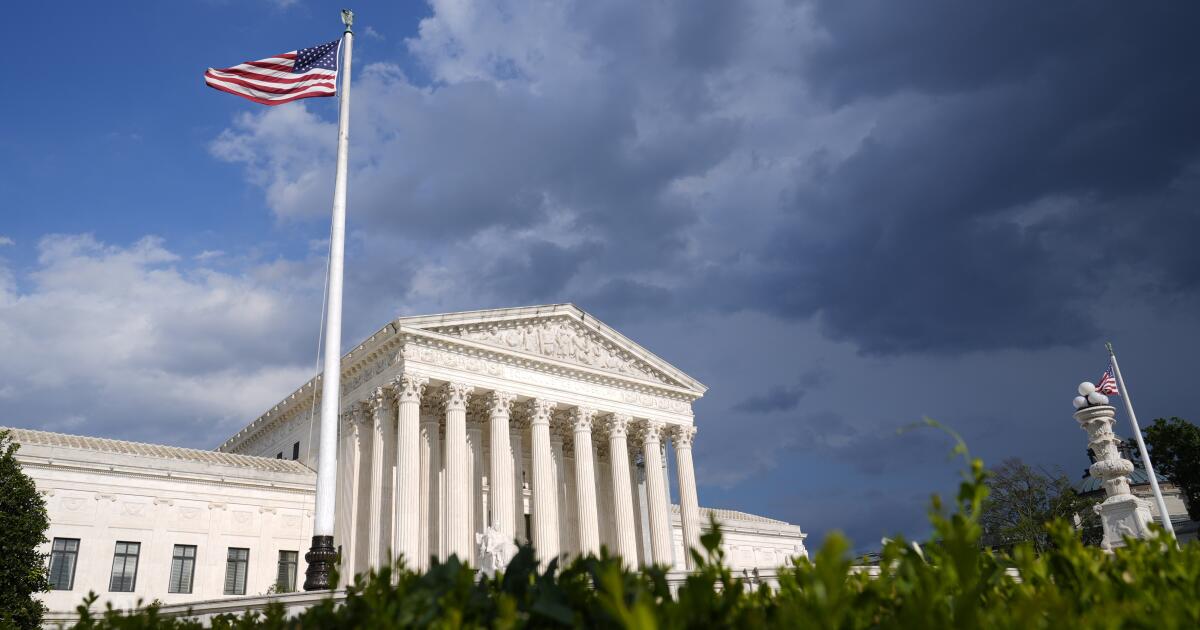
WASHINGTON — The Supreme Court cast doubt Monday on whether police may obtain cellphone data to find crime suspects.
In a 6-3 decision, the justices said this location information showing where a cellphone user has traveled is personal and private and subject to the protection of the 4th Amendment’s ban on unreasonable searches.
Justice Elena Kagan said these “records serve as a personal journal of a user’s movements.”
She said the information “resembles other private materials — think of emails, documents, photographs, or calendars—that even if stored on Google’s servers, a user reasonably views as his own…and reasonably expects to be shielded from the inquisitive eyes of the government.”
Because an “individual has a legitimate expectation of privacy in his cellphone location data,” she said police investigators need a valid search warrant from a magistrate.
The court stopped short of deciding the proper basis for a search warrant in such cases. Instead, the justices sent the case back to judges in Virginia.
But the outcome casts doubt on “geofence warrants.”
In recent years, police have gone to Google and cellphone companies seeking tracking data on cellphones that were at a crime scene. Sometimes, they have had a warrant from a magistrate.
Civil libertarians say the use of this tracking data raises the specter of mass surveillance on innocent people.
Police and government lawyers say no one has a reasonable right to privacy when they are walking on a sidewalk or driving down the street.
The case before the court arose from the armed robbery conviction of a Virginia man who stole $195,000 from a credit union in a small town near Richmond.
By the time police arrived, the robber had fled. But surveillance cameras showed he was carrying a gun and a cellphone.
Lacking other leads, detective Joshua Hilton asked a judge to issue a special type of warrant seeking information from Google.
Referred to as a “geofence warrant,” it seeks data from phones in a particular area at a particular time.
The detective sought data on phones that were within 150 yards of the credit union within one hour of the late afternoon robbery.
After examining and paring down the data, the detective asked for the phone records of Okello Chatrie. Then, with a search warrant of his home, investigators found two robbery-style demand notes, a semi-automatic pistol and about $100,000 in cash.
A judge refused to suppress the evidence from an allegedly unconstitutional search, and Chatrie entered a conditional guilty plea.
The full 4th Circuit Court of Appeals split evenly on the legality of the geofence warrant, and the Supreme Court agreed to decide the issue in Chatrie vs. U.S.
Usually investigators obtain warrants to search the home or vehicle of a known crime suspect.
The new and disputed geofence warrants seek to find a suspect by examining data on the cellphones that were at the scene of a crime.
The FBI used this cellphone data in 2021 to identify suspects who broke through police barricades on Jan. 6, 2021, and pushed their way into the Capitol to disrupt the official counting of electoral votes.
Chief Justice John G. Roberts Jr. and Justices Sonia Sotomayor, Neil M. Gorsuch, Brett M. Kavanaugh and Ketanji Brown Jackson agreed on the outcome in Chatrie vs. U.S.
In a 21-page dissent, Justice Samuel A. Alito Jr. said the court had “carefully set the stage for its planned performance: striking a pose as a great champion of privacy in the digital age. I cannot support this irresponsible escapade.”
Justice Clarence Thomas agreed.
Justice Amy Coney Barrett agreed in a one-paragraph dissent. “Chatrie had no reasonable expectation of privacy in data about his public movements that he voluntarily disclosed to Google,” she said.
The Supreme Court ruled 6-3 that President Trump could fire independent regulators for any reason. But the justices carved out an exception for the Federal Reserve, preventing the immediate removal of Lisa D. Cook, a Federal Reserve governor.
-
 West Virginia4 minutes ago
Across West Virginia, public schools are closing. Communities are feeling the loss.
-

 Wisconsin6 minutes ago
What did prized Wisconsin commit Baboucarr Ann average in 2025-26?
-

 Wyoming14 minutes ago
‘Not just coloring tipis,’ experts debate quality of Indian education in Wyoming schools – WyoFile
-

 Crypto21 minutes ago
Japanese Yen Sinks to 162.27, Its Weakest Since 1986, Reviving Intervention Bets
-

 Finance23 minutes ago
World Bank drops climate finance target amid US pressure
-

 Fitness29 minutes ago
Fitness Point: The Small Weekly Investment That Could Transform Your Health – KT PRESS
-

 Movie Reviews39 minutes ago
Movie Review – Minions & Monsters (2026)
-
World51 minutes ago
Pope issues last-ditch appeal, begs breakaway traditionalist group to back off bishop consecrations


