Sports
Fifty years later, the chaos of Cleveland's 10-Cent Beer Night still shocks


There were streakers, kissers and wannabe prize fighters. There were arrests, threats and flying chairs. There were bruises, there was blood and there was beer. So, so much beer.
There was plenty of blame to pass around: the fans, the umpires, the team officials, the managers, local broadcasters and radio hosts. Oh, and according to one Cleveland resident, the real instigator causing that evening’s mayhem? The moon. And that’s not a reference to the fans who yanked down their pants and showed Rangers players their backsides.
Fifty years ago, chaos descended upon Municipal Stadium on 10-Cent Beer Night. Now, the infamous events of June 4, 1974, when an alcohol-fueled crowd spilled onto the field, confronted players and forced a forfeit, are often viewed in a light-hearted manner, the stuff of commemorative T-shirts and parodied ballpark promotions.
But at the time? Cleveland’s sports chroniclers considered it a black eye for Cleveland on a night that resulted in many of them.
Texas manager Billy Martin: “The fans showed the worst sportsmanship in the history of baseball.”
Cleveland manager Ken Aspromonte: “I’ve never seen anything like that in all my life and I have played baseball all over the world.”
Umpire Nestor Chylak: “They were uncontrolled beasts. I’ve never seen anything like it except in a zoo.”
Let’s travel back in time and dig into the archives of The Plain Dealer to re-live one of the most surreal scenes ever to unfold on a baseball field.
‘They would have killed him. I guess these fans just can’t handle good beer’
The attendance that night: 25,134. Beers sold that night: 65,000. A Guardians spokesman estimated an average crowd today consumes about 23,500 beers.
Columnist Hal Lebovitz surmised that half of the fans “drank little or no beer,” which meant those participating accounted for about five Stroh’s each. “I saw five fans stand in the beer line, each getting the maximum six cups,” Lebovitz wrote. “That’s 30 beers. Some of them drank two cups and the others inhaled nearly 10 apiece.” For a buck, he added, a fan could snag a 50-cent bleacher seat and five beers. A security guard was quoted saying he saw “kids that couldn’t be more than 14 years old drinking beer.”
“Small wonder the bleachers were quickly sold out,” Lebovitz wrote. “Not even free soup or bread would have caused those long lines.”
The team increased its security presence from the customary 32 guards to 48. Early in the game, it was merely a comedic spectacle, though one rated “R.” Dan Coughlin wrote: “A woman walked up to the home-plate umpire Nestor Chylak and tried to kiss him. Compared to what followed, this was cute.”
Fans breached the field of play in the middle innings. They showered Martin with beer when he disputed a call, and he blew kisses back at them. As beat writer Russ Schneider detailed: “In the sixth inning, one of the youths who raced across the outfield stopped and disrobed — then streaked back and forth until he escaped over the right-field fence and into the arms of a policeman.”
“The brew-propelled bleacher fans began to hop into the better seats, roam around the park, disturb the bullpens, jump over the fence and onto the field,” Lebovitz wrote. “The hooliganism was not confined to bleacherites only, but they were in the vast majority.” Umpires, ushers, security guards and the grounds crew spent much of their time herding fans off the field and scooping up their discarded clothing, empty beer cups and other trash.
In the seventh, fans tossed a string of firecrackers near the Rangers’ bullpen, forcing the relievers to scamper across the field to the visitors’ dugout. Cleveland’s relievers followed suit a half-inning later. That led to Martin sticking with reliever Steve Foucault through the end of the game since the bullpen, as Schneider noted, “was barren of players.”
Cleveland erased a 5-3 deficit in the ninth and appeared poised for a walk-off win when all hell broke loose. It was a ballpark riot, lasting nearly 10 minutes, players versus fans in one of the ugliest scenes ever to grace a baseball field. From Schneider’s dispatch: “A couple of spectators leaped onto the playing field and tried to steal the cap from the head of Jeff Burroughs, the Rangers’ right fielder. Burroughs fought back and, quickly, scores of youths jumped over the railing and onto the field — while players from both the Indians and Rangers raced to the defense of the outfielder. This time the Indians and Rangers — who fought each other last Wednesday night in Arlington, Texas — joined forces to protect themselves from the unruly mob.”
Cleveland pitcher Tom Hilgendorf absorbed a metal folding chair to the head. Chylak was cut on the hand. Police had caps and badges stolen. The bases were swiped — and not by some speedy infielder. There were a dozen arrests.
“Maybe it was silly for us to go out there,” Martin said after the game, “but we weren’t about to leave a man out there on the field unprotected. It seemed that he might be destroyed. They would have killed him. I guess these fans just can’t handle good beer. There were some knives out there, too. We’re fortunate somebody didn’t get stabbed.”
Coughlin’s story asserts that someone “standing in a mob on top of the Texas Rangers dugout punched a newspaper reporter in the side of the head several minutes after the riot at the Stadium apparently had subsided. ‘I’ll kill you,’ said the youth, who seconds later blindsided the reporter again. ‘And if Burroughs comes out on that field tomorrow night, I’ll kill him.’”
Jeff Burroughs, center, is escorted off the field after fighting with fans. (Paul Tepley Collection / Diamond Images / Getty Images)
“I could see that there was sort of a riot psychology,” Burroughs said. “You have to realize all I had to protect myself with was my fists.”
The game was ruled a forfeit in favor of the Rangers, the first forfeit since September 1971, when the Senators played their final game in Washington D.C. before relocating to become … the Rangers. Cleveland pitcher Dick Bosman, a member of that 1971 Senators team, said the fans in Washington “were only looking for mementos” when they disrupted the game. After 10-Cent Beer Night, Bosman said: “This was a mean, ugly, frightening crowd.”
Cleveland’s players, bloody, bruised and shouting in frustration, returned to the home clubhouse. Aspromonte collected himself for 10 minutes before telling reporters in a soft voice: “Those people were like animals. But it’s not just baseball, it’s the society we live in. Nobody seems to care about anything.’ We complained about their people in Arlington last week when they threw beer on us and taunted us to fight, but look at our people. They were worse. I don’t know if it was just the beer.”

GO DEEPER
Beers in the hot tub, holes in the wall: Tales from Cleveland’s Municipal Stadium clubhouse
Martin called Aspromonte to thank the Indians for coming to his team’s defense. The Rangers remained in their locker room for nearly two hours before returning to their hotel with a significant police presence. Umpires exited in a private car that pulled up outside their locker room.
Frank Ferrone, chief of stadium security, shook his head and acknowledged it was the worst incident in the history of Cleveland baseball as he spoke with reporters.
“We would have needed 25,000 cops to handle this crowd,” he said.
‘I don’t know who to blame, but I’m scared’
Lebovitz wrote: “They weren’t baseball fans. They wanted the beer. Thus, in essence, the Indians’ management wasn’t promoting baseball. It was pushing beer.”
The cheap-beer marketing ploy wasn’t unique to Cleveland. The Brewers and Rangers had used similar promotions. The Indians had a nickel-beer night a few years earlier. The previous summer, Clevelanders could swig 10-cent beers at a variety of downtown events, including a rib burnoff, an art show and the All Nations Festival, where the libations were so popular that “more than 1,000 gallons were pumped in just a couple of hours,” according to a Plain Dealer article.
In fact, the Rangers held the same promotion a week earlier, the night they tangled with the Indians in an eighth-inning brawl. Lenny Randle dropped down a bunt and ran several feet inside the baseline to collide with Cleveland reliever Milt Wilcox. Randle had leveled infielder Jack Brohamer to break up a double play, so Wilcox greeted him with a pitch uncomfortably inside. Cleveland’s John Ellis tackled Randle, and the dugouts and bullpens emptied. As the Indians left the field, fans pelted them with beer.
Schneider wrote: “(Dave) Duncan, still wearing his catcher’s equipment, shouted at one of the fans, who, in turn, challenged the Cleveland player to fight. As Duncan stood there arguing — and with the total absence of any policemen or security agents — another man threw a cup of beer in Duncan’s face. It incensed Duncan and he attempted to climb over the roof of the dugout to reach the fan while his teammates, coaches and Aspromonte clung to his body to keep him away from the spectators. At the same time, several fans crawled on the roof of the dugout and continued their taunts and insults. After nearly five minutes, three policemen rushed to the dugout with hands on their pistols.”
For a week, the hype built. Pete Franklin fanned the flames nightly on his popular Cleveland radio show. Lebovitz chided broadcaster Joe Tait for urging fans to “Come out to Beer Night and let’s stick it in Billy Martin’s ear.” Tait called Lebovitz to say he only made that declaration once, and only did so because Martin insisted there would be no hostile environment in Cleveland because the team didn’t have enough fans.
“The impression may not have been the one Joe intended,” Lebovitz wrote. “But that’s the inference the listeners got. Joe, with his high-voltage delivery, conceivably helped create an atmosphere that led to the final scene.”
Tait, though, pointed out a visual in the sports section the morning of the game that had a team mascot wearing boxing gloves. Lebovitz admitted that was a mistake. “In retrospect,” he wrote, “I felt ill over our contribution to the night’s events.” Lebovitz opted not to pen a column pleading with the team to postpone Beer Night because of the previous scrap between the teams. He didn’t think his words would have carried much weight.
“These people probably came out with sort of a chip on their shoulders,” said Rangers catcher Duke Sims, “and then got beered up.”
There were other culprits, too. Chylak said he “saw trouble coming as early as the seventh inning” and Lebovitz wrote the umpires began plotting their own exit, but “didn’t think beyond personal safety.”
Cleveland’s executive vice president, Ted Bonda, told Schneider he considered handing Gaylord Perry a microphone to deliver a calming message to the fans in the seventh inning, “but I talked to somebody who talked me out of it. I wish now I had obeyed my gut feeling, but hindsight is better than foresight.”
Schneider wrote that a stern warning would have sufficed. He also stressed umpires should have ordered the team to plead with the fans. When Mets fans tossed debris at Pete Rose in the playoffs the previous year, the umpires ordered the PA announcer to threaten fans with a potential forfeit. Manager Yogi Berra and veterans Willie Mays and Tom Seaver stepped onto the field and asked fans to “give us a chance to win on the field.” Schneider wrote, “This, it would seem, should be a common practice as well as common sense.”
Lebovitz also pinned some blame on team officials for not preventing fans from shifting to closer seats that aided their fence-hopping and for not calling city police when it became apparent the fans couldn’t be contained.
“But the major blame,” he wrote, “must fall on Beer Night. Without the 10-cent beer, the game would have been played to its proper conclusion in a relatively normal atmosphere. The beer brought out twice as many fans as expected and it brought out the worst in many of them, particularly the teenage kids who can’t handle it.”
Aspromonte: “I don’t know who’s to blame, but I’m scared.’”
Martin feared retaliation when the Indians returned to Texas in late August. He vowed to use his radio show to highlight how Cleveland’s players actually came to their aid.
“It was an unfortunate thing last week when that fan threw beer in Aspromonte’s face,” Martin said, “but it shouldn’t have caused this. I really was scared. I was afraid someone was going to get seriously hurt. Someone could have had an eye put out.
“That’s probably the closest we’ll come to seeing someone getting killed in the game of baseball. In the 25 years I’ve played, I’ve never seen any crowd act like that. It was ridiculous.”
A woman called The Plain Dealer newsroom to inform them they had omitted the driving force behind the night’s events: “There was a full moon.”

Some fans in Cleveland climbed atop the team dugouts and a few later charged the field. (Paul Tepley Collection / Diamond Images/Getty Images)
“Beer Night became the gasoline that caused it to burst into full flame,” Lebovitz wrote. “There is no better fuel than alcohol.
“The whole evening was a shame. It would be a tragic mistake to slough it off — to blame it on the full moon. In that case, the riot will have taught us nothing.”
‘Beer, a hot dog, popcorn and a lot of bellyaching’
Cleveland public address announcer Bob Keefer warned fans ahead of the game the following night that they would be prosecuted if they entered the field of play. The message was met with applause.
The Indians had two more 10-cent beer nights scheduled. In the early innings, when the only madness was a few young fans who had run across the field, Bonda had no qualms about the future promotions, as he told The Plain Dealer: “We plan to have them. These are young people. They are our fans. Where have they been? I’m not going to chase them away. They haven’t interrupted the game.”
He spoke too soon.
Plain Dealer columnist Chuck Heaton criticized Bonda and general manager Phil Seghi for downplaying the events and leaving the game early.
“The better course would be to admit some misjudgment,” Heaton wrote, “in anticipating the size of the turnout, providing adequate security forces and in decisions on how to handle the various incidents that happened. They certainly didn’t feel that matters would get so hairy as they did in that last inning or both would not have left the game early and missed a first-hand view of the melee.”
The day after the brouhaha in Cleveland — one of only five forfeits in the last 70 years — Mets shortstop Bud Harrelson said: “Beer doesn’t help. But I would be the last man to suggest that you ban beer at a ballpark. That’s the name of the game — beer, a hot dog, popcorn and a lot of bellyaching. I’ll tell you, if we ever had 10-cent beer at Shea (Stadium), it would be a disaster.”
A half-century later, that night’s memories, softened over time, prevail through popular T-shirts around Cleveland — at one point, available at the Progressive Field team store — and copycat promotions. The Portland Pickles, a collegiate summer team, are partnering with a brewery for a 10-cent Beer Night on Tuesday. As their promotion reads: “10 Cent Beer Night went down as one of the worst failed promotions in sports history. That’s why we’re bringing it back.”
American League president Lee MacPhail initially declared “beer nights will not be permitted at Indians home games in the foreseeable future.” He later backtracked, and the Indians held another beer night on July 18, 1974, but with stricter purchasing limits.
Bonda feared the fracas would hurt the club’s attendance. Heaton wrote he didn’t think there would be a correlation, but he did predict team officials would use it as a convenient excuse if the Indians didn’t draw better. Ultimately, they attracted more than 1.11 million to Municipal Stadium, the club’s largest attendance figure for a quarter-century stretch (1960-85).
“The fans know that riots are rare occurrences,” Heaton wrote, “and that Tuesday’s outburst very well may never be part of the Cleveland scene again.”
(Top photo: Paul Tepley Collection / Diamond Images / Getty Images)



Sports
London descends into disorder as Morocco fans flood streets after World Cup elimination by France

NEWYou can now listen to Fox News articles!
Public unrest began in parts of London late Thursday night, and it appears Morocco’s exit from the 2026 FIFA World Cup at the hands of France is the reason.
France took down Morocco 2-0, eliminating the African country for the second consecutive tournament, this time in a quarterfinal match.
As a result, many feared Paris would erupt into riots, especially after the chaos that followed Paris Saint-Germain’s UEFA Champions League victory over Arsenal in May.
Instead, images and videos from Edgware Road in northwest London showed police clashing with large crowds as smoke billowed through the streets and debris littered the roadway.
A police vehicle is parked in a road as people from pro-Palestinian activist groups gather near the Edgware United Synagogue during a demonstration against the “Great Israeli Real Estate Event” organized by real-estate agency My Home in Israel, which markets property in Israeli settlements in the occupied West Bank, in London, Britain, June 14, 2026. (Toby Shepheard)
Riot police, equipped with shields and body armor, tried to contain the crowds as they clashed with people launching fireworks and throwing debris. One video also appeared to show an officer down.
KYLIAN MBAPPÉ, OUSMANE DEMBÉLÉ FIRE FRANCE INTO WORLD CUP SEMIFINALS WITH WIN OVER MOROCCO
It’s unknown what happened to the officer who was down on the asphalt or how he was injured.
Fans waved Moroccan flags in the middle of the streets, which held up traffic. Some even jumped on top of vehicles trying to get through the area.
Moroccan fans in the stands before a FIFA World Cup 2026 quarterfinal match between France and Morocco at Boston Stadium July 9, 2026, in Foxborough, Mass. (Richard Sellers/SportsphotoAllstar)
Similar scenes unfolded after Egypt’s World Cup exit, when Argentina rallied for a controversial 3-2 victory that featured several disputed officiating decisions.
Paris, on the other hand, looked more like a city celebrating than one on the brink of a riot. Supporters of both France and Morocco flooded the streets, slowing traffic in several parts of the city.
One video showed horns blasting from cars with French and Moroccan flags out the windows on the L’avenue des Champs-Élysées in Paris. Supporters on the side of the road, waving their own flags, joined in on the celebration.
France’s Kylian Mbappé scored his eighth goal of this World Cup, which ties him for the most with Argentina’s Lionel Messi. Ousmane Dembélé also scored in the second half for France in the 2-0 win over Morocco.
It’s the third straight semifinal appearance for France, while Morocco still made World Cup history despite the loss. After becoming the first African country to reach the quarterfinals and semifinals in World Cup history in 2022, Morocco added to that by becoming the first-ever African nation to reach more than one quarterfinal.
Moroccan fans react while attending a watch party for the World Cup round of 8 match between France and Morocco in Boston, Massachusetts, on July 9, 2026. (Joseph Prezioso/AFP)
CLICK HERE TO DOWNLOAD THE FOX NEWS APP
Morocco’s exit means there are no more African nations alive in the World Cup. France will be taking on the winner of Spain and Belgium, while England and Norway and Argentina and Switzerland face off in the quarterfinals.
Follow Fox News Digital’s sports coverage on X and subscribe to the Fox News Sports Huddle newsletter.
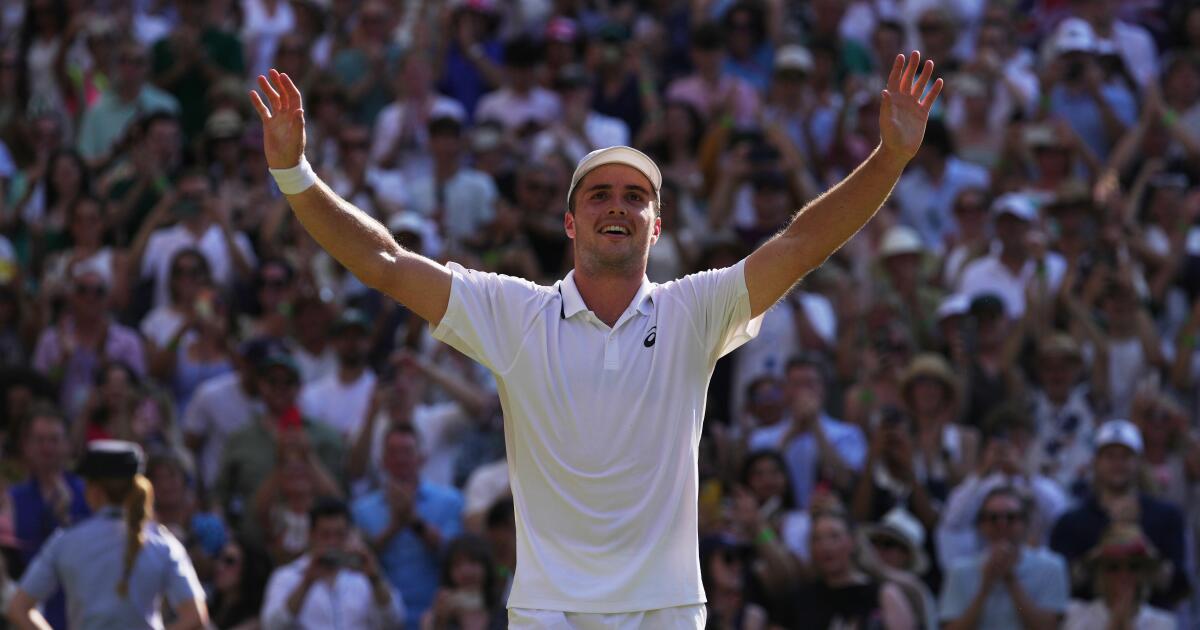
LONDON — A local boy sleeps in his own bed, plays in front of a king and queen and makes a Cinderella run to the Wimbledon semifinals. Sounds like a Hollywood script that might never see the silver screen.
But it’s no fairy tale — it’s Arthur Fery’s out-of-nowhere performance over the last 10 days.
Fery, a virtually unknown British wild card with a triple-digit ranking, has become the emotional heartbeat of Wimbledon while legitimately diverting some national attention from England’s World Cup quest.
The royal treatment at his matches across the All England Club has come in more ways than one.
Fery, who grew up five minutes from Wimbledon and is staying at home during the tournament, first played before grass-court king Roger Federer, Wimbledon’s eight-time singles champion, during Monday’s fourth-round victory. Two days later, he beat No. 9 seed and French Open runner-up Flavio Cobolli of Italy in the quarterfinals 6-4, 7-6 (4), 6-0 in front of Queen Camilla.
Ranked 114th, Fery had never reached the semifinals of an ATP Tour event, let alone a major, before his brief chat with the queen following the match.
“She just said, ‘Congratulations, keep going,’” 23-year-old Fery told reporters later. “I told her it was my birthday on Sunday, so it would be great to play the Wimbledon final on my birthday.”
That’s still a match away. To get there, Fery will have to get past one of the hottest players on tour: No. 2 seed Alexander Zverev, who is fresh off his first Grand Slam title at the French Open. Looming on the other side of the draw is a highly anticipated showdown between defending champion Jannik Sinner against 24-time major winner Novak Djokovic.
If Fery can continue his magical run to the end, he would become the first British wild card to win a Wimbledon title.
Arthur Fery reacts after defeating Flavio Cobolli in the Wimbledon quarterfinals on Wednesday.
(Maja Smiejkowska / Associated Press)
Born in France, Fery’s family moved to Wimbledon when he was an infant. His mother played professional tennis. He was a top British junior but chose to sharpen his game for three years in the U.S. collegiate system at Stanford, as many of his compatriots have done.
“I came out with a lot of hunger coming out of that, and I was ready to attack the pro circuit,” Fery said.
After struggling with bone bruising in his arm that limited him to playing mostly on the lower-tier Challenger circuit in recent years, Fery is finally healthy and playing consistently.
His path to the last four in London has been a masterclass in clutch come-from-behind performances. The Brit has stared down near-certain elimination in multiple matches, repeatedly breaking his opponents’ momentum with Houdini-like on-court acts.
At 5-foot-9, Fery possesses a skill set perfectly suited for low-bounding grass.
His compact strokes, low center of gravity, and elite movement allow him to hug the baseline, take time away from opponents, and confidently execute delicate volleys at the net, according to ESPN analyst Chris Eubanks.
“He defends well,” said Eubanks, a 2023 Wimbledon quarterfinalist. “He can scrap. He can claw. He can dig his way back into points. And when he ventures forward, he’s very, very comfortable at the net. This is a picture-perfect example of someone whose game is built for the surface.”
Still, it’s hard to fathom the multitude of milestones for Fery, who briefly reached the No. 1 ranking in college and earned 2023 Pac-12 Singles Player of the Year honors before leaving early to pursue a pro career.
He arrived at Wimbledon with just one main-draw victory at a major, a losing record as a professional, and only one previous ATP quarterfinal, at Queen’s Club last month. He’s now 11-8, won his first two five-set matches, and is the first British wild card to reach the Wimbledon men’s semifinals in the Open Era. The only other men’s wild-card semifinalist was Goran Ivanisevic, who won the title as a wild card in 2001.
Fery, who started the season ranked No. 185 and will climb to at least No. 36 after the tournament, said there were a “lot of first times” as he reflected on his unprecedented run. “First five-setter, longest match that I’ve ever played, first time breaking into the top 100, first second week in a slam, all at home, five minutes from where I grew up. It’s a great story for me,” he said.
The gap with his fellow semifinalists is understandably massive.
Entering Wimbledon, Djokovic, Sinner and Zverev’s combined records include 29 Grand Slam titles, 2,088 match wins and 155 tour-level titles. Fery was 6-8 in tour-level matches with zero titles.
But he has singlehandedly lifted the tournament for locals. With top hopes Jack Draper and Emma Raducanu withdrawing before the tournament and the rest of Britain’s singles prospects falling one by one — 18 men and women were eliminated by the third round — Fery became the nation’s last knight standing.
If his first name inevitably evokes Arthurian legend, Fery’s march through the draw gave Britain reason to believe again. No sword, no Round Table, just world-class shot-making, a lion’s heart and a Centre Court crowd thrilled to rally behind him.
“This is really quite something to see on home soil,” said Russell Fuller, the BBC’s tennis correspondent, who compared it with Raducanu’s stunning U.S. Open win in 2021 as a qualifier.
Fery earned every bit of it.
In the first round against Damir Dzumhur, Fery dropped the opening set and trailed by a break in the second before surging back. Against Zizou Bergs in the third round, he faced a 4-1 deficit with a double break in the fourth set, and again fell behind 4-1 in the fifth, before somehow surviving.
Then, stepping onto Centre Court for the first time against former top-10 stalwart Grigor Dimitrov of Bulgaria in the fourth round, Fery clawed out of a 2-sets-to-1 hole and a break down in the fourth set to clinch the victory in a fifth-set tiebreak.
“He carries himself with humility, but he’s a fierce competitor, and he’s got a ton of belief in himself,” said Stanford men’s coach and former top-60 player Paul Goldstein, who flew to England Tuesday to see his former charge compete against Cobolli.
While Fery attempts to outmaneuver Zverev on Friday, the other semifinal features a 2025 Wimbledon semifinal rematch between seven-time Wimbledon winner Djokovic and top-ranked Sinner, who defeated the Serb in straight sets on his way to the title. It’s also their second Grand Slam semifinal meeting in 2026. At January’s Australian Open on hard courts, Djokovic bested 24-year-old Sinner in five sets before falling to now-injured Carlos Alcaraz in the Melbourne final.

Arthur Fery hits a return during his Wimbledon quarterfinal win over Flavio Cobolli on Wednesday.
(Clive Brunskill / Getty Images)
Djokovic, 39, enters the match after surviving a grueling five-set, 5-hour-plus quarterfinal slugfest against No. 3 Félix Auger-Aliassime that concluded just minutes before Wimbledon’s 11 p.m. curfew. But the seventh-seeded Serb has a way of defying Father Time and he has had two days to recover on a surface where points are shorter and generally less taxing on the body.
Italy’s Sinner, who defeated Alcaraz in last year’s Wimbledon final, has been efficient if not at the level that saw him capture five consecutive titles before crashing out in the second round at the French Open. After a first-round scare here, the four-time Grand Slam champion has dominated opponents behind his improving serve, winning 80% of his first-serve points. He hasn’t dropped a set since the opening round. Sinner leads the head-to-head with Djokovic 6-5.
According to Eubanks, Djokovic must disrupt Sinner’s movement to break his rhythm, and take his chances.
“He’s got to play similar to how he played in Australia, where it was just all-out aggression,” Eubanks said.
For Sinner, he added: “His serve can be a neutralizing force for what Novak is going to try to do.”
On the other side of the ledger, Fery’s poise under pressure and deft use of the home crowd will be paramount to continue his surprise run against Germany’s Zverev, whom he called a “step up again” from his last five matches. Zverev, 29, is seeking his fifth major final and first at Wimbledon.
“I’m ready for it,” Fery said. “I have nothing to lose. I’m just going to go out there and … put my game on the court, do what I’ve done, believe in myself. We’ll see where that takes me.”
Home has never been closer to Centre Court. Nor has Arthur Fery ever been closer to tennis history.
Sports
Pirates star pitcher makes unfortunate history after being taken out in middle of perfect game bid

NEWYou can now listen to Fox News articles!
Jared Jones was flirting with Major League Baseball history on Wednesday night — he got it, but it was not what he originally envisioned.
The Pittsburgh Pirates pitcher retired the first 18 batters he faced, but he was taken out in the middle of his perfect game bid after six innings.
Now, the Pirates certainly have their reasons — the 24-year-old Jones hasn’t thrown more than 81 pitches in eight starts since returning May 20 after missing all of last season while undergoing ulnar collateral ligament internal brace surgery on May 21, 2025. He was yanked with 77 pitches and likely would have needed more than 100 pitches to record the 25th perfect game in MLB history.
Jared Jones of the Pittsburgh Pirates pitches during the first inning against the Atlanta Braves at PNC Park on July 8, 2026, in Pittsburgh, Pennsylvania. (Photo by Joe Sargent/Getty Images)
However, Jones left the game after getting zero run support, so when the Atlanta Braves tacked on three runs late for a 3-0 victory, Jones instead found himself in the wrong chapter of the history books.
According to Opta Stats, Jones became the first pitcher in the modern era (since 1920) to pitch at least six perfect innings and not record a win.
“It does suck. Something’s cool coming on, but I’m on what? My eighth start off of surgery? I completely understand it, and it is what it is,” Jones told reporters after the game.
Pittsburgh Pirates starting pitcher Jared Jones (17) makes his way to the field to warm up before pitching against the Atlanta Braves at PNC Park. (Charles LeClaire/Imagn Images)
JUSTIN VERLANDER ANNOUNCES HE WILL RETIRE AFTER THIS SEASON: ‘I’VE REALIZED THAT TIME HAS COME’
Jones said he didn’t entertain attempting to complete the perfect game.
“Not with the pitch count,” he said. “Not really ever expecting to go nine right now, so that was never in my head.”
Joey Bart, traded to the Braves from the Pirates on June 18, followed a double by Mike Yastrzemski with a 422-foot, two-run homer to left-center field off a slider from Dennis Santana. Drake Baldwin added an RBI single to center in the ninth for good measure.
It was the second time in less than a week that a pitcher was taken out of the game with a perfect bid through six innings — the Miami Marlins took Eury Perez out after seven innings in which he had 92 pitches. Perez, too, is in the midst of returning from injury and has surprisingly found himself right in the postseason mix.
He was pulled for Lake Bachar to start the eighth, and the Marlins allowed eight runs to the Athletics in the final two innings, but held on to win 9-8.
Jared Jones (17) of the Pittsburgh Pirates delivers a pitch during a MLB game against the Cincinnati Reds on June 27, 2026, at PNC Park in Pittsburgh, Pennsylvania. (Joe Robbins/Icon Sportswire via Getty Images)
CLICK HERE TO DOWNLOAD THE FOX NEWS APP
The Pirates are 4.0 games out of the final wild card spot, which is held by the Marlins.
The Associated Press contributed to this report.
Follow Fox News Digital’s sports coverage on X, and subscribe to the Fox News Sports Huddle newsletter.
-
Pennsylvania5 minutes ago
Man arrested over alleged antisemitic threats to Gov. Josh Shapiro | The Jerusalem Post
-

 Rhode Island7 minutes ago
Aquatic Weed Treatments Planned for 2 RI Ponds, 1 Lake
-

 South-Carolina13 minutes ago
South Carolina Lottery Pick 3, Pick 4 results for July 9, 2026
-

 South Dakota20 minutes ago
Iverson Ford Welcomes the 2027 Ford Expedition to Drivers Across Eastern South Dakota
-

 Tennessee23 minutes ago
Tennessee Highway Patrol holds open house at Jackson district office
-

 Texas35 minutes ago
Longhorns Daily News: Texas coach Steve Sarkisian named among Dodd Trophy watch list
-

 Utah37 minutes ago
Utah Jazz vs Washington Wizards recap: Darryn Peterson is only a man
-
Vermont43 minutes ago
VT Lottery Gimme 5, Pick 3 results for July 9, 2026


