Dallas, TX
How Dallas Baptist became college baseball's most unlikely perennial contender


Only five schools have reached the NCAA baseball tournament in each of the last 10 seasons. Four of those are expected names: Vanderbilt, Florida, LSU and Oklahoma State. They’re power conference schools with giant athletic departments and 11 baseball national championships between them.
But the fifth school on that streak is Dallas Baptist, a 4,200-student school that plays all of its other sports at the Division II level, the only D-I baseball school to do so.
With state-of-the-art facilities and a long list of MLB Draft picks — 73 in the last 16 years — Dallas Baptist has carried itself like a top-level college baseball program since it moved up to D-I in 2004. The Patriots haven’t had a losing season since 1978. Nobody involved with the program knows anything but winning. Their 44 wins this season are third-most in the country, including wins against Oklahoma and Arizona, the latter of which will host No. 2 seed DBU at a Regional in Tucson this weekend.
But how did this happen here, of all places? And as college sports continue to shift, with even more money funneled to the power conferences and sports like baseball discussing the potential to change their scholarship limits, can DBU continue to win?
“Everybody wishes they had a crystal ball,” said athletic director Matt Duce, who played baseball at DBU from 2015 to ’18. “The great thing about sports is that the field is level. When you get out there, I’d take the Patriots all day.”
Decatur Baptist College was Texas’ first junior college, founded in 1898. It moved to the outskirts of Dallas in 1965, renamed itself and soon became a four-year college. Five years later, it created a baseball program. The Patriots played at the NAIA level until moving up to Division I as an independent in 2004. When head coach Eric Newman left for the Nebraska pitching coach job in 2007, DBU promoted 29-year-old assistant Dan Heefner to the job, and he hasn’t left, 17 seasons later.
GO DEEPER
College baseball NCAA Regional predictions: Who advances to the College World Series?
In a state full of high-level college baseball programs, DBU has found a winning formula of player development. It’s not going to sign the best players away from Texas, Oklahoma or Texas A&M. But Texas is a big state with a lot of players. DBU’s recruiting classes often rank in the 30s nationally, but in some years it’s the 80s or 90s. It’s a cliché, but Heefner and his staff know how to spot talented players and coach ’em up. Last year’s team lost 11 players to pro baseball, including a school-record nine draft picks. The program didn’t miss a step. Every year, role players become stars.
“A lot of people are successful just on recruiting — get the best players you can and let them go,” Heefner said. “For us to compete, we’ve got to develop them. They come in at this (level) and we pour into them every day. By the time the season rolls around, they’re a different player.”
Heefner pointed out that baseball recruiting is a different challenge than football or basketball.
“It’s not like a guy’s in ninth or 10th grade and you know he’s a five-star,” he said. “We’ve had a number of guys who were not good enough to go anywhere, they go junior college, then we get them and they become All-Americans and make it to the big leagues.”
Nine players on the current DBU roster came from junior college. For as much damage as the transfer portal has done to mid-majors in football and basketball, it’s been a net positive for DBU thus far; this year’s roster features five other transfers from Division I schools.
Reliever Nick Wilson transferred in from Southern University for his final season and has become a key part of the bullpen. The Carrollton, Texas, native grew up going to DBU games but had two offers out of high school and started at a junior college.
“If you’re in the Dallas area and you’re highly recruited, you’ve got OU, A&M, the big football schools coming at you,” he said. “How does a little school like DBU put out seasons like this continually? It’s about the development.”
Investment has helped sustain the on-field success. Horner Ballpark opened in 2013. It added a turf field and a pitching lab in 2016. The school just built a pro locker room for alumni to come back and use, which they frequently do. The program’s most famous alumni include former All-Star Freddy Sanchez and World Series MVP Ben Zobrist.
“If I’m a high school kid that isn’t getting the the big major school offer I wanted to get but I want to play high college and professional baseball, I’m looking serious at DBU,” Zobrist said. “If I want to win and be developed, I’m going there.”
“They’ve invested in a way a lot of mid-major programs don’t,” said Baseball America writer Teddy Cahill.
The program does have an NIL collective, but DBU knows it can’t operate on the level of the SEC schools in the state. DBU rarely loses players to bigger schools, banking on its culture and development to keep the best players from going elsewhere.
“Ryan Johnson, our No. 1 starter last year, has a chance to be a first-round draft pick this year, he could’ve gone anywhere,” Heefner said. “He was an All-American and was on Team USA. But for him, (transferring) wasn’t even a question.”
Heefner has drawn interest from bigger programs, especially in Texas. But he has stayed each time because of the personal fit, both for baseball and his faith, the latter an outward and important part of the program. He always felt DBU could mold its program after Rice, another Texas private school that won the 2003 national championship and made five men’s College World Series appearances in the 2000s.
DBU hasn’t made it there yet. The program hasn’t reached Omaha, coming as close as seven outs away in 2021.
“There’s only one thing we haven’t done, and that’s gone to Omaha, and we really feel like we can,” Heefner said. “It’s a fun thing when you’re a part of building something from the beginning. You want to keep going and see how far you can take it.”
Everyone around DBU hopes that continues, but they’re still adjusting to college sports’ recent landscape changes. The Patriots joined Conference USA from the Missouri Valley Conference last year for a step up in competition and a simpler travel schedule. They earned CUSA’s automatic bid as conference champion, but they would’ve made the field as an at-large anyway.
The recent settlement in House v. NCAA could lead to the elimination of scholarship limits or the creation of roster caps, which would have a dramatic impact on a sport like baseball. DBU has thrived in a college baseball environment in which every program is allotted 11.7 scholarships. What happens if that limit increases to 20 or 25?
“We constantly have our eye on the horizon,” Heefner said. “What’s happening? How are we going to fit into that? What do we need to do to make it work for us?”
For now, DBU heads into the Tucson Regional looking to emerge from a field that includes Arizona, West Virginia and Grand Canyon. Reaching this level of the NCAA Tournament has become the baseline standard of success. Whatever the future holds, DBU plans to be there.
“It’s incredibly fun,” Zobrist said. “Every year, you’re wondering if this is going to be the year. They don’t have off years. It’s been so long that they’ve had a chance. Everybody’s super proud of what Dan’s created there. Look at the track record of guys going pro. They really develop players.”
“We’re at the point where it’s not like they’re a mid-major program,” Cahill said. “It’s more like, of course they’re good.”
(Photo: Nathan J. Fish / The Oklahoman / USA Today)



Egypt takes on the Socceroos on Friday, July 3. See ticket prices for Dallas
Editor’s note: See all updated scenarios for the 2026 World Cup tournament bracket
The most volatile group has come to a close at the 2026 World Cup.
Egypt and Iran played to a 1-1 draw late on Friday night, which allowed Belgium to rise up from third place all the way to the top spot in the group while Egypt took second. Iran will have to wait and see if their third place finish is good enough to qualify for the knockout round.
As the Group G runner up, Egypt will take on Australia in the round of 32.
SHOP: Egypt vs. Australia 2026 World Cup tickets
Australia finished as the second-place team in Group D, sitting on four points. Egypt and Australia will face off in Dallas on Friday, July 3, the final match of the round of 32.
Here is everything you need to know in order to buy Egypt vs. Australia World Cup tickets.
Shop Egypt vs. Australia tickets
Egypt vs. Australia round of 32 World Cup tickets
As of publication, the cheapest ticket to attend the Egypt vs. Australia costs $834. Lower-level seats for the round of 32 match at AT&T Stadium in Dallas start at $1,083.
Egypt World Cup next opponent
Egypt will take on Australia in the round of 32. Australia finished as the runner up in Group D, finishing the group stage with one win, one draw and one loss.
Shop Egypt vs. Australia tickets
Egypt World Cup schedule
- June 15 – Egypt vs. Belgium at Lumen Field in Seattle – DRAW 1-1
- June 21 – Egypt vs. New Zealand at BC Place Stadium in Vancouver – WIN 3-1
- June 26 – Egypt vs. Iran at Lumen Field in Seattle – DRAW 1-1
- Friday, July 3 – Australia vs. Group G runner up at AT&T Stadium in Dallas (round of 32) – Shop tickets
World Cup Group G Standings
| TEAM | POINTS | RECORD |
| Belgium | 5 | 1-2-0 |
| Egypt | 5 | 1-2-0 |
| Iran | 3 | 0-3-0 |
| New Zealand | 1 | 0-1-2 |
Shop Egypt vs. Australia World Cup tickets
Australia World Cup schedule
- Australia vs. Turkey – WIN 2-0
- Australia vs. United States – LOSS 2-0
- Australia vs. Paraguay – DRAW 1-1
- Friday, July 3 – Australia vs. Group G runner up at AT&T Stadium in Dallas (round of 32) – Shop tickets
World Cup Group D Standings
Shop Egypt vs. Australia tickets

Restaurants across Dallas-Fort Worth are doubling down on their patriotism for the Fourth of July and America’s 250th birthday, firing up limited-time deals and celebratory menus that range from elevated, reservation-only experiences and skyline dinners to casual fast-food specials, family meal packs, and grab-and-go treats designed for star-spangled celebrations. Special props to those that have found a way to work in “1776” and “250.”
Here are the DFW spots offering patriotic specials and deals. (Note: This list will grow as more are announced closer to the holiday.) For a list of top 4th of July events and fireworks, go here.
Black Sheep Coffee is celebrating America’s birthday over Fourth of July weekend with $4 matcha drinks from July 3-5. The special is good for small Iced Vanilla Matcha, Iced Blueberry Matcha, and Iced Strawberry & Cream Matcha drinks, with a $1 upgrade to a 16-ounce medium. The offer is available in-store and through the app at all four DFW locations.
Cantina Laredo is bringing back its patriotic USA ‘Rita for the Fourth of July weekend. Available July 3-5 at the Addison and Frisco locations, the festive frozen cocktail puts a red, white, and blue spin on the restaurant’s signature Casa ‘Rita with layers of Blue Curaçao and strawberry purée.
USA ‘Rita at Cantina LaredoPhoto courtesy of Cantina Laredo
El Chico is spicing up Independence Day weekend with Family Meal Packs available July 4-5 at its Rockwall location only (503 Interstate 30, Rockwall). Options include Family Fajitas ($73.99) with chicken, steak, or both; Family Tacos ($47.99) with 12 tacos and sides of rice and refried beans; and Family Enchiladas ($49.99) with a choice of beef, cheese, spinach, or chicken enchiladas, all serving six to eight people.
Ford’s Garage, the Plano burger and craft beer restaurant inspired by the heritage of the Ford Motor Company, is celebrating America’s 250th with a patriotic meal deal available July 1-4: an American Standard Burger, fries, and select draft beers or a soft drink for for $17.76, in tribute to the nation’s founding in 1776.
HTeaO tea shops are celebrating the Fourth of July with a pair of patriotic summer specials. Through Labor Day, the tea chain is serving a limited-time Blue Razzler Energy Refresher topped with vanilla cold foam and red, white, and blue sprinkles in a commemorative America’s 250th cup. From July 1-4, participating locations will also offer three gallons of freshly brewed tea for $17.76, a nod to the year the United States declared its independence.
JD’s Chippery is celebrating Independence Day with festive Fireworks Cookie Cakes, available in a variety of sizes and cookie flavors with hand-decorated patriotic designs. The bakery’s Preston Royal location is also hosting a daily Cookie Happy Hour through July 31 from 5-7 pm, featuring a buy-one, get-one-free cookie deal.
JW Steakhouse at the JW Marriott Dallas is marking Independence Day with a four-course dinner for two on July 4. Priced at $195 per couple, the menu includes buffalo bison cigars and shrimp ceviche tostadas, a toasted farro salad with Fredericksburg peaches, a pepper-crusted tomahawk steak with charred cipollini onions and black garlic truffle purée, and chipotle chocolate cake with Garrison Brothers bourbon cherry sauce. Optional wine pairings are available for an additional charge.
Kessaku will offer a Fourth of July experience with limited window seating atop The National in downtown Dallas. Guests can reserve exclusive window tables with a $250 deposit, securing panoramic skyline and fireworks views from one of Dallas’ highest dining destinations.
Luckys Diner on Oak Lawn Avenue is celebrating Independence Day with a Stars, Strips & Sausage special available July 1-4. The $10.49 meal includes a grilled sausage plate with potato salad and pinto beans, with the option to add a slice of apple pie.
Monarch is marking Independence Day with Stars, Stripes & Skyline, a Fourth of July celebration atop The National on July 4. The experience features a prix-fixe dinner priced at $150 per person (with a $55 children’s menu), served from 5:30-10 pm, along with optional window seating for fireworks views. The menu will include dishes such as wagyu filet, wood-grilled branzino, hamachi crudo, hearth-grilled lamb ribs, and a shared s’mores dessert. Monarch is also offering a limited-time gift card promotion over the July 4 weekend: purchase a $250 gift card and receive a $50 bonus card for a future visit, available July 4-5.
Nothing Bundt Cakes is celebrating America’s 250th birthday with a lineup of festive cakes and patriotic-themed desserts. Seasonal offerings include a patriotic decorated cake, Fireworks and Freedom Bundtini toppers, and the return of S’mores Made With Hershey’s through July 19, featuring chocolate cake with milk chocolate chips, marshmallows, and graham streusel. From July 3-5, Bundtastic Rewards members can earn 250 bonus points on any purchase as part of the holiday promotion.
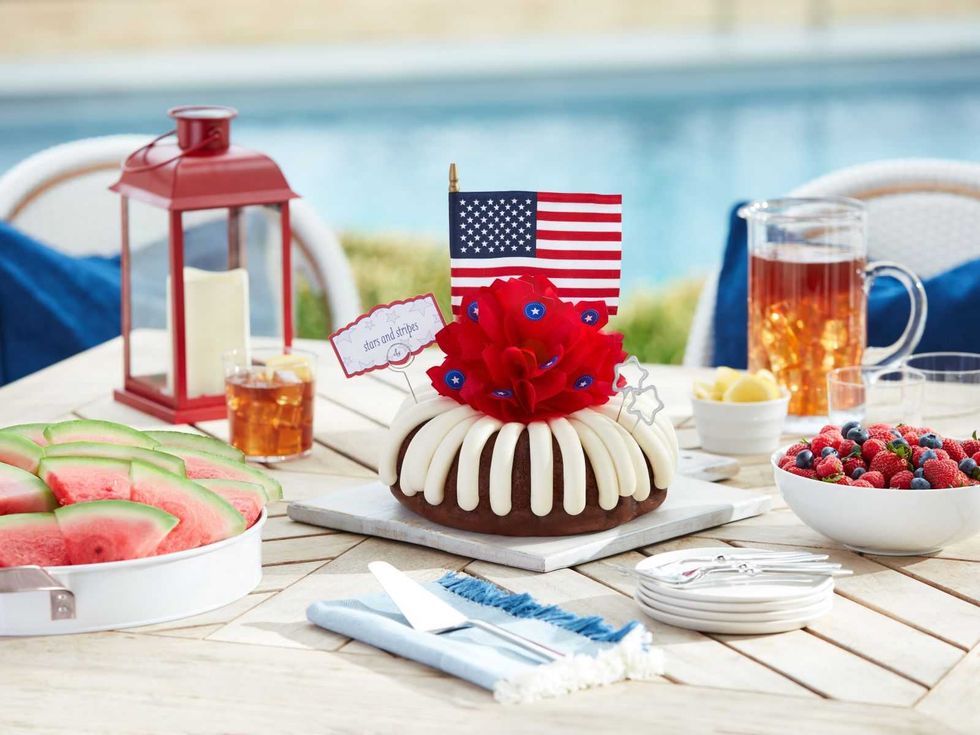 Nothing Bundt Cakes are getting patriotic for the 4th.Photo courtesy of Nothing Bundt Cakes
Sonic is celebrating America’s 250th with a limited-time America $2.50 Menu available through July 12. Participating locations are offering fan favorites for $2.50 each, including the returning Red, White & Blue Slush Float, Jr. Double Cheeseburger, All-American Hot Dog, and medium onion rings. The chain is also serving drinks in limited-edition commemorative cups.
The Statler in downtown Dallasis celebrating Independence Day and America’s 250th birthday on July 4 with all-day dining, drink specials, and rooftop festivities across its venues, including Overeasy, Scout, and Waterproof. Overeasy is offering breakfast specials like BBQ Brisket Benedict, Red, White & Blue Pancakes, and Firecracker Omelets from 7 am-2 pm. Later in the day, Scout and Waterproof will serve classic American fare such as burgers, ribs, and smoked sausage alongside themed cocktails like Uncle Sam’s Punch, Star Spangled Spritz, and The Patriot. The celebration culminates at Waterproof with a rooftop pool and fireworks watch party from 7 pm-1 am, featuring a $35 cover charge, live entertainment, and patriotic frozen treats and cocktails.

Editor’s note: See World Cup standings and scenarios updated in real time
The Socceroos live on at the 2026 World Cup.
Australia and Paraguay played to a 0-0 draw on Thursday night, which was good enough for Australia to secure second place in Group D and advance to the knockout stage of the tournament. Paraguay is likely to advance as a high-ranking third place team, but nothing is confirmed at the moment.
SHOP: Australia round of 32 World Cup tickets
Australia will head to Dallas where they will play their first elimination match on Friday, July 3 against the second-place team from Group G.
While we don’t yet know Australia’s opponent, we know the location, date and time of the match, which means tickets are already available. Here is everything you need to know in order to buy Australia World Cup tickets in Dallas.
Shop Australia Round of 32 tickets
Australia round of 32 World Cup tickets
As of publication, the cheapest round of 32 ticket to see Australia in Dallas on Friday, July 3 is $937. Any ticket for less than $1,000 at this point in the tournament is a steal considering most other prices.
Australia Round of 32 opponent
As the runner-up of Group D, Australia will take on the second-place finisher from Group G. Australia’s opponent will be finalized on Friday, but given the current standings it could be any of the following four teams:
- Egypt
- Iran
- Belgium
- New Zealand
Shop Australia Round of 32 tickets
Australia World Cup schedule
- Australia vs. Turkey – WIN 2-0
- Australia vs. United States – LOSS 2-0
- Australia vs. Paraguay – DRAW 1-1
- Friday, July 3 – Australia vs. Group G runner up at AT&T Stadium in Dallas (round of 32) – Shop tickets
World Cup Group D Standings
Shop Australia World Cup tickets
-
World11 minutes ago
Cape Verde’s dream run continues, becoming smallest country into World Cup knockout round
-
 Lifestyle49 minutes ago
Amateurs now conduct most weddings. Here is some basic advice
-

 Technology58 minutes ago
It’s the last day of Prime Day — here are over 140 great deals to choose from
-

 World1 hour ago
Rubio announces framework deal between Israel and Lebanon as experts warn Iran will fight to sabotage it
-

 Politics1 hour ago
Lawyer who beat Hawaii gun law calls state’s reliance on Black Code ‘disgraceful’
-

 Sports1 hour ago
2026 World Cup Group Scenarios: What Remaining Teams Need To Advance To Round of 32
-

 Technology1 hour ago
Ohio robot cop retires after zero arrests
-
 Business1 hour ago
Commentary: Puncturing the myth of Alan Greenspan, whose policies gave us the Great Recession


