Southwest
New Mexico's first step toward reuse of fracking water met with public concern

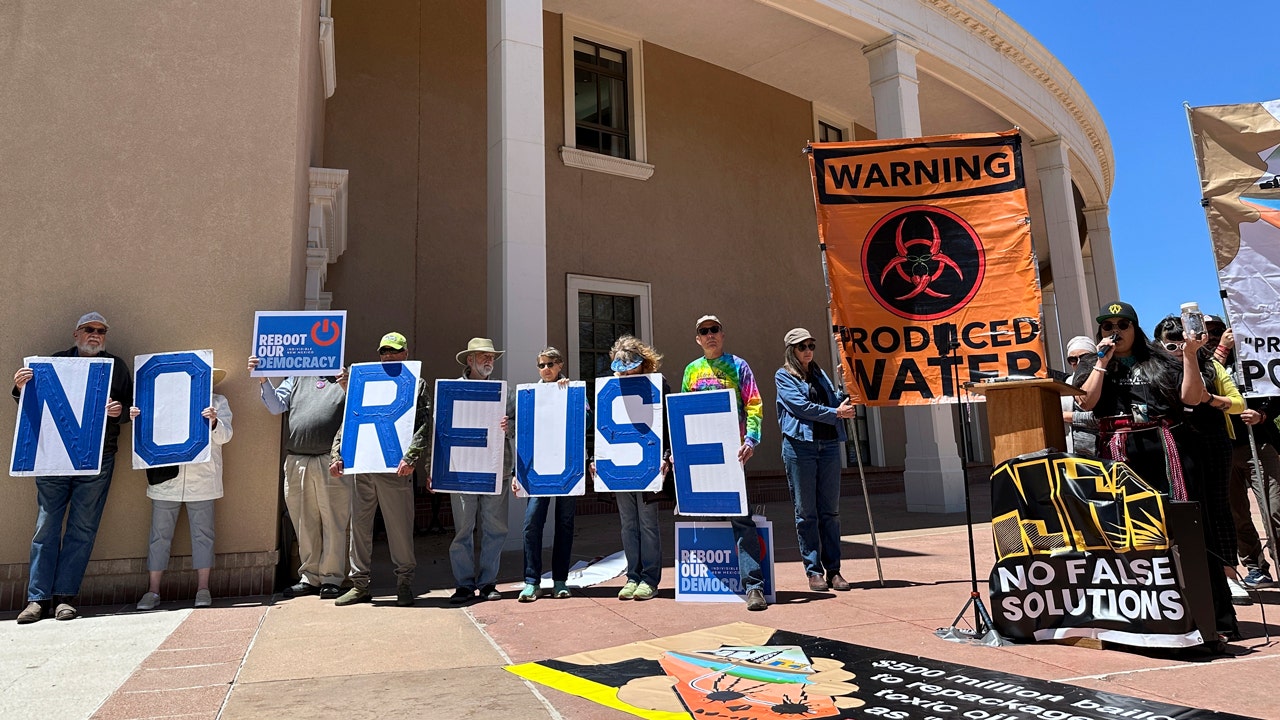
Environmental officials in New Mexico took initial steps Monday toward regulating the treatment and reuse of oil industry fracking water as the state grapples with scarce water supplies and fossil fuel producers confront shrinking opportunities for wastewater disposal.
A state water quality commission opened a weeklong series of hearings as the nation’s No. 2 state for petroleum production begins to build out a series of rules that initially prohibit the release after treatment of so-called produced water from oil and gas production while still opening the way for pilot projects.
“The rule is prohibitive when it comes to any type of release of any type of produced water, whether treated or untreated,” said Andrew Knight, assistant general counsel to the state Environment Department, in opening statements. “At this point, we couldn’t even tell you what testing would be needed to determine that a certain treatment technology or combination of technologies would be protective.”
BIDEN ADMIN ENACTS FIRST-EVER PFAS ‘FOREVER CHEMICAL’ LIMITS ON DRINKING WATER
He said the agency’s initial rule would be “as protective as possible while still allowing the science to advance through pilot and then demonstration projects.”
The proposal is generating public protests that give voice to fears of undisclosed contaminants used in the oil- and gas-drilling process. At the same time, oil producers and at least one water service provider say the regulations don’t provide specific water quality standards that might help effective treatment projects move forward.
The Environment Department “apparently wants a regulation to be able to deny a permit based on the source of the water, not its quality,” said Liz Newlin Taylor, an attorney for Select Water Solutions, a Houston-based water-management company for energy producers with operations in Carlsbad. “New Mexico certainly needs additional sources of water, and treated produced water could be part of this solution. These proposed regulations, however, failed.”
Protesters gather outside the New Mexico Statehouse to denounce a proposed rule for the treatment and recycling of oil-industry fracking water on May 6, 2024, in Santa Fe, New Mexico. (AP Photos/Morgan Lee)
Several environmental groups are urging the Environment Department to strike definitions that refer to the reuse of treated water in agriculture, recreational fields, rangeland and potable water.
“The public, understandably, is concerned that the rule allows land application of produced water, and that produced water will infiltrate and pollute groundwater,” said Tannis Fox, an attorney representing environmental groups Amigos Bravos and The Sierra Club. “This is not what the rule says, but it is what members of the public are concerned about.”
New Mexico Gov. Michelle Lujan Grisham has pitched plans for the state to underwrite a strategic new source of water by buying and selling treated water that originates from the used, salty byproducts of oil and natural gas drilling. Related legislation stalled at the Legislature in February without a House or Senate floor vote, but the governor has said she’ll persist.
Several dozen protesters gathered last week outside the state Capitol to condemn the oil wastewater rule. They included the lead plaintiff in a lawsuit alleging the state has failed to meet constitutional provisions for protecting against oil and gas pollution.
Another protester, Reyes DeVore, of Jemez Pueblo and the Native American environmental rights group Pueblo Action Alliance, said, “We collectively stand in opposition to the reuse of toxic oil and gas wastewater outside of the oil field.”
“The strategic water supply that the Gov. Grisham announced, it’s not a real solution,” she said.
Expert testimony submitted by the New Mexico Oil and Gas Association paints a dire portrait of competition in New Mexico for water resources among cities, farms, industry and wildlife — even as oil-industry water demands grow for fracking.
“Over the next 50 years, New Mexico will have approximately 25% less water available in rivers and aquifers,” said John D’Antonio, who previously served as New Mexico’s top water regulator — the state engineer. “It impacts everything from municipal planning to population growth to economic activity.”
Other expert testimony from the association notes that oil companies have more and more produced water to dispose of as they increase drilling activity — with decreasing capacity for disposal because of concerns including earthquakes linked to high-pressure injection wells. The industry generates four or five barrels of wastewater for every barrel of oil produced, said Robert Balch of the Petroleum Research Recovery Center at New Mexico Tech in Socorro.
Read the full article from Here


The star-studded feel-good giveback event of the summer has returned. KTLA 5 is teaming up once again with Project Angel Food for the annual “Lead with Love: Going the Distance” telethon to raise critical funds for medically tailored meals delivered to people living with serious illnesses throughout Los Angeles County. The seventh annual telethon airs […]

A woman was hospitalized with serious injuries after she was violently attacked by a robber in downtown Long Beach. On June 18, Jennifer Silva, 34, was attending a World Cup watch party at a Hooters restaurant at 90 Aquarium Way. After the game ended, she left the restaurant just before 11 p.m. As she walked […]

Jurors deliberating the fate of the man accused of starting the Palisades Fire, one of the most destructive wildfires in California’s history, failed to reach a verdict Thursday afternoon, telling the judge they were deadlocked.
A spokesperson from the United States Attorney’s Office told KTLA that jurors will continue to deliberate until they reach a verdict or give up.
Jonathan Rinderknecht, 30, a former Uber driver and one-time Pacific Palisades resident, is accused of starting the Lachman Fire on New Year’s Eve. The fire continued to smolder underground for about a week, even after Los Angeles firefighters believed it had been extinguished.
Flames reignited on Jan. 7, erupting into the deadly Palisades Fire that killed 12 people and destroyed thousands of homes in the upscale community, authorities said.
-

A courtroom sketch of Jonathan Rinderknecht, 29, during his initial court appearance on Oct. 23, 2025. (Bill Robles) -
The U.S. Dept. of Justice booking photo of Jonathan Rinderknecht over the Palisades Fire devastation in Malibu, California in January 2025 (AP).


Prosecutors argued that Rinderknecht deliberately set the fire, claiming he had grown increasingly resentful of wealthy residents and viewed Pacific Palisades as a symbol of that frustration.
“Their case, though circumstantial, is strong,” KTLA legal analyst Alison Triessl said. “The defense is relying on, can they (prosecutors) show beyond a reasonable doubt that Mr. Rinderknecht actually started this fire and it wasn’t the result of fireworks or some intervening cause.”
The defense argued there is no direct physical evidence tying Rinderknecht to the fire and said the prosecution’s case relies entirely on circumstantial evidence. Rinderknecht did not testify during the trial.
Defense attorney Steve Haney spoke outside the courthouse Wednesday about why he believes it will be difficult for prosecutors to prove how the fire started.
“The lack of scene preservation. The fact that they got there after a lot of the evidence was missing. Not a lot of direct evidence. This is a circumstantial case, which is always difficult as a prosecutor to prove,” Haney said.
Rinderknecht, who was arrested and indicted last October, faces up to 45 years in prison if found guilty of three arson counts, including destruction of property by means of fire, arson affecting property used in interstate commerce and timber set afire.
Tony Kurzweil contributed to this report
-

 Milwaukee, WI3 minutes ago
Brewers score: Mitchell, Contreras power Crew past Cubs
-

 Atlanta, GA10 minutes ago
How to watch San Francisco Giants vs. Atlanta Braves
-

 Minneapolis, MN13 minutes ago
Man, 19, hospitalized after shooting in north Minneapolis; no arrests
-

 Indianapolis, IN25 minutes ago
Man’s body found in White River in downtown Indianapolis
-

 Pittsburg, PA28 minutes ago
South Side Street Fest adds more metal detectors and ID scanner to speed up lines
-

 Augusta, GA33 minutes ago
Augusta Pride celebration moves to fairgrounds amid Broad Street construction
-

 Washington, D.C40 minutes ago
States show their stuff: The Great American State Fair opens in D.C.
-

 Cleveland, OH43 minutes ago
Colt Emerson Leads Mariners Past Guardians In Return to Ohio – WHIZ – Fox 5 / Marquee Broadcasting

