Lifestyle
Sage Against the Machine is how L.A.'s native plant nerds release their rage


In a cavernous convention hall in Northern California, at the end of a long, loooong day of important, yes, but eventually mind-numbing presentations about native plants, nearly 200 scientists, botanists and students had had enough. It was pushing 9 p.m. and everyone, exhausted from paying attention, was edging toward the doors and the beckoning bars. That’s when six native-plant nerds took the stage, plugged in their musical instruments and sonically set the room on fire.
L.A.-based band Sage Against the Machine played with a driving, unexpected intensity and enough volume to make your chest hurt in a hard-to-pinpoint style. Was it punk? Rap-metal? Early Doors? Frontman Antonio Sanchez stepped to the microphone in his signature below-the-knee baggy shorts over leggings and monarch-butterfly-wing earring, his head bald save for a slicked-back streak of silver-black hair, and began shouting out lyrics in a blend of caressing wail and shriek.
Crouching and crooning is just one of frontman Antonio Sanchez’s styles, here with lead guitarist Rico Ramirez at one of Sage Against the Machines’ many nursery gigs.
(Michelle Fieler)
Suddenly a rather subdued group of serious academics and researchers at the California Native Plant Society’s 2022 convention in San José turned into a mosh pit of bouncing, frenzied fans, screaming lyrics back at the band and dancing the way people dance when they don’t know any steps but they have to move because they’re too joyously possessed to stand still.
It wasn’t just the throbbing music that hooked them. It was the sly, salty lyrics, full of in-jokes and puns and references only fellow native-plant nerds would understand.
The other day I was watering my lawn
The government told me I was wrong.
They said, “You’re gonna have to turn your irrigation off.”
Sanchez crooned the slow opening to one of the band’s most crowd-pleasing songs, “Kill Your Lawn,” speeding his delivery to squeeze the increasingly complicated lyrics into the meter:
They told me to kill, kill my lawn
But those native plants are such a yawn.
Besides, what am I gonna tell my landscaper, I forgot his name, I think it’s Jose … or, no, no it’s Juan.
What do I tell my landscape designer, I remember his name … his name is Ron,
and what about my landscape architect, he tucks his shirt in, his name is Sean …
Then the music went berserk, and Sanchez and his bandmates were screaming, “I gotta kill my lawn, gotta kill my lawn …” Everyone in the room joined in, jumping and screeching with the chorus: “Kill your lawn!”

Sage Against the Machine members Nicole Calhoun, left, on bass, Rico Ramirez on lead guitar, Hector Cervantes on drums, Jason Suddith on rhythm guitar and Evan Meyer on keyboards are arrayed behind frontman Antonio Sanchez during a performance at the Central Library’s Mark Taper Auditorium in October 2023.
(Gina Ferazzi / Los Angeles Times)
The gig was cathartic for the audience and a giant high for the band. “After listening [to presentations] all day, it was sweet release,” said drummer Hector Cervantes during a recent interview. “I know it sounds stupid, but that was our Super Bowl, the Super Bowl of plants. And I hope they’ll invite us back for the next convention.” (The convention isn’t scheduled until early 2026, said California Native Plant Society communications director Liv O’Keeffe, “but we definitely want them back.”)
Undoubtedly the band will be there anyway, because the six members of Sage Against the Machine, all huge fans of the ’90s hip-hop, punk, metal, funk and rock band Rage Against the Machine, spend their days working with plants, primarily native plants at some of the most prominent organizations in Southern California.
Sanchez, a former Marine who started the now-defunct Nopalito Native Plant Nursery in Ventura, runs the Santa Monica Mountains Fund Native Plant Nursery in Newbury Park. He founded the band in 2013 with Evan Meyer, executive director of the Theodore Payne Foundation, when the two of them worked for the state’s largest botanic garden devoted to California native plants, Rancho Santa Ana Botanic Garden in Claremont, now known as California Botanic Garden.
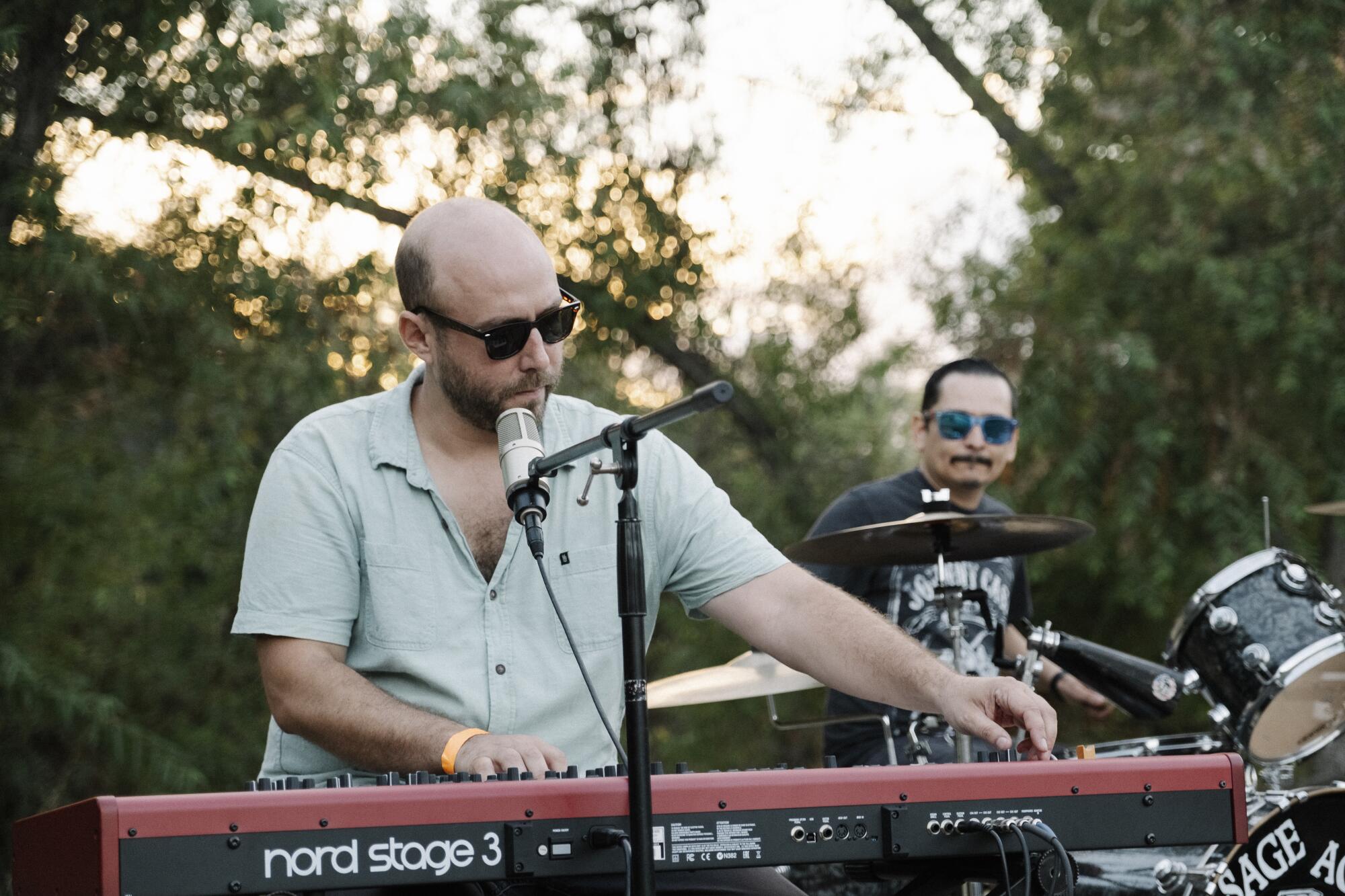
Keyboard player Evan Meyer, co-founder of Sage Against the Machine, with drummer Hector Cervantes during a performance at Rio de Los Angeles State Park in October 2023.
(Rio Asch Phoenix)
Meyer said their first gig was unplanned and totally improvised. He was playing background piano at a garden party when Sanchez came over, sat down beside him and began making up some lyrics. “We were friends. We started freestyling, and people thought it was funny,” Meyer said. “And that’s how it all started. Our first performance was in front of an audience, speaking to people who love plants. It was always meant to be music for our community of plant people.”
Sanchez said they started playing during informal Friday night sessions at the garden “over $1 beers and tacos.” Rico Ramirez, a certified botanist and arborist working for Caltrans, was an intern at the garden then and added his driving lead guitar to the mix. Ramirez’s family is Indigenous Gabrielino Shoshone — his late grandmother, Ya’anna Vera Rocha, was chief of the Gabrielino Shoshone Tribal Nation — and he feels a deep connection to California native plants, especially white sage (Salvia apiana), “our most spiritual plant.” Music has been a priority since he was a child, he said. He’s classically trained in guitar, but his style now is more blues and metal.

Lead guitarist Rico Ramirez. (Kyle Karbowski)
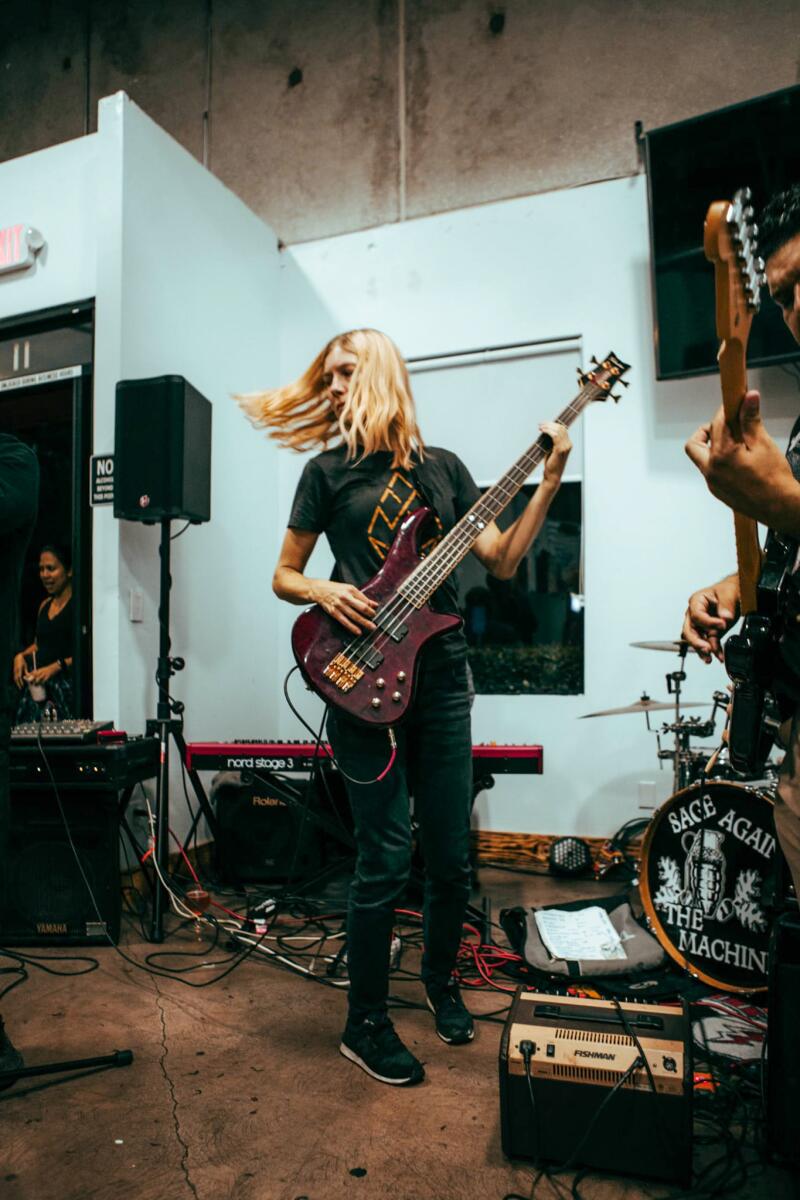
Bass player Nicole Calhoun. (Kyle Karbowski)
“We’re all very serious musicians who, behind the scenes, are entangled in botany and restoration,” Ramirez said. “That’s kind of our passion. We’re playing music to express our passion.”
Eventually all three left the garden but kept playing together sporadically. Sanchez, who was still growing plants on his own, showed up selling plants at Artemisia Native Plant Nursery in El Sereno, which opened in 2018. The owner, Nicole Calhoun, held community events at the nursery “just to let people know we existed.” Sanchez said he had a band, and in April 2019, Calhoun invited the group to perform.
Cervantes, a self-taught drummer and horticulturist working as an agriculture inspector for the Los Angeles County agriculture commissioner, was then working in the native plant section of Descanso Gardens. A colleague invited him to attend the show, and he was intrigued when he heard the band’s name “because I grew up idolizing Rage Against the Machine. Their music had angst, but it was angst toward Mother Earth, a voice for Mother Earth, and right up my alley.”
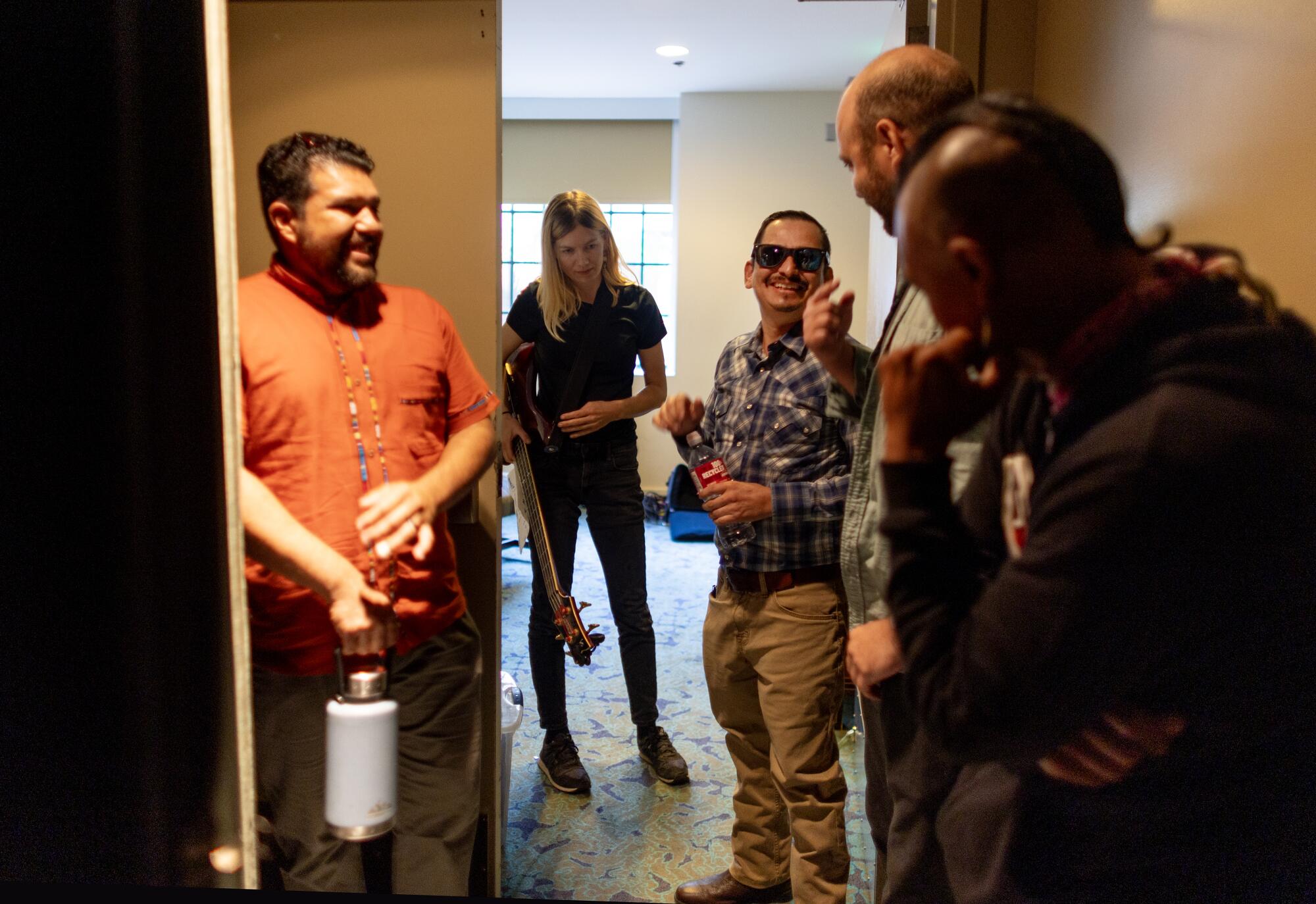
Backstage at the Mark Taper Auditorium, Sage Against the Machine bandmates Rico Ramirez, left, Nicole Calhoun, Hector Cervantes, Evan Meyer and Antonio Sanchez joke around before they go onstage in October 2023.
(Gina Ferazzi / Los Angeles Times)
That night was a big turning point. “Hector went up to them after the show and said, ‘You guys need a drummer. Can I join your band?’ And I said, ‘I want to join too,’” said Calhoun, who studied cello in college, “got tapped out with the classical scene” and eventually started playing electric bass for “fun, punk school garage bands.”
About a year later, Sanchez brought an intern at his nursery to practice, Jason Suddith, to play rhythm guitar. And just like that, Sage Against the Machine had six members and a camaraderie that went beyond the music.
“We get on really well, musically and not musically,” said Suddith, who is now the manager of the Arroyo Seco Foundation’s Hahamongna Native Plant Nursery. “People tell us, ‘Oh, you guys sound really good for practicing so infrequently,’ but it comes from a love for each other. We do tend to spend holidays together, with all our families. Even the band wives have their own separate group chat. It’s more than a silly band to us. We’re friends who consider each other like family.”
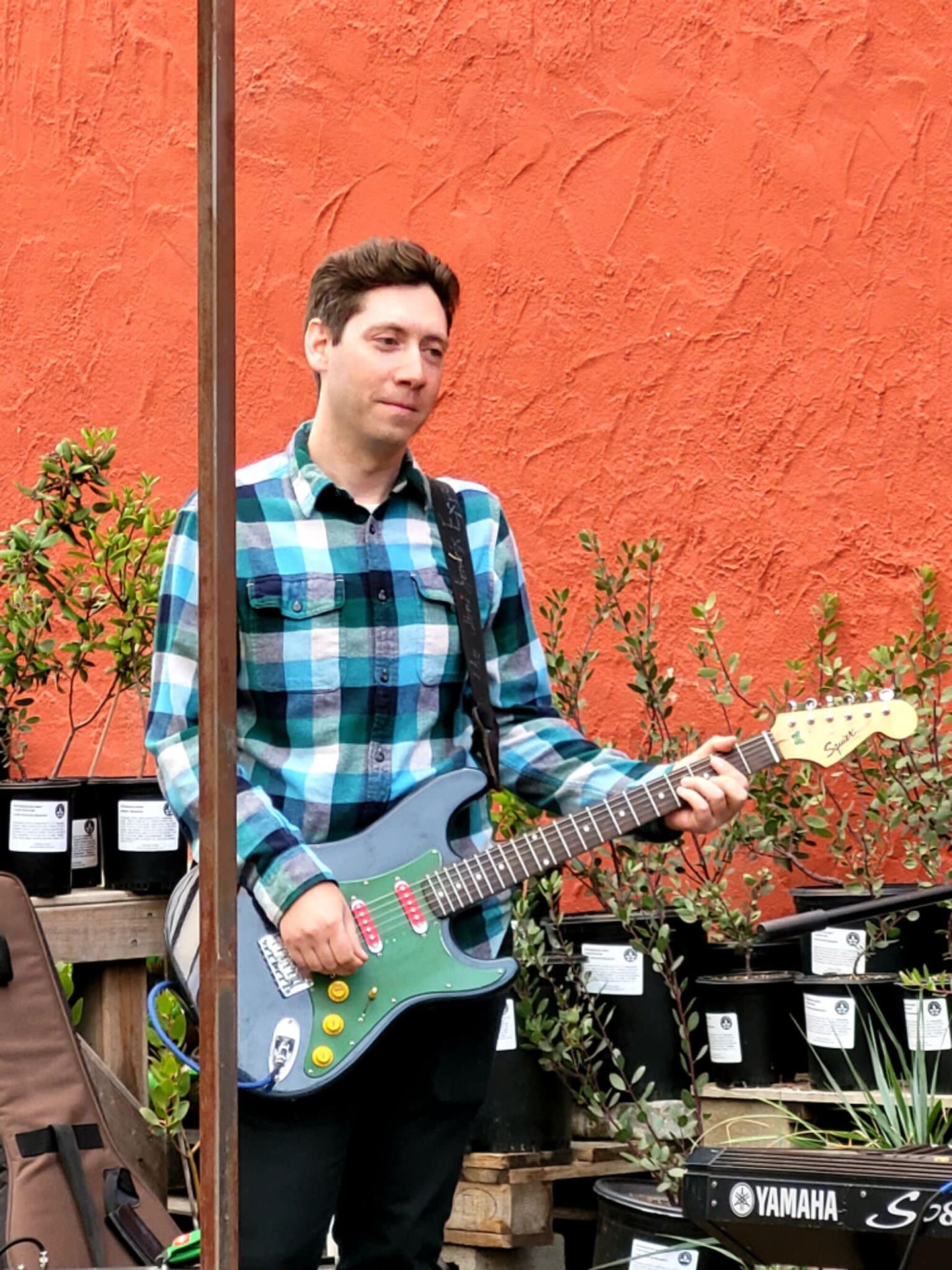
Rhythm guitarist Jason Suddith at a nursery gig with Sage Against the Machine.
(Michelle Fieler)
But it’s also a way for the group to do a little proselytizing about native plants “and blow off steam too, because we care about the natural world, and it’s being destroyed all the time,” said Calhoun. “We’re trying to rebuild some of those relationships and we give each other strength. It’s important to everyone’s mental and spiritual health. We do a lot of s— talking too, and it feels great to have that release.”
Finding times to practice is challenging. After all, these aren’t teenagers playing in a garage band after school. The band members are in their mid-30s to mid-40s and working full-time jobs. They’re all married or in committed relationships and most have children. Calhoun, whose daughter is 2, is trying to finish a graduate degree in landscape architecture, “so I can take my business a little further.”
Still, they’re all committed to performing, and will release their new album on Spotify later this month. Just don’t look for Sage Against the Machine at traditional rager venues. The band is most likely to perform at nurseries and family-friendly plant festivals, such as their upcoming gigs on April 13 at the Puente Latino Assn. Earth Day celebration at DeForest Park in Long Beach, April 21 at the Earth Day Celebration, plant swap and market in Thousand Oaks and May 25 at the Museum of Art and History in Lancaster. (Check out their Instagram page @nativesageagainstthemachine for exact times.)
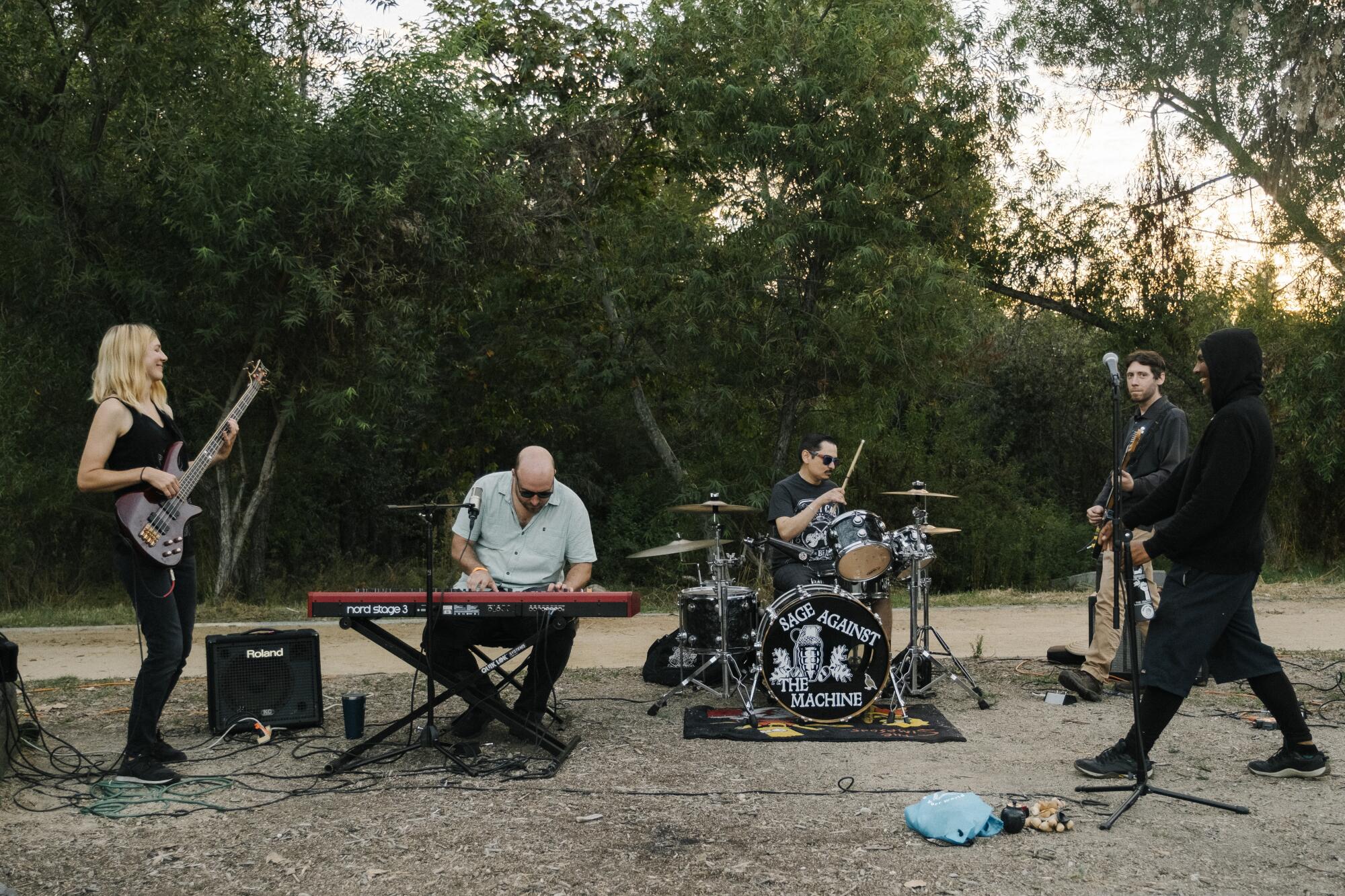
Nicole Calhoun, left, Evan Meyer, Hector Cervantes, Jason Suddith and Antonio Sanchez are five of the six native-plant nerds who make up the L.A. punk-rock band Sage Against the Machine.
(Rio Asch Phoenix)
People who attend the band’s performances get to hear lyrics that are often playful, as in the bouncy polka “Munching Milkweed,” about a monarch’s metamorphosis from caterpillar to butterfly, and sometimes playfully suggestive, as in “California Poppy Chulo,” a play on the Spanish phrase “papi chulo,” which translates to “a hot guy.” Ostensibly, it’s a song about bees looking for flowers to pollinate, but the opening lines make it clear that this is more than a nature documentary:
He’s a California poppy chulo,
Every pollinator that you know
wants to get a little piece of that c—
“The c—” is a vulgar Spanish word for buttocks commonly used in popular reggaeton music. “But it would never appear in print in La Opinión [L.A.’s Spanish-language newspaper],” Sanchez said laughing. “But you know, those guys are having sex with plants; you almost want to put a partition up because the bees are enjoying it so much. It’s like, ‘You’ve got to calm down! Do you not know I’m looking at you right now?’”
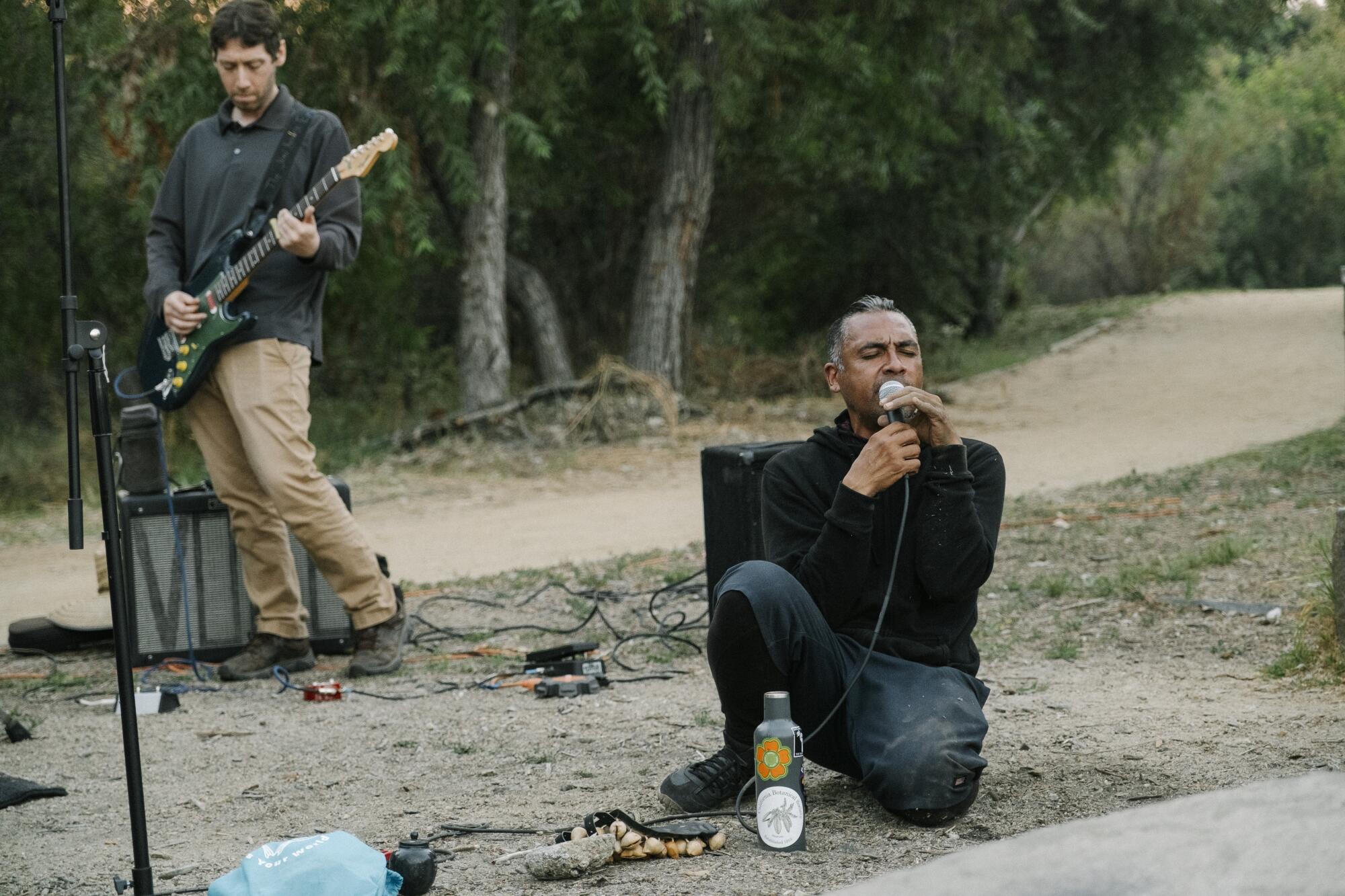
Frontman Antonio Sanchez on his knees with Jason Suddith keeping up behind him on rhythm guitar.
(Rio Asch Phoenix)
The lyrics, mostly written by Sanchez, can be biting at times, as in “PSA,” a hard-driving song about white sage poaching. They also can be poignant, like in the song “I Wanna Be a Native Plant.” In a video posted on YouTube, Sanchez roams the stage, jumping, crouching, rubbing his head and shout-crooning, “I wanna be a native plant, I wanna grow where they say I can’t. … Mama, make me a native plant, so I can grow where they say you can’t.”
More often than not, Sage Against the Machine’s songs are funny, even when they have an edge. The band’s most popular song, “Baby I’m a Botanist,” has about 18 versions, Sanchez said, because he’s always improvising new lines while the basic premise stays the same: A plant lover falls in love with a botanist.
“It’s funny because so many people think that song is about them,” Sanchez said, “but really it’s just me, who doesn’t have a degree and barely even went to school for plants, saying, ‘You don’t have to have a degree to be a botanist.’ Some of our greatest plant people have hands too hard to shake because they got [them] working with plants. But the native-plant world can be super stuffy — ‘Oh, you’re not pronouncing Salvia apiana correctly’ — and we’re just trying to break down some of those barriers and have fun with plants.”
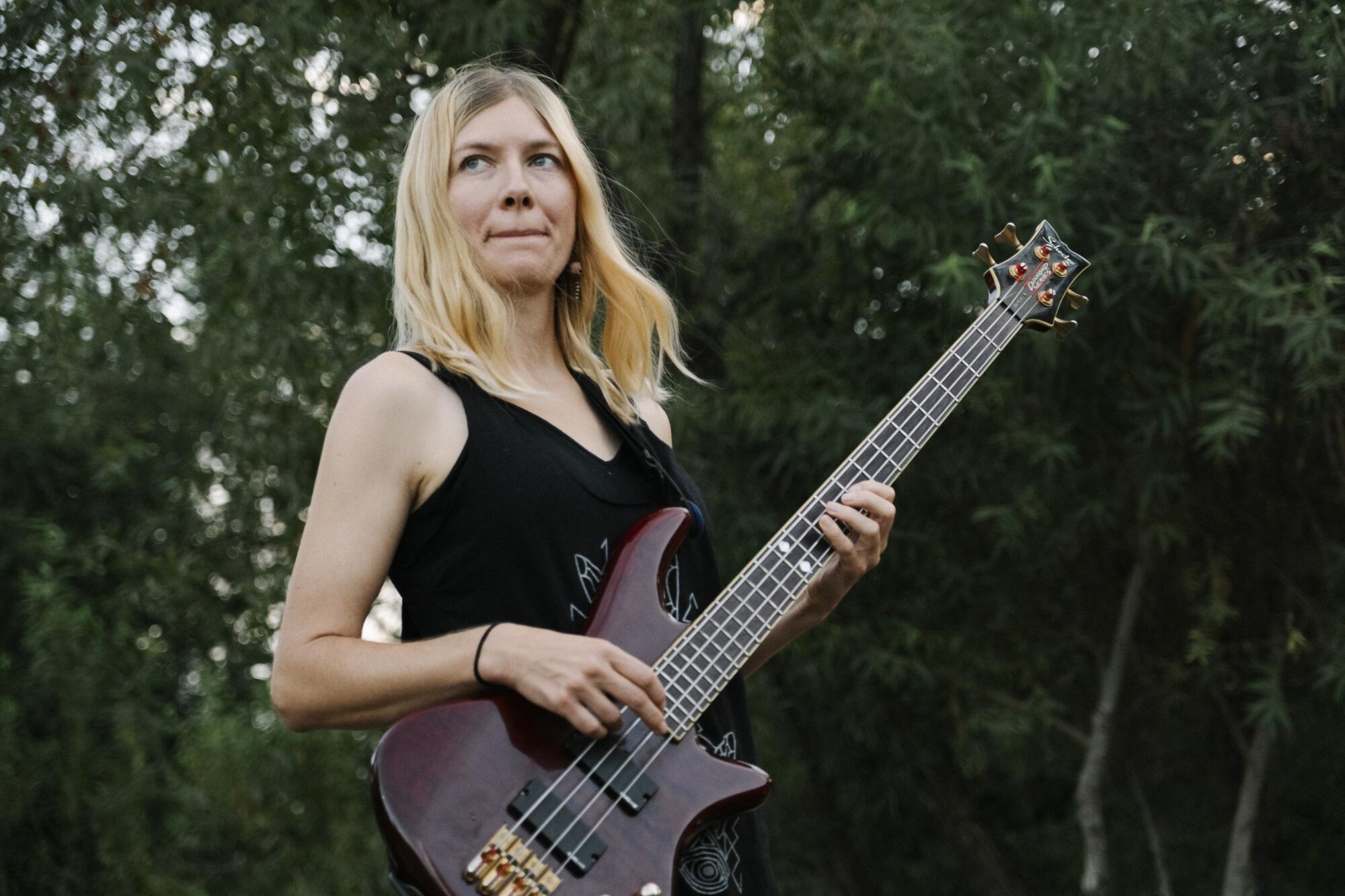
Nicole Calhoun, bass player for the band Sage Against the Machine.
(Rio Asch Phoenix)
Their catalog has tender songs too, including the romantic ballad co-written by Meyer and Sanchez, “Your Love is Like a Manzanita, Slow to Grow, Quick to Die,” instantly understandable to anyone who has ever been in love or tried to grow a finicky manzanita. They already have one live album on Spotify, and plan to drop another this month.
They’re such a unit when they perform — professional, focused yet still having fun — that it raises the question: Will Sage Against the Machine ever hit the big time? It’s something they all say they would love, “if my boss would give me a year and half off to tour,” Ramirez said jokingly, but the bandmates aren’t holding their breath. Major success is probably unlikely, Cervantes said, because their songs are too specific to California and its plants. “If it goes that way, then it’s meant to be,” Cervantes said, “but we’ve built a little niche for ourselves that’s pretty much our own.”
Then again, who knows. If the Beach Boys could make surfing a national phenomenon, who says Sage Against the Machine can’t get everyone excited about California buckwheat and white sage? It’s like what Sanchez screams in his favorite song, “Connected:”
If you are the lightning, then I’ll be your fire and she’ll be the wind; what does that make us?
If you are the clouds; then I’ll be your rain and she’ll be the earth; and what does that make us?
Connected! Connected! Connected!
We are all connected!


The Kennedy Center, the facade of which remains covered with a tarp, is seen in Washington, DC, on June 28, 2026. A US federal judge asked on June 24 for an explanation for why a tarpaulin continues to cover the facade of the Kennedy Center where President Donald Trump’s name was recently removed. District Judge Christopher Cooper gave the board of trustees of the performing arts venue until the end of July to explain “the purpose for and status of the tarp and scaffolding that Defendants have erected on the front portico of the Center.”
ALEX WROBLEWSKI/AFP via Getty Images
hide caption
toggle caption
ALEX WROBLEWSKI/AFP via Getty Images
More than two weeks ago, President Trump’s name was removed from the Kennedy Center facade though it is still covered by a tarp and the legal battle continues.
On Monday, a U.S. Department of Justice filing on behalf of the Kennedy Center included some surprises. The document was submitted in response to issues raised by lawyers for ex-officio board member Rep. Joyce Beatty of Ohio who is suing to remove President Trump’s name from the center and stop its closure for renovations.
Among the revelations, the Kennedy Center admitted that, during a board meeting on December 18, 2025, Beatty had been “muted and prevented from speaking.” It was at that meeting that the board voted to add President Trump’s name to the center. The filing later acknowledges the congresswoman was “prevented from voicing her opposition.”
The John F. Kennedy Center for the Performing Arts is a living memorial to its namesake. The guidelines for how the theatre complex spends federal dollars are very specific. Among other rules, it states that “no additional memorials or plaques shall be designated or installed.” Beatty argues adding Trump’s name runs afoul of those rules and that any change requires approval from Congress.
According to one of Beatty’s filings, “There was no advance notice in the agenda that the Board would be considering a name change,” a statement the Kennedy Center now does not deny. The center admits that, prior to voting, there was “no discussion about potential risks or downsides of the vote to adopt a secondary name for the Center.” Nor was there a board discussion “about any potential conflict of interest that might result from the vote.”
The center’s lawyers previously contended that if Trump’s name were to be removed, it would “lose money from donors who support” him and “impede the Center’s fundraising efforts.”
Closing for renovations
Earlier this year, Trump announced on social media that the Kennedy Center would close for two years for renovations. He wrote that he made the decision after “a one year review” with “Contractors, Musical Experts, Art Institutions, and other Advisors and Consultants.”
But, according to the center’s lawyers, Trump’s announcement “was made without presenting any plans, analyses, timelines, or funding information to his cotrustees and without any Board vote.”
The Kennedy Center has long denied reporting by The Washington Post that ticket sales plummeted after President Trump became the Center’s board chair. In Monday’s legal filing, the Center admits that, by October 2025, “nearly half of the Center’s tickets were going unsold.”


Paul Tremblay has made a career of pushing the horror genre – and the novel format – in strange and exciting new directions.
In his latest, Dead but Dreaming of Electric Sheep, the author offers an amalgamation of genre elements that can be best described as psychological-dystopian-science-fiction horror. It’s a mouthful, but the narrative does all of that and more in a way that defies categorization.
Julia Flang is a former semiprofessional gamer working two mediocre jobs she dislikes and living in a modest ranch house in a San Fernando Valley suburb with her retired uncle, whom she calls Uncle Fun. Julia likes movies and gaming but there’s little else going on in her life, so when her estranged mother, the CFO of a large tech company, contacts her with a possible job offer – a “once-in-a-lifetime thing” that pays handsomely just for doing the interview – she hesitantly agrees.

The job is relatively simple and perfect for someone with gaming skills: using a controller built into a phone to get a man, who is stuck in a vegetative state, from California to the East Coast. It will require her to learn how to control his body – walking, moving, sitting, standing, using his arms – so she can maneuver him out of the facility where he is located and into cars and planes and through crowded airports. A fan of movies, Julia decides to call the man Bernie – after the movie Weekend at Bernie’s. When the ethics of the job start to bother her, Julia realizes it’s too late and she must go through with it. However, she’s soon contacted by people interested in sabotaging the whole thing, people who, like her, don’t align with the shady interests of conglomerates and those set to make “gobs of money” from this new, somewhat inhuman technology.

As with every Tremblay novel, any synopsis barely scratches the surface. The novel’s chapters alternate between Julia and you (yes, you). Julia’s chapters are “normal” in the sense that they obey a chronological order and have action, basic descriptions of movement and places, and dialogue. The chapters in second person are like fever dreams from a shadow world; the desperate experiences of a man trapped inside his own body with no control of it, no clue what’s happening to him, and only a few fragmented memories of his life. Also, Tremblay uses a similarly fragmented style of storytelling (including words and sentences trapped in boxes and/or “moving” on the page) to keep things interesting but also confusing and creepy.
This novel operates on several different levels and – planes of existence? Bernie has a head full of AI that controls his body, but his consciousness is still there and struggling to regain control, struggling to remember things. There are monsters, leeches, mysterious rabbits, and eerie shadows in his world, but the true horror comes from the lack of control, from being moved around against his will and having no clue what comes next. Bernie is the embodiment of losing control to AI, and when taken together with the commentary of creativity and AI and the meta interludes in which the author takes a wrecking ball to the fourth wall and addresses readers, this is the best anti-Generative AI story horror has produced so far.
Despite the horror of it, this is a very funny novel. Julia is sarcastic and struggles to keep her comebacks in line, but the conversations she has and messages she writes are always entertaining. However, the humor is far from the crown jewel here. That title belongs to a plethora of big ideas Tremblay juggles. The nature of life, death, and consciousness, the evils of conglomerates, inhuman practices in the name of capitalism, and AI, and even what it means to be human are all explored here: “Is Bernie alive? Is he feeling pain? Is he experiencing everything as a prisoner looking through the bars of his body? Has his consciousness been winnowed to a metaphysical keyhole? Where does consciousness begin or end?” There are no definite answers here, but the way Tremblay infuses humanity, love, the importance of relationships, and humor throughout the narrative provides the kind of answers that can’t and don’t need to be spelled out.
A genre-bender full of big ideas that constantly switches between a world full of real or uncomfortably plausible nightmares and a bizarre hellscape in which loss of self, memory, and autonomy are only the tip of the proverbial iceberg, Dead but Dreaming of Electric Sheep is a horrific and terrifyingly disorienting novel that invites readers to consider a future that already started. Tremblay has always been an innovator, but this beautifully written collection of real and imagined grotesqueries cements him not only as one of the most original and exciting voices in horror but also as one of the smartest, most engaging authors in contemporary fiction.
Gabino Iglesias is an author, book reviewer and professor living in Austin, Texas. Find him on X, formerly Twitter, at @Gabino_Iglesias.

-

 Los Angeles, Ca11 minutes ago
Man dies after violent solo crash in Sherman Oaks
-

 Detroit, MI29 minutes ago
Priority Waste CEO shares progress on plan to fix disruptions, delays across Metro Detroit
-

 San Francisco, CA41 minutes ago
The San Francisco Church That Holds America’s Secrets
-

 Dallas, TX44 minutes ago
Crews battle large fire at Pilates studio in Uptown Dallas, officials say
-

 Miami, FL44 minutes ago
alaïa clads first miami boutique in pink mosaic tiles, from interior to facade
-

 Boston, MA56 minutes ago
Looking for a lodging adventure? Beat the heat at a floating B&B. – The Boston Globe
-

 Denver, CO59 minutes ago
Lavender festival, Tennyson Street Fair and more free and cheap things to do in July
-

 Seattle, WA1 hour ago
Seattle’s solution for the middle-class housing squeeze: government housing | CNN Business

