South-Carolina
Cause of death of Mica Miller, wife of South Carolina pastor, revealed


Mica Miller, the wife of a South Carolina pastor she accused of being abusive before she was found dead, died of a self-inflicted gunshot wound, according to the local medical examiner.
The 30-year-old’s death was ruled a suicide by the Robeson County Medical Examiner, Richard Johnson, ABC 15 reported Monday.
“Based on the nature of the wound, that it is consistent with a self-inflicted gunshot wound. And it was not in the back of the head, as it has been speculated,” Johnson told the local news station.
Miller was found dead at Lumber River State Park on April 27 — two days after her husband Pastor John Paul Miller, of Solid Rock at Market Common congregation, was served divorce papers by her, according to court documents.
Before her death, she reportedly told her sister that if she was ever found dead in the exact manner she was found in the park, her husband was responsible, according to an affidavit filed by her younger sister Sierra Francis in Horry County Probate Court.
“Mica stated to me on many occasions “if I end up with a bullet in my head, it was not by me, it was JP,” Francis wrote in the sworn affidavit obtained by the Christian Post.
Miller — who met her husband when she was just 14 or 15 years old, while he was between 28 and 29 — reportedly feared for her life and spoke about being violently abused by her husband to her family and other church members, Francis said in the affidavit she submitted seeking to be appointed the special administrator of her sister’s estate.
In the weeks before her death, she discovered a tracking device on her car and had her tires slashed more than once, Miller’s brother Nathaniel Francis said in a separate affidavit.
John Paul reportedly confessed and apologized to Miller for the tire slashing and damage to her car via emails that Miller forwarded to her brother.
“Mr. Miller’s email to my sister continued to state that he was angry when Mica confided or ‘put family before’ him and that made him want to hurt her,” her brother said in the document. “In his words ‘When someone hurts me, I try to hurt them back rather than forgive,’ and ‘instead of me forgiving you …. I just attack and try to cause pain.’”
Police reports obtained by 15 News dated March 11 detail the alleged stalking of Miller though the suspect’s name was redacted.
Miller told officers she “was afraid for her life” as the suspect showed up where she was numerous times the same day — with mechanics later finding a tracking device on her vehicle.
Even while Miller was in the presence of a police officer while out front of the Magistrate’s office to get a restraining order, the suspect drove by slowly before speeding off, according to the report.
In some of her last Facebook posts, Miller spoke out in support of abuse survivors in a video and captioned a photo of herself: “When terrible terrible TERRIBLE things happen to you… (yall know what I’m talking about;) RPF: resting peace face.”
Her pastor husband told the Christian Post that his wife, whom he wed in 2017, suffered from “bipolar II, schizophrenic and dependent personality disorder” and did not always take her medication.
He said that she had made previous attempts to take her own life and went to the hospital for mental treatment on multiple occasions.
“I would never expose this stuff of her if I didn’t have to now, but every time she tried to kill herself, I would be there. I would literally sometimes pick her up physically, put her in the truck, take her to the [hospital],” he told the religious outlet — claiming that he has video of his wife testifying that she previously tried to shoot herself in the head.
But Miller’s sister said she was looking towards the future and was looking forward to her life after the divorce as she planned to move to Kenya part-time to do missionary work.
The family is asking for justice for Miller and a full investigation into her death.
The pastor — who casually announced his wife took her own life at the end of his sermon during mass — has since been released from all ministerial duties at his church, Solid Rock, 15 News reported.
If you are struggling with suicidal thoughts or are experiencing a mental health crisis and live in New York City, you can call 1-888-NYC-WELL for free and confidential crisis counseling. If you live outside the five boroughs, you can dial the 24/7 National Suicide Prevention hotline at 988 or go to SuicidePreventionLifeline.org.



In Laurens County, a dual-sided historic marker stands next to a mailbox off the side of the road. The name Jonathan Downs was commemorated on one side, while the other side was signed with the story of Lindley’s Fort in the American Revolution.
The Battle of Fort Lindley took place July 15, 1776, some 1,800 feet away from the modern-day historic marker. Private farmland now sits where the battle ensued, but physical pieces of history and oral retellings of the battle have continued to propel the story in Laurens County lore.
Loyalists to the British crown and Cherokee citizens planned an attack on a group stationed at the fort. The Little River Regiment used the fort as their base. Loyalist Capt. David Fanning described the scene as a “fort built with logs” in his autobiographical retelling of the Revolutionary War.
Cherokee land had continually been encroached on, which pushed members of the tribe to retaliate.
The loyalists who joined in the attack were dressed as Native Americans. They – along with other South Carolina backcountry loyalists – were referred to as Scopholites. The group took action at midnight for what became a two-hour fight in one of the first conflicts of the Cherokee War of 1776.
Historian Durant Ashmore said the crux of the battle was a clash of culture and a fundamental lack of understanding among the groups.
“One thing that has been very important to understand is the conflicts between cultures – the misunderstandings between cultures – and the deadly consequences that can result from that,” he said.
Luis-Alfredo Garcia
/
South Carolina Public Radio
Troops at the fort had at first not believed word of the upcoming attack when informed by a group of soldiers, according to a pension application of Matthew Brown, who was a 16-year-old boy stationed at a fort about 20 miles away from Fort Lindley. The men were drunk from a night of indulging in rum, which Ashmore said was a common occurrence during the war.
“The Little River Regiment did not believe them. They actually even leveled their guns at them, saying, ‘Who’s telling you such lies as this?’” he said.
Maj. Downs, however, prepped the troops for defense. Downs was a previous member of the First Provincial Congress, Second Provincial Congress, and South Carolina General Assembly.
A sizable chunk of the Patriot troops had already experienced fighting Cherokee citizens during the Anglo-Cherokee War that lasted from about 1758-1761. Soldiers at Fort Lindley responded to the attack by sending out troops in lines of 10. Eventually, the loyalists and Cherokee citizens retreated.
The patriot victory boosted local morale and belief in their cause, but for some unscathed loyalists and Cherokee citizens, the aftermath’s impact trumped the actual battle loss in consequences.
The morning after the battle, troops from the fort found about 30 horses at a campsite. One saddlebag contained the commission papers of Capt. James Lindley. Lindley was a staunch loyalist and the eponymous owner of Fort Lindley.
Six months prior to the battle, he had been captured at the Battle of Great Cane Break. Lindley had promised to not take up arms against patriot forces again, or he would face death. Although he was not captured in the midnight battle, he did succumb to patriot troops at the Battle of Kettle Creek and was hanged for breaking his parole.
As for the Cherokee citizens, their land was further encroached upon and people killed; about 2,000 were killed during the Cherokee War of 1776.
Ashmore said the consequences from escalating conflict were terrible.
“Patriots gathered together with the idea of a plan, the goal of eliminating the Cherokees. Genocide,” he said. “That’s what was preached to the backcountry settlers along with the ability to make their own decisions. A primary motivating factor in the American Revolution is the right of self-determination.”
Luis-Alfredo Garcia
/
South Carolina Public Radio
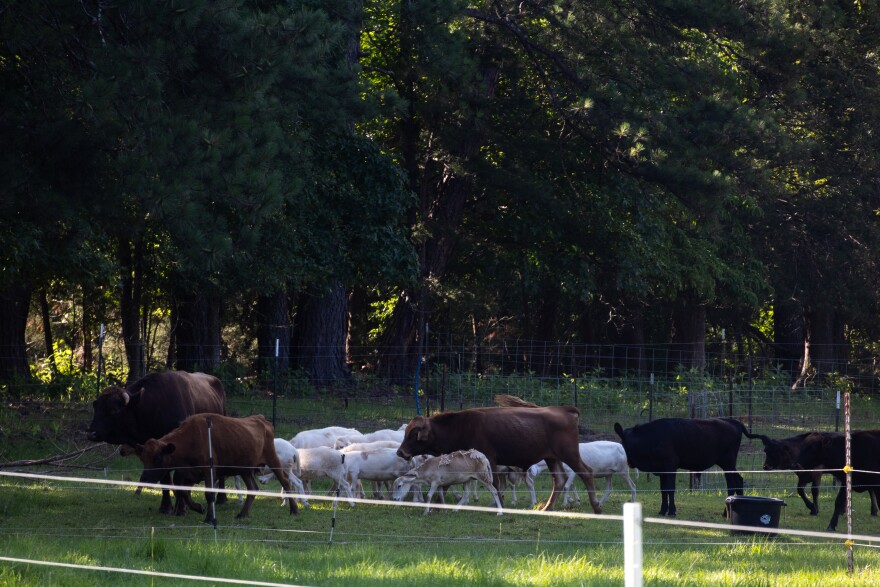
Now, private land with cows and sheep sits on the area where the fort once stood. Ashmore said he gives tours just during the winter to avoid the risk of ticks. The area where trenches once helped shield soldiers are still visible.
Some remnants from the fort now reside at the Laurens County Museum in the city of Laurens’ downtown area. The objects, although not individually labeled, will be part of an upcoming opening collection.

Luis-Alfredo Garcia
/
South Carolina Public Radio
Museum docent Julia Sermons said being informed of local history helps shape modern decisions.
“You have to know where you’re coming from to know where you’re going,” she said.
Ashmore, too, saw the same value.
“We are all in the middle of this,” he said. “This history – the important role that South Carolina played in the Revolution.”
An estimated 14 battles took place in Laurens County, according to Ashmore. He has been keeping track of local history for about 6 years. He said the county has set a 50-year plan to help with future record keeping.

Luis-Alfredo Garcia
/
South Carolina Public Radio


Video of SCHSL 5A Division 1 Upper State track and field championships
Here’s video of some of the action from the SCHSL Class 5A Division 1 Upper State boys and girls track and field championships held May 8 at Dorman.
Riley Vaughn of Spartanburg girls Track and Field was named the 2025-26 South Carolina girls Gatorade Player of the Year.
Vaughn won the shot put and discus events at the Class 5A-D1 state championships. She nailed a 13.1 meters on the shot and 41.77 meters on the discus. Her 14.41 in the shot at the region meet was the state’s best for 2026.
The 5-foot-10 junior helped lead Spartaburg to a fifth-place team finish. Vaughn had also competed on the national stage after taking third place in the shot put event at the Under Armour Nationals.
“Unbeaten in the discus throw on home state soil this year, Vaughn achieved success in both throws, but really sparkled in the shot put circle,” PrepCalTrack editor, Rich Gonzalez, said. “Her season-best there was the state’s top mark in the event in seven years and moved her to No. 4 on South Carolina’s all-time list.”
Vaughn is now part of an elite group of athletes who have won the prestigious award, including four-time Olympic gold medalist Sydney McLaughlin, five-time Olympic medalist Sanya Richards, and 11-time Olympic medalist Allyson Felix.
Vaughn was also named to the Greenville News’ All-Upstate First Team in girls’ Track and Field for the second consecutive season.
Kamryn Jackson covers high school and college sports for the Spartanburg Herald-Journal, Greenville News, Anderson Independent Mail, and the USA TODAY Network. Please email her at KEJackson@gannett.com and follow her on X @KamxJack (formerly Twitter).

-

 Nebraska3 minutes ago
HealthierU opens wellness coaching program to employees
-

 Nevada6 minutes ago
Shaquille O’Neal Foundation donates 260 supply-filled backpacks to Nevada students
-

 New Hampshire11 minutes ago
Police: Man stabbed during domestic dispute in Nashua, NH
-

 New Jersey18 minutes ago
1 injured after vehicle hits tree in West Deptford, NJ
-

 New Mexico21 minutes ago
1 dead following shooting involving Rio Arriba County Sheriff’s Office
-

 North Carolina26 minutes ago
Former Madison County chief deputy in North Carolina custody after Arizona arrest
-

 North Dakota33 minutes ago
North Dakota composer launches statewide virtual choir project
-

 Ohio36 minutes ago
UC Bearcats baseball playing Ohio State, Vanderbilt in Nashville in 2027

