Connect with us

News

How good is OpenAI’s Sora video model — and will it transform jobs?

Published

on

How good is OpenAI’s Sora video model — and will it transform jobs?

OpenAI has been showcasing Sora, its artificial intelligence video-generation model, to media industry executives in recent weeks to drum up enthusiasm and ease concerns about the potential for the technology to disrupt specific sectors.

The Financial Times wanted to put Sora to the test, alongside the systems of rival AI video generation companies Runway and Pika.

We asked executives in advertising, animation and real estate to write prompts to generate videos they might use in their work. We then asked them their views on how such technology may transform their jobs in the future.

Sora has yet to be released to the public, so OpenAI tweaked some of the prompts before sending the resulting clips, which it said resulted in better-quality videos.

On Runway and Pika, the initial and tweaked prompts were entered using both companies’ most advanced models. Here are the results.

Advertisement

Charlotte Bunyan, co-founder of Arq, a brand advertising consultant

OpenAI’s revised version of Bunyan’s prompt to create a campaign for a “well-known high street supermarket”:

Pike and Runway’s videos based on Bunyan’s original prompt:

“Sora’s presentation of people was consistent, while the actual visualisation of the fantastical playground was faithfully rendered in terms of the descriptions of the different elements, which others failed to generate.

“It is interesting that OpenAI changed ‘children’ to ‘people’, and I would love to know why. Is it a safeguarding question? Is it harder to represent children because they haven’t been trained on as many? They opted for ‘people’ rather than a Caucasian man with a beard and brown hair, which is what Sora actually generated, which raises questions about bias.

“Pika felt surreal as if you were in a trippy film moment. The children’s version is much better than the League Of Gentlemen surrealness of the adult iteration, but the rest of the environment lacks details from the prompt. I do have a certain fondness for the vibrancy of [Pika’s children’s] version, as it conveys a sense of joy and happiness more strongly than any of the others.”

Advertisement
The video generated by Sora includes multiple elements, such as the banana slide, runner bean frame and watermelon roundabout
A screenshot of the AI generated video created by Runway displaying two children on a watermelon spinning
The video generated by Runway has distorting limbs throughout

“Runway was very much in the middle. Certainly, in the adult version, there was less glitching, but the representation of the playground elements was lacking.

“I could potentially use the Sora video as a taster of something we could bring to life in a virtual experience. It would demonstrate the playfulness of food. However, you may need to add a human layer to the content by using editing tools.

“These tools will speed up the way we communicate creative ideas and make them more tangible. For example, in the early stages of presenting a concept to a brand, this would make it much easier for clients to understand what it could look like or how it would work.

“My prompt has abstract creative concepts that are harder for these tools. Often, in the world of creativity, you’re trying to create something that hasn’t existed before. I know there is a lot of concern and perhaps negativity about AI taking all of our jobs, but I think we should consider how AI is going to make our jobs easier and relieve some burdens.”


Alex Williams of Escape Studios, an animator whose credits include ‘The Lion King’

Videos generated by OpenAI’s revised prompt:

“It has that slight morphy quality that AI-generated work has, which I don’t think makes it client-ready yet, but that’s something that will get smoothed out.

Advertisement

“Each one is amazing in terms of what it does, but each one [has] obvious mistakes . . . like heads changing shape and flamingos blending into other flamingos — it doesn’t work yet.”

Stills from AI-generated video of flamingos by Runway
Runway’s video had issues with heads changing shape
Stills from AI-generated video of flamingos by Runway

“It didn’t manage to produce a short film with a beginning, middle and end, so it didn’t do what I hoped it would. On the other hand, what it does in terms of animation is very impressive.

“Since I started in animation in the ‘80s, some very significant technological advances have changed the medium a lot. There’s no question that this is the biggest change I’ve seen in my career.

“I would draw comparisons with the switch from 2D to 3D animation, which happened in the late ‘90s when Toy Story came out. There was a lot of resistance among the hand-drawn animation community to those changes, including me, in the beginning.

“It took me a couple of years to realise I had to embrace this change. We all fought it collectively for a while, but it became the great box office driver. As an industry we do need to embrace technology because you never want to get on the wrong side.”


Ashley Shakibai, production manager at commercial real estate agents OBI Property

Videos generated by prompt for promotional video of a commercial building in Manchester:

Advertisement

“Sora did a reasonable job at the start. The transition will always be tricky, and it struggled with that. But I think the photorealism at the end of the shot was quite pleasing and surprising.

“Technically, the prompt was that people were walking in the building, but that was not shown and there were many other elements it didn’t achieve.

“All Pika has gathered from my prompt is a ‘sunny day’. It has given us some flares and a couple of buildings, but you can’t make out the people.”

A screenshot from AI video generated by Sora of a couple’s faces
Sora generated people with more realistic faces
A screenshot from AI video generated by Runway of distorted body
Runway distorted people’s features

“I had to laugh when I watched this Runway one. There’s a bit more photorealism but the people are walking forwards and then backwards, so it’s certainly not a believable scene.

“As an industry professional, my expectation is perfection. I am looking for realistic quality video, and AI is probably never going to quite get there.

“At the end of the Sora video, the couple is having a conversation in a coffee shop, looking like they’re enjoying themselves. That would be a shot that we’d use to sell a commercial property space as an amenity nearby.

Advertisement

“We will eventually reach a point where this is an incredibly powerful tool for creators, inevitably eliminating the use of other tools. Sora will seriously challenge stock websites and the role of actors, both of which we use now.

“You must be very careful when adding computer-generated imagery. If it’s not for a purpose, if it’s not believable, it can be too distracting. It is very much at the testing stage.”

Additional reporting by Madhumita Murgia

News

What the Supreme Court did on the final day of its term

Published

on

What the Supreme Court did on the final day of its term

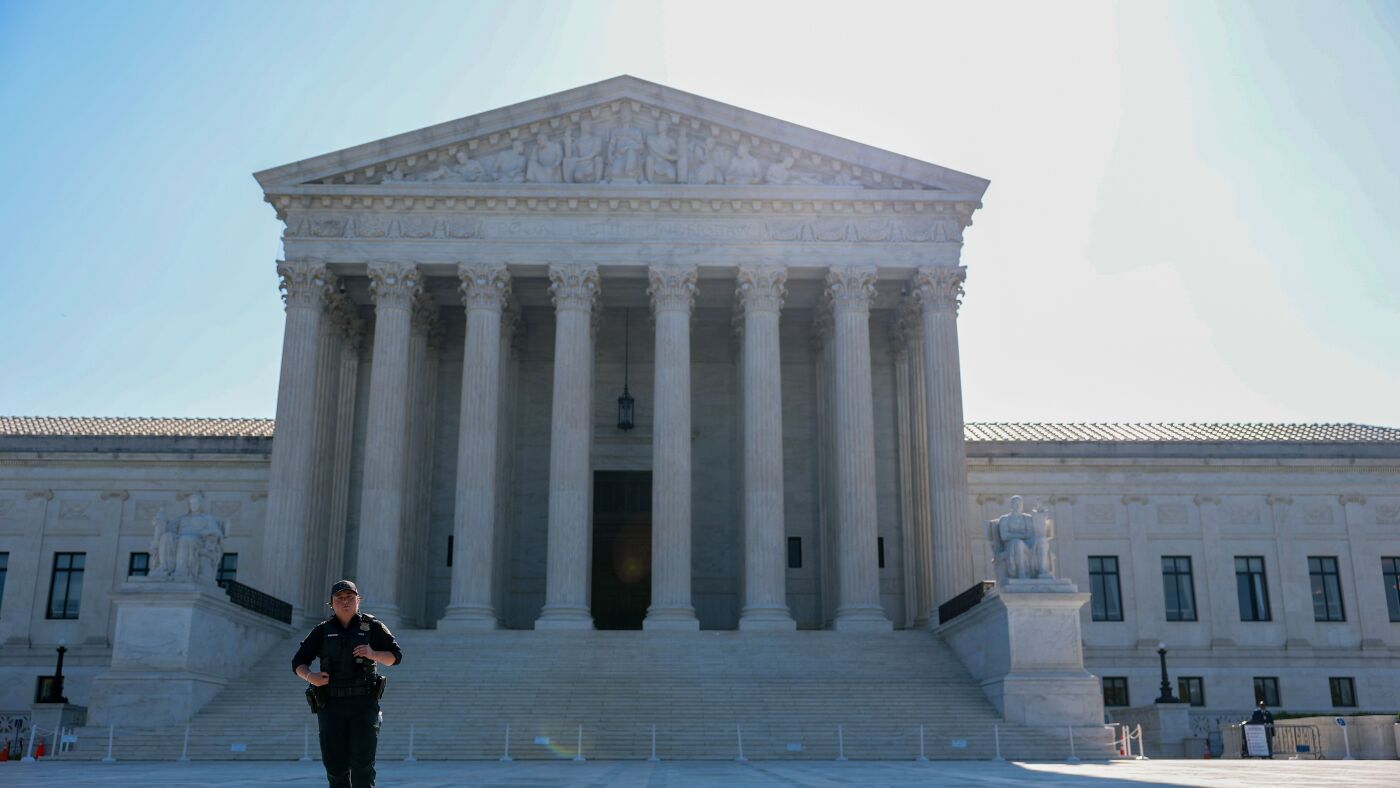
The U.S. Supreme Court

Tasos Katopodis/Getty Images


hide caption

toggle caption

Advertisement

Tasos Katopodis/Getty Images

The Supreme Court Tuesday upheld the long-established right of children born on U.S. soil to automatic American citizenship, regardless of their parents’ immigration status. In so doing, the court rejected President Trump’s most aggressive attempt to limit immigration in the United States.

Writing for the court majority, Chief Justice John Roberts traced birthright citizenship back to the founding of the nation. Just as the colonists demanded “the rights of Englishmen” more than 250 years ago, he said, Congress, after the Civil War, amended the Constitution to specify automatic citizenship for any child born on U.S. soil.

“Citizenship then and now was the right to have rights”—and the framers of the 14th amendment extended that promise to every free born person in this land. He concluded: “We keep that promise today.”

Advertisement

The vote was 6-to-3, depending on how you count it. Altogether, five justices signed on to the Roberts’ majority opinion. A sixth, Justice Brett Kavanaugh, agreed only that federal legislation enacted in the 1950s grants automatic citizenship for children born in the U.S.

Justice Clarence Thomas wrote the lead dissent, a 91-page opus that agreed with Trump’s assertion that the 14th amendment only applied to former slaves and their descendants. The Thomas dissent added ominously that he “was not sure that “today’s opinion will stand the test of time.” The dissent was joined by Justice Neil Gorsuch, with Justice Samuel Alito writing a separate dissent.

Justice Ketanji Brown Jackson, who, like Thomas is African American, responded to some of the themes in the Thomas dissent.

“Despite his longstanding endorsement of a colorblind society,” she wrote, “Justice Thomas now surprisingly suggests that the citizenship clause was a race-conscious remedial measure relating only to freed slaves.”

Cecillia Wang, legal director of the ACLU, who successfully argued the case at the Supreme Court, said President’s Trump failed attempt to limit birthright citizenship was transparent.

Advertisement
Continue Reading

News

Rep. Tom Kean returns to Congress, says depression is why he went missing for months

Published

on

Rep. Tom Kean returns to Congress, says depression is why he went missing for months

Rep. Thomas Kean Jr., R-N.J., arrives at the U.S. Capitol with his wife Rhonda Kean on June 30.

Anna Moneymaker/Getty Images


hide caption

toggle caption

Advertisement

Anna Moneymaker/Getty Images

New Jersey Republican Thomas Kean Jr. said it was struggles with depression that kept him away from Congress for nearly four months with no explanation to his constituents.

Kean last voted on March 5th, missing numerous votes and other appearances on Capitol Hill since. In April, House Speaker Mike Johnson told reporters he had spoken to Kean and that he was dealing with an undisclosed medical issue. Kean was not spotted until recently at his New Jersey home.

Speaking from the House floor on Tuesday, the second term lawmaker said he had checked into a hospital for testing several months ago after health concerns, and was subsequently diagnosed with depression.

Advertisement

“Talking about myself has never come naturally,” Kean said. “But I believe that I owe an explanation to the people of New Jersey’s seventh district, to my colleagues in this chamber and to the American people for my absence.”

Kean said he originally did not think his diagnosis would result in a long-term absence. Doctors recommended he remain in the hospital to address the illness, and it was his fastest route to recovery, he said.

“It is physical. It is emotional,” he said. “And until you experience it yourself, it is difficult to fully understand how powerful this illness could be.”

Kean said he miscalculated how long he would be away, estimating it would be a matter of weeks. However, he said like the roughly 48 million Americans who have battled the illness, he learned there is no timeline for recovery.

“I am grateful that I accepted help,” Kean said. “Today I stand before you healthier, stronger and excited to return to the work that I love.”

Advertisement

Kean’s absence proved a struggle for House Republicans, who contend with a razor thin majority to pass party priorities. For weeks, Kean and his office declined to share additional details on why he was away, feeding rumors and speculation and raising interest in a member known for his privacy.

Continue Reading

News

Michigan governor threatens to pull troops from D.C. if used for Trump task force

Published

on

Michigan governor threatens to pull troops from D.C. if used for Trump task force

Members of the National Guard stand in front of a large image of U.S. President Donald Trump that hangs from the the Robert F. Kennedy Department of Justice Building on May 18, 2026 in Washington, D.C.

Andrew Harnik/Getty Images North America


hide caption

toggle caption

Advertisement

Andrew Harnik/Getty Images North America

WASHINGTON, D.C. — In a strongly worded letter to the head of Michigan’s National Guard, Gov. Gretchen Whitmer reiterated troops from her state are only to be used for operations surrounding America 250 celebrations in Washington, D.C., and not for President Trump’s long-running — and controversial — joint task force to fight crime. She said that she would pull her troops from the city if that is not the case, in the letter obtained by NPR.

“Please take all necessary measures to ensure the Michigan National Guard is only supporting the narrow and limited America 250 Mission and is in no way supporting the D.C. Safe and Beautiful Mission,” wrote Gov. Whitmer, referencing the official name for the federal task force.

Trump deployed hundreds of troops to Washington, D.C., in August of 2025, in what experts said was a stunning departure from governing norms. He said he did so to address rampant crime, despite declining crime rates at the time. The number of troops in the city has increased over time to more than 4,800 from Washington, D.C. and almost two dozen states, which until recently were exclusively Republican-led.

Advertisement

Michigan — which has 161 guard members currently in the city — is one of four Democratic-led states that sent members of their National Guard to D.C. in recent weeks, ahead of an influx of tourists for America 250 celebrations. North Carolina and Kentucky each sent one member of their guard, while Minnesota sent more than a hundred last week.

Kentucky confirmed to NPR Monday that it had recalled its one guard member over the weekend, after that member was “diverted to the task force by the federal government without the knowledge or consent of Gov. Beshear of the Kentucky Guard,” Scottie Ellis, a spokesperson for Gov. Beshear, wrote to NPR in an email.

When contacted by NPR, spokespeople for each respective Democratic governor’s office made it clear that their guard members were sent to help specifically with America 250, not for law enforcement purposes as part of the larger ongoing federal joint task force operation. All four states have been clear about their opposition to the Trump administration’s ongoing deployment of National Guard troops to D.C., filing an amicus brief in support of litigation challenging it as recently as May.

Continue Reading
Advertisement

Trending