Midwest
People with disabilities sue in Wisconsin over lack of electronic absentee ballots

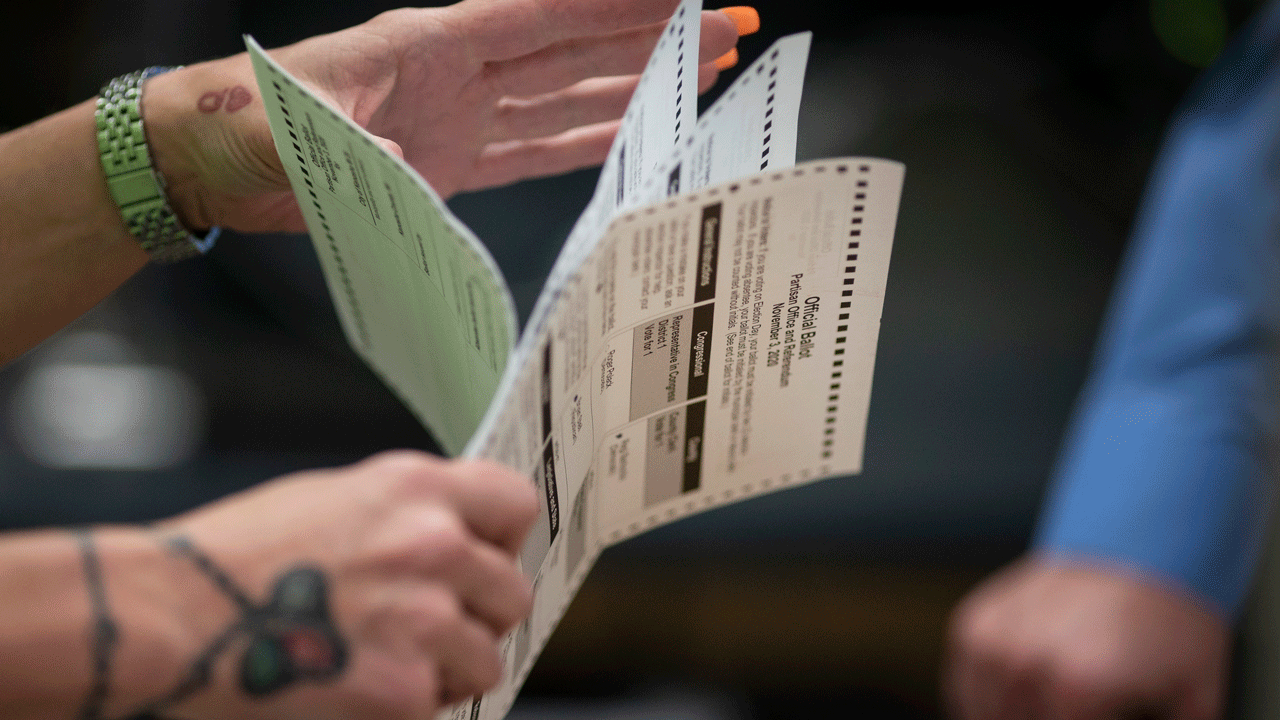
MADISON, Wis. (AP) — Wisconsin voters with disabilities should be able to cast their ballots electronically and failure to provide that option for the upcoming Aug. 13 primary and November presidential election is discriminatory and unconstitutional, a lawsuit filed Tuesday in the battleground state alleges.
The lawsuit seeks to require that electronic absentee voting be an option for people with disabilities, just as it is for military and overseas voters. Under current Wisconsin law, people with disabilities are “treated unequally and face real and considerable hurdles to participating in absentee voting,” the lawsuit argues.
WI ELECTIONS COMMISSION APPROVES GUIDANCE, VOTERS WITH DISABILITIES CAN RECEIVE HELP WITH ABSENTEE BALLOTS
Absentee ballots, including who can return them and where, have been a political flashpoint in swing state Wisconsin, where four of the past six presidential elections have been decided by less than a percentage point. The Wisconsin Supreme Court is scheduled to hear arguments next month in a case seeking to overturn a previous ruling banning absentee ballot drop boxes.
Poll workers sort out ballots at the Kenosha Municipal building on Election Day, Nov. 3, 2020, in Kenosha, Wis. A lawsuit in Wisconsin argues that voters with disabilities should be able to cast their ballots electronically and that failing to provide that option for the upcoming Tuesday, Aug. 13, primary and November 2024 presidential election is discriminatory and unconstitutional. The lawsuit filed Tuesday, April 16, seeks to require that electronic absentee voting be an option for people with disabilities in Wisconsin, just as it is for military and overseas voters. (Wong Maye-E/AP Photo)
A federal court sided with disability rights activists in 2022 and said the Voting Rights Act applies to Wisconsin voters who require assistance with mailing or delivering their absentee ballot because of a disability. The ruling overturned a Wisconsin Supreme Court ruling that said only the voter can return their ballot in person or place it in the mail.
The new case was filed against the Wisconsin Elections Commission in Dane County Circuit Court by four voters, Disability Rights Wisconsin and the League of Women Voters. Riley Vetterkind, a spokesperson for the elections commission, declined to comment on the lawsuit.
Voters with disabilities must have the ability to vote electronically in order for Wisconsin to comply with a variety of state and federal laws related to accommodation and equal-access, the lawsuit argues. Electronic voting will also ensure that people with disabilities are treated the same as other voters, the lawsuit contends.
The lawsuit states that because absentee voting for most in Wisconsin is by paper ballot, many people with disabilities are unable to cast their votes without assistance. They could vote in private if electronic voting were an option, the lawsuit argues.
“This unconstitutional defect in Wisconsin’s absentee ballot system is well-known yet remains unaddressed,” the lawsuit alleges.
The individuals who brought the lawsuit are Donald Natzke, of Shorewood, and Michael Christopher, of Madison, both of whom are blind; Stacy Ellingen, of Oshkosh, who has cerebral palsy; and Tyler Engel, of Madison, who has spinal muscular atrophy. All four of them are unable to vote absentee privately and independently, the lawsuit argues.
The lawsuit alleges that not providing electronic absentee voting for people with disabilities violates the state and federal constitutions, the Americans with Disabilities Act and the federal Rehabilitation Act, which prohibits all organizations that receive federal financial assistance from discriminating on the basis of disability.
People with disabilities make up about one-fourth of the U.S. adult population, according to the Centers for Disease Control and Prevention. They have been ensnared in battles over access to the polls as many Republican-led states have passed restrictive voting laws in recent years, including over limits on what assistance a voter can receive and whether someone else can return a voter’s mailed ballot.
Read the full article from Here



Powerball, Mega Millions jackpots: What to know in case you win
Here’s what to know in case you win the Powerball or Mega Millions jackpot.
Just the FAQs, USA TODAY
The Illinois Lottery offers multiple draw games for those aiming to win big.
Here’s a look at June 28, 2026, results for each game:
Winning Pick-3 numbers from June 28 drawing
Midday: 3-8-6, Fireball: 8
Evening: 4-1-7, Fireball: 7
Check Pick-3 payouts and previous drawings here.
Winning Pick-4 numbers from June 28 drawing
Midday: 0-0-8-3, Fireball: 4
Evening: 9-7-1-8, Fireball: 0
Check Pick-4 payouts and previous drawings here.
Winning LuckyDay Lotto numbers from June 28 drawing
Midday: 04-06-15-16-40
Evening: 05-33-38-43-45
Check LuckyDay Lotto payouts and previous drawings here.
Feeling lucky? Explore the latest lottery news & results
Are you a winner? Here’s how to claim your prize
- Prizes up to $600: Claim at an Illinois Lottery retailer, a Claim Center, by mail, or via an e-Claim. By mail, send the required documentation to: Illinois Lottery Claims Department, P.O. Box 19080, Springfield, IL.
- Prizes from $601 to $10,000: Claim at a Claim Center, by mail, or via an e-Claim.
- Prizes over $10,000: Claim at a Claim Center or by mail.
- Appointments Required: Schedule an appointment for in-person claims.
- Documentation: Bring a photo ID and Social Security number proof.
When are the Illinois Lottery drawings held?
- Powerball: 9:59 p.m. CT on Monday, Wednesday, and Saturday.
- Mega Millions: 10:00 p.m. CT on Tuesday and Friday.
- Lucky Day Lotto (Day): 12:40 p.m. CT daily.
- Lucky Day Lotto (Evening): 9:22 p.m. CT daily.
- Lotto: 9:22 p.m. CT on Monday, Thursday, and Saturday.
- Pick 3 (Day): 12:40 p.m. CT daily.
- Pick 3 (Evening): 9:22 p.m. CT daily.
- Pick 4 (Day): 12:40 p.m. CT daily.
- Pick 4 (Evening): 9:22 p.m. CT daily.
This results page was generated automatically using information from TinBu and a template written and reviewed by an Illinois editor. You can send feedback using this form.

Indiana Dunes balance environment and development after years of debate
Indiana Dunes reach a turning point as preservation efforts and regional growth pressures shape the future of the lakeshore landscape
Last year, the Trump administration asked visitors to hundreds of national parks to report any “divisive” signs or monuments that tarnished the country’s image.
Called “snitch signs” by critics, notices with QR codes appeared in places that included Indiana Dunes National Park, encouraging visitors to report signage that portrayed Americans negatively, or failed to “emphasize the beauty, grandeur, and abundance” of the park’s landscape.
Roughly 35,000 comments poured in from June 4, 2025, to Jan. 14, 2026. The campaign, however, appears to have backfired.
The submissions were released by the agency in May. While a significant number appeared to be non-political, copy-pasted duplicates, jokes, memes or submissions written by the same person, USA TODAY found an overwhelming majority of unique entries were critical of the White House’s effort to rid the national parks of “woke ideology.”
In Indiana, feedback from visitors was nearly all positive, expressing support toward National Park Service rangers and criticizing the Trump Administration.
One person at Indiana Dunes National Park appeared to take issue with a sign at the Bailey Homestead painting what they called “an outdated and overly idyllic picture” of the fur trade.
“There shouldn’t be signs about history that whitewash and erase the centuries of discrimination against the people who have cared for this land for generations,” they wrote, advocating collaboration with local tribal leaders to determine how the history of the land and its people should be represented.
Others submitted comments that took direct shots at the current administration.
“Censoring the ‘negative’ parts of our history is cowardly and un-American,” wrote one visitor to Indiana Dunes National Park who identified themselves as a U.S. Marine Corps veteran.
“Asking visitors to tattle on history because it makes someone uncomfortable is beyond ridiculous, it’s dangerous,” wrote another visitor last June. “What’s next? Rewriting trail signs so we don’t hurt Andrew Jackson’s feelings?”
White House defends president’s order to ‘restore sanity’ to History
The controversial signs contested at U.S. national parks resulted from an executive order President Donald Trump signed in March 2025, titled “restoring truth and sanity to American History.”
In the order, Trump directed federal officials to remove any language from the country’s national parks, monuments and museums the portrayed the country as “inherently racist, sexist, oppressive, or otherwise irredeemably flawed.”
The White House defended the president’s order as “honoring our country’s extraordinary heritage and restoring a sense of national pride” in a statement provided to The Courier Journal, which examined similar feedback from visitors at Kentucky’s Mammoth Cave National Park.
“The President has put an end to the radical left’s divisive and inaccurate characterization of our nation’s history, which infiltrated our national parks and museums, and is restoring truth and sanity,” said White House spokesperson Taylor Rogers.
Story continues after photo gallery
In a statement, the Department of the Interior, which oversees the park service, said it was implementing the president’s order “to review interpretive materials to ensure accuracy, honesty, and alignment with shared national values.”
National Park Service staff “were asked to identify materials that might warrant clarification,” the department said. “Elevating an item for consideration does not mean it violates the Order, and it does not mean it will be changed. In the vast majority of cases across the system, flagged materials remain unchanged.”
A court filing from June 17 reveals 57 exhibits, signs or other materials were removed by the Trump administration from monuments, parks or other sites across the country —none of which included Indiana, IndyStar confirmed with the Department of the Interior.
If the administration was hoping for Americans to be more supportive of its efforts, it made a poor bet. Some visitors to national parks in the Hoosier State sounded livid.
National park visitors in Indiana had this to say about Trump’s ‘snitch signs’
IndyStar reviewed more than 200 comments submitted to the administration from June 11, 2025 through Dec. 11, 2025 across three Indiana-based national parks — Indiana Dunes National Park in Porter, George Rogers Clark National Historical Park in Vincennes, and Lincoln Boyhood National Memorial in Lincoln City.
The following comments provide a sample of what was said, some edited minimally for clarity and length.
On supporting the National Park Service with praise, more funding, more signage
- “The NPS deserves more staff, money, resources. These new signs asking for reporting of negative signage is actually insane. Not all American history is great, but it’s all important. There should actually be more information readily available and posted throughout all our parks talking about the native peoples that inhabited these lands before and the atrocities committed toward them.”
- “If you actually want to protect the ‘beauty, grandeur, and abundance of landscapes and other natural features’ the Department of the Interior should be providing more funding to rangers in all departments and their work. Fund the national parks, hire more NPS staff, and make sure the diverse ecosystems of the Indiana Dunes can be protected for years to come.”
- “Love this park (George Rogers Clark National Historical Park); keep up the good work NPS and ignore the BS coming from above.”
- “Thank you to my park rangers for everything you do! You are so valued by this American and everyone I know. We appreciate you for remaining steadfast in your service. Thank you a thousand times. Please continue to tell factual and honest information, including all details of history.”
Critiques directed against the Trump Administration against censorship in Indiana
- “Censoring the ‘negative’ parts of our history is cowardly and un-American. Hiding the science of how human activity & climate change is expected to affect the Parks in the future is likewise a cowardly form of censorship. As a veteran of the USMC, I am deeply disappointed in this administration, especially regarding their attempts to manipulate the history and science of our public lands in this way.”
- “This QR code to erase history is appalling. Grow up (Interior) Secretary Burgum.”
- “This isn’t patriotism, it’s political theater, and we all see through it. Please return to educating —not editing — history!”
- “This is a message for the Trump administration: Hands off our history,” submitted one commenter at Indiana Dunes National Park. “The rangers at this National Park are doing a great job. They are providing an essential service, protecting our history and beautiful natural landscapes for future generations. Instead of undermining them, you should support them.”
- “This Orwellian attempt to sanitize history is not only insulting to the intelligence of the American people— it’s a grotesque misuse of my taxpayer dollars. Parks are not propaganda zones. They are places of learning, reflection, and truth. …You’re wasting time and resources chasing culture war shadows when park infrastructure, staffing, and preservation desperately need funding. How about spending $45 million on our Parks instead of pacifying the Mango Mussolini.”
- “I’m writing to express my frustration over the absurd QR code initiative asking visitors to report supposedly negative historical facts at national parks. It is a total waste of my taxpayer dollars! If the Trump administration is trying to save money then this stupid idea is not going to do this! Instead Trump should be funding more money into our National Parks which are our national treasure. Please return to educating, not editing our history!”
- “This bull**** idea that we cannot show anything ‘negative about either past or living Americans.’ This is un-American.”
- “Requesting feedback on ‘signs or other information that are negative about either past or living Americans, or that fail to emphasize the beauty, grandeur, and abundance of landscapes and other natural features?’ THIS sign is about as un-American as the thing you see in the mirror. Respectfully, GO F*** YOURSELVES.” Rangers, have a lovely day. You are appreciated.”
- “I do not appreciate the portrayal of America that this very feedback sign connotes. That our federal government can’t tolerate any semblance of ‘negative’ aspects of our history so that we can grow and learn from the mistakes of our past concerns me greatly. Our very ability to be responsive and adaptive is an example of the moral beauty of our country and this sign is the opposite of that which the moral fabric of our country should be.”
- “I don’t know why the government is wasting time looking at this. History is sometimes negative. Not all people, just because they were born in the US, are good people. Continue to be honest in signage. History is history, it is not based on what people want it to be.”
- “Signs asking me to snitch on other signs as sources of historical knowledge that are inconvenient for the illusion of a squeaky clean national history are negative about past and living Americans who deserve acknowledgement, and those signs should be removed.”
What park visitors in Indiana said about the subject of history
- “These national parks are a treasure and so are the people working them. Our story (and I am a white Republican female) is the story of all. Diminishing voices simply because they don’t jive with Trump’s narrative is truly insane: it’s the opposite of the claim ‘restoring sanity…’. Our history isn’t perfect, but if we keep telling it to include the good and bad, as well as the stories of all, we will continue to grow.”
- “Let’s recognize our history, including our shortcomings and our failures. Let’s learn and grow from our mistakes instead of pretending they never happened.”
- “We are strong enough to learn that sometimes in history, America has been evil and that LGBTQ people and Black people exist.”
- “We like our history interesting, exciting, and EXACTLY how it happened. The government has no business whitewashing history to fit some ‘reality’ that never happened. The national parks belong to the American people, not an administration bent on a ‘pretend’ past. Believe me, the American people see through that every time.”
- “I’m very concerned that there are discussions within the new administration of whitewashing historical information on the country. Our national parks should tell the full story of our country’s history, including the chapters that we are not proud of, but that we can learn from so as not to repeat them.”
- “Honest storytelling matters for all visitors — our parks must reflect our full history and include all our stories. Discouraging ‘any signs or other information that are negative about past or living Americans’ is erasing a very real history that people come to these parks to learn about. All of our parks were sacred spaces for indigenous people that past (and living) Americans have committed atrocities against. To pretend that didn’t happen disrespects the legacy and memory of these places.”
📩 Start your morning with the top Indy news delivered straight to your inbox with IndyStar’s Daily Briefing. Sign up for free at indystar.com/newsletters.
John Tufts covers trending and breaking news for IndyStar and Midwest Connect. Send him a news tip at John.Tufts@IndyStar.com. Find him on BlueSky at JohnWritesStuff.

High School On SI Iowa recently published polls for the midseason high school softball player of the year in each of the five classifications. Now, it is time to vote for the baseball midseason player of the year in Iowa.
The Iowa High School Athletic Association State Baseball Tournament begins July 20 in both Cedar Rapids for Class 4A and Class 3A and in Carroll for Class 2A and Class 1A. Many of the players you will see listed below are part of teams currently ranked in the High School On SI Iowa Top 25 State Baseball Rankings.
Below are the nominees for the High School On SI Iowa Class 1A Baseball Midseason Player of the Year. Stats listed with the players are from Bound and accurate as of June 28, 2026.
Feel free to vote as many times as you like, with voting set to close on Monday, July 6 at 11:59 p.m. CT.
High School On SI Iowa Class 1A Baseball Midseason Player Of The Year Nominees
Ty Heydon, Coon Rapids-Bayard, Junior
Heydon is hitting .623 with a .710 on-base, blasting six homers with 12 doubles, five triples, 53 RBI and 42 runs scored. He has stolen 24 bases and is 4-0 with a save and 61 strikeouts in just under 33 innings pitched.
Colton Wight, Martensdale-St. Marys, Senior
Wight, a leader for the Blue Devils, has 44 RBI with 18 doubles, nine homers and three triples. He is batting .581 with 56 runs scored. He has stolen 19 bases and struck out 18 in just under 11 innings.
Connor Mullenbach, Saint Ansgar, Senior
Over seven starts and nine games, Mullenbach has yet to allow an earned run, going 8-0 with 41 strikeouts. He has surrendered just three runs total and 23 hits. At the plate, Mullenbach is batting .403 with 33 runs scored and 22 steals.
Colton Moffitt, Baxter, Senior
The Class 1A leader with 109 strikeouts, Moffitt is 9-1 with one save over 53-plus innings. Opponents have just 19 hits and two earned runs off him, as he owns a .106 batting average against and a 0.26 earned run average.
Macklin Loftus, Logan-Magnolia, Sophomore
Just a 10th-grader, Loftus has taken the state by storm, allowing four total hits and one earned run in 32-plus innings, striking out 81 batters. He is a perfect 5-0 on the mound.
About Our Midseason Baseball Player Of The Year Voting
High School on SI voting polls are meant to be a fun, lighthearted way for fans to show support for their favorite athletes and teams. Our goal is to celebrate all of the players featured, regardless of the vote totals. Sometimes one athlete will receive a very large number of votes — even thousands — and that’s okay! The polls are open to everyone and are simply a way to build excitement and community around high school sports. Unless we specifically announce otherwise, there are no prizes or official awards for winning. The real purpose is to highlight the great performances of every athlete included in the poll.
Follow
-

 Florida4 minutes ago
Mothers gather in Florida to honor children lost to gun violence
-
Georgia8 minutes ago
Georgia Lottery Cash 3, Cash 4 results for June 28, 2026
-

 Hawaii13 minutes ago
Suspect sought in Kailua drive-by shooting
-
 Idaho20 minutes ago
Severe weather postpones 16th annual Idaho Patriot Thunder Ride
-

 Illinois23 minutes ago
Illinois Lottery Pick 3, Pick 4 results for June 28, 2026
-

 Indiana28 minutes ago
Visitors slam Trump’s ‘snitch signs’ at Indiana national parks
-

 Iowa35 minutes ago
Vote: Class 1A Iowa High School Baseball Midseason Player Of The Year
-
Kansas38 minutes ago
Kansas Lottery Pick 3, 2 By 2 winning numbers for June 28, 2026

