Vermont
In Vermont, ‘Town Meeting’ is democracy embodied. What can the rest of the country learn from it? – The Boston Globe


But in pockets of New England, democracy is done a bit differently. People can still participate directly and in person. One day each year, townsfolk gather to hash out local issues. They talk, listen, debate, vote. And in places like Elmore, once itâs all over, they sit down together for a potluck lunch.
Town Meeting is a tradition that, in Vermont, dates back more than 250 years, to before the founding of the republic. But it is under threat. Many people feel they no longer have the time or ability to attend such meetings. Last year, residents of neighboring Morristown voted to switch to a secret ballot system, ending their town meeting tradition.
Not so in Elmore, population 886. Its residents are used to holding tight to traditions. Theyâve fought to keep open their post office, their store and their school, the last one-room schoolhouse in the state. Last fall, Elmore residents voted 2-1 in favor of keeping their town meetings.
And so it is at 9 a.m. on the first Tuesday in March, when, atop an elevated stage, moderator Jon Gailmor stands up.
âGood morning, everyone, and welcome to democracy,â he says. âThis is the real thing, and we should all be proud that weâre doing this.â
Community and government, hand in hand
Elmore calls itself the beauty spot of Vermont. The town borders a lake, which in early March is dotted with people ice fishing. Beyond, a mountain rises. At night, steam floats up from sugarhouses, where maple sap is being boiled down into syrup.
The heartbeat of the town is the store. âIâve always said itâs a live, living, breathing creature. I donât own it; she owns me,â says Kathy Miller, 63, who bought the store with her husband, Warren, in 1983. People would come in not only to buy milk and pick up the mail but to use the fax machine, find a plumber or just to swap gossip.
In 2020, Warren died. He loved collecting things â advertising signs, beer-tap handles, snowboards. At home, Miller looks through some of his collections and talks about selling stuff. Her sense of loss is profound. Her best friend, the man she worked alongside every day, is gone.
The year he died, COVID-19 restrictions also took a toll on the business, and Miller found she was struggling. Then townsfolk began giving her money in advance. âI had one gentleman give me $5,000 just to keep the store going,â Miller says, choking up.
Miller kept running the store for another 18 months before she was bought out by a community trust, set up to ensure the store remains open. These days, the store is run by Jason Clark. Miller helps out when sheâs not serving meals at a food kitchen. And she still collects her bills from P.O. Box 1.
Miller recalls that after joining the state grocersâ association in the 1980s, she testified before Congress about the impact of credit card fees. Back then, she believed that little people could have a voice in national politics. But these days, she says, Washington has gotten away from the basics. Too big, she says. Too messed up. Tilted off its axis.
Her husband served as a Republican representative in the Vermont state legislature, and Miller describes herself as a Republican who hasnât drunk the Kool-Aid. She notes both Vermont and Elmore have shifted more Democratic over the years. But at Town Meeting, she says, political differences donât mean a thing.
âThereâs no animosity,â she says. âPeople can talk about things. You shake hands with your neighbor when you leave.â
At Town Meeting, Miller makes a pitch to increase the townâs library funding from $1,000 per year to $3,000, to reflect the increasing patronage and expenses. The townsfolk agree.
A moderator who keeps things moderate
Gailmor, 75, is a singer-songwriter who brings an element of performance to his role as moderator.
âReappraisals of your homes are going to start in the spring,â he says as he reads through a dry list of announcements. But then, to laughter, he adds: âSo spruce âem up.â
He describes himself as an independent voter who has supported both Republicans and Democrats over the years.
The day before the meeting, Gailmor plays his guitar at the library in Morristown. Heâs helping a group of senior citizens practice the songs they have written for an upcoming performance. They are supposed to ax two of the eight songs but canât bring themselves to choose. Instead, they decide, they will perform them all.
The seniors love Gailmor, who says he has somehow aged to become one of therm. They joke about âflatlandersâ â people not born in Vermont â and have come up with a song that celebrates the spring thaw: âSo break out the booze, weâve got nothinâ to lose, embracing the ooze, itâs the mud season blues.â
Gailmor first moved to Elmore in 1980 and says he found the town meeting tradition nothing short of miraculous. It wasnât some politician spouting off but real people taking part. He was so inspired that he even wrote a song about it. He plays it for the seniors.
âGreet the old town folks, hear the gossip and the jokes, dip a donut in a good strong cup of Joe,â Gailmor sings. âFind your favorite chair, plant your buttocks there â weâre getting down to business, donât you know.â
At town meetings, people sometimes go beyond voting on local issues and decide to take a stand on national issues of the day. At home, Gailmor holds a photograph of his wife, Cathy Murphy, who died two years ago. Captured by an Associated Press photographer, the image shows Murphy at an Elmore Town Meeting in the 1980s, when she was speaking out against nuclear weapons as part of the Nuclear Freeze movement.
âYou feel important,â Gailmor says. âYou feel like you are being listened to.â
This year, Elmore decides to take a stance on another broader issue by adopting a declaration of inclusion. It states the town will welcome all people regardless of race, religion, sexual orientation or gender identity.
A âforced civilityâ that works
âForced civility.” Frank Bryan, a retired University of Vermont professor who wrote a book about town meetings, coined that term to describe the way people dealing with disagreements in person are compelled to recognize each otherâs common humanity in a way that larger-scale political interactions do not allow.
That doesn’t mean it always goes smoothly. In Gailmor’s decade of moderating, he says one incident stands out. He invoked the rules to stop one man from repeatedly talking on a particular issue. The man seethed, then came up to Gailmor after the meeting to say he felt like chopping his head off. He stormed off and later moved away. The animosity with Gailmor was never resolved.
Miller says she learned her own lesson about small-town politics after once putting up a political sign about school choice in her store. She had one customer who wouldnât come back and stopped speaking to her, she says. Even with that, though, she is confident about the gentility of the system in which she participates.
Just having voters show up for hours on a weekday morning is challenging. Morristown is one of many Vermont towns to end the tradition of town meetings. Richard Watts, the director of the Center for Research on Vermont at UVM, says people in larger towns tend to feel less sense of connection.
There’s a key downside when a town moves to secret ballot, also known as an Australian ballot because states there were the first to adopt such a system in the mid-19th century: It’s usually a straight up-or-down vote. That means people can’t make tweaks or debate issues. And for some, the open, collegial debate is the genius of the entire system.
âYouâll always have disagreements, and sometimes, sides,â Miller says. âBut itâs not hate. Thereâs not the rage that Iâm seeing on TV.â
Why people get involved (and stay involved)
At the meeting, people leaf through the town report, which features a photo of Brent Hosking and a note thanking him for his 25 years of service as Elmoreâs volunteer fire chief.
A retired industrial arts teacher, Hosking, 74, first bought an old farmhouse in Elmore in 1979. What’s sprouted on his property since then is testament to his never-ending tinkering. He has built a huge barn, an addition to his home and a sugarhouse to make maple syrup. Antique vehicles are scattered around his farm like animal carcasses, projects for another day.
He’s tapped 400 maple trees â a small operation compared to some of his neighbors â and still uses buckets to carry the sap from some of them to the boiler. He and his wife, Sharon Fortune, sell some of the syrup they make from home and use the rest. Not only on their French toast and pancakes, but also in spaghetti sauce, stews, baking, on top of popcorn and in their morning coffee.
âThe people in town, if they come over to eat, they say âWell, is there maple syrup in this?â” Hosking says, chuckling.
He helped start the fire department in 1983 after locals tired of paying neighboring towns to extinguish fires. They get callouts for car accidents, structure fires, and unprepared hikers who get stranded on Mount Elmore.
Being involved has helped foster a sense of community, Hosking says. He knows others will have his back, like when he was once on vacation and other department volunteers corralled his escaped cattle back onto his farm. Town Meeting helps foster that sense of community, he says. It’s a time to get to know your neighbor, he says, which is important in a small town.
Hosking says he’s a Democrat but supports Vermont’s moderate Republican Governor Phil Scott. Like many of his fellow citizens in town, he doesn’t like the turn that national politics has taken.
“You feel helpless, because all you do is one vote,” Hosking says. âIt seems like it gets lost. And I think a lot of people in the nation feel the same way.”
Democracy accomplished. Letâs eat.
Elmoreâs Town Meeting has been going for nearly four hours. What has unfolded represents a cross-section of democracy, of people choosing for themselves how to live and work and govern.
â First, a big surprise: Nancy Davis throws her hat in the ring for a position on the cemetery commission, going up against incumbent John Fish. Nobody can remember a contested cemetery election. Davis, a relative newcomer to Elmore, wants to get more involved.
From there, democracy plays out. People write their choices on Post-it size pieces of green paper and slot them in an old mailbox. Three vote-counters tally the results: Fish 37, Davis 36 â and one spoiled ballot by somebody who has voted for both candidates.
â An impassioned speech by Julie Bomengen secures an extra $500 for the Lamoille Community Food Share, raising Elmoreâs annual contribution to $750.
â Several people have been criticizing the town’s spending habits. Others argue that replacing equipment like the road maintenance truck will only end up costing more if the can is kicked down the road. âWe have just spent two-and-a-half million on this new garage, and then we go out and put $300,000 into a new truck. I think that’s a little overkill,â Shorty Towne tells the crowd.
â After exhaustive discussions, Elmore’s annual town budget of $1.1 million is passed in a voice vote. There is no dissent.
â A move to change next year’s Town Meeting to a Saturday to encourage better attendance is rejected after a survey on people’s preferences proved inconclusive. Elmore, after all, likes its traditions.
Gailmor, who has been voted in for another year as moderator, commends townsfolk for holding a particularly lively and well-attended meeting. Kipp Bovey, who has been active in the meeting, has made good progress on knitting her sweater. Towne has had his say about the truck. Democracy has unfolded on a small canvas. And the much-discussed American political polarization? It’s nowhere in sight.
It’s time to adjourn.
âLunch is cold,â Gailmor says. âBut it will be in the church.â



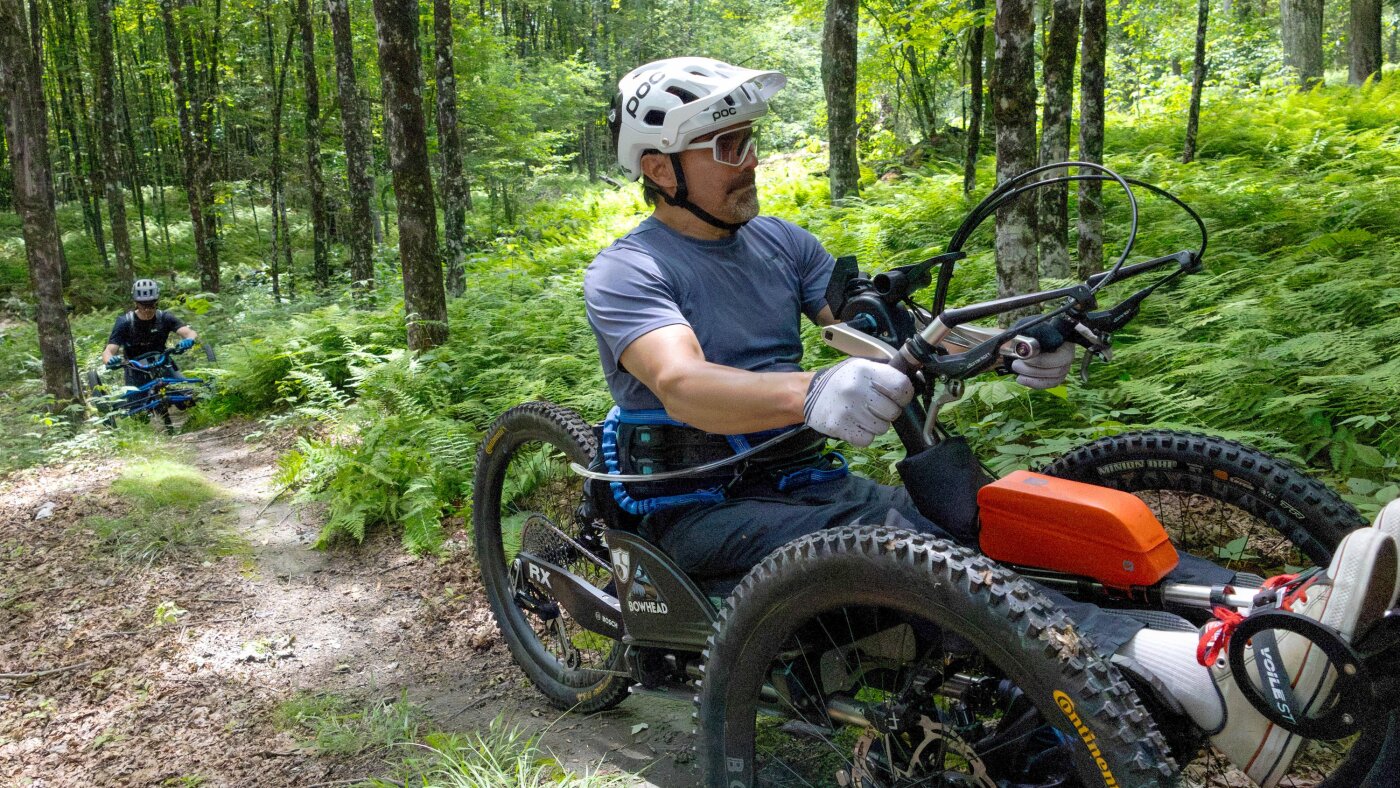
Louis Arevalo rides his adaptive mountain bike through the trails at Randolph Town Forest during an adaptive assessment on Thursday, June 25. Nick Bennette, with the Vermont Mountain Bike Association, rides behind.
Zoe McDonald/Vermont Public
hide caption
toggle caption
Zoe McDonald/Vermont Public
Mountain bike enthusiasts have been working for years on an ambitious 485-mile, multi-use trail called The Velomont that will span the length of the state.
When finished, the collaborative project will knit together existing trail networks, connect 27 communities and include huts and hostels for overnight stays.
New trail construction is finally ramping up after years spent on permits, plans and public input. And organizers say they want to make it as user-friendly as possible.
“For us, it’s not a huge lift to just be mindful when we’re trying to build trail or improve trail to think about the adaptive rider,” said Angus McCusker, the Velomont trail director with the nonprofit Vermont Huts and Trails.
McCusker is referring to the growing number of disabled athletes who mountain bike with specially designed equipment.
“The challenge,” said McCusker, “is we’re connecting to existing trail networks that were never intended for adaptive bikes. So, where we can, we’re trying to do adaptive assessments.”
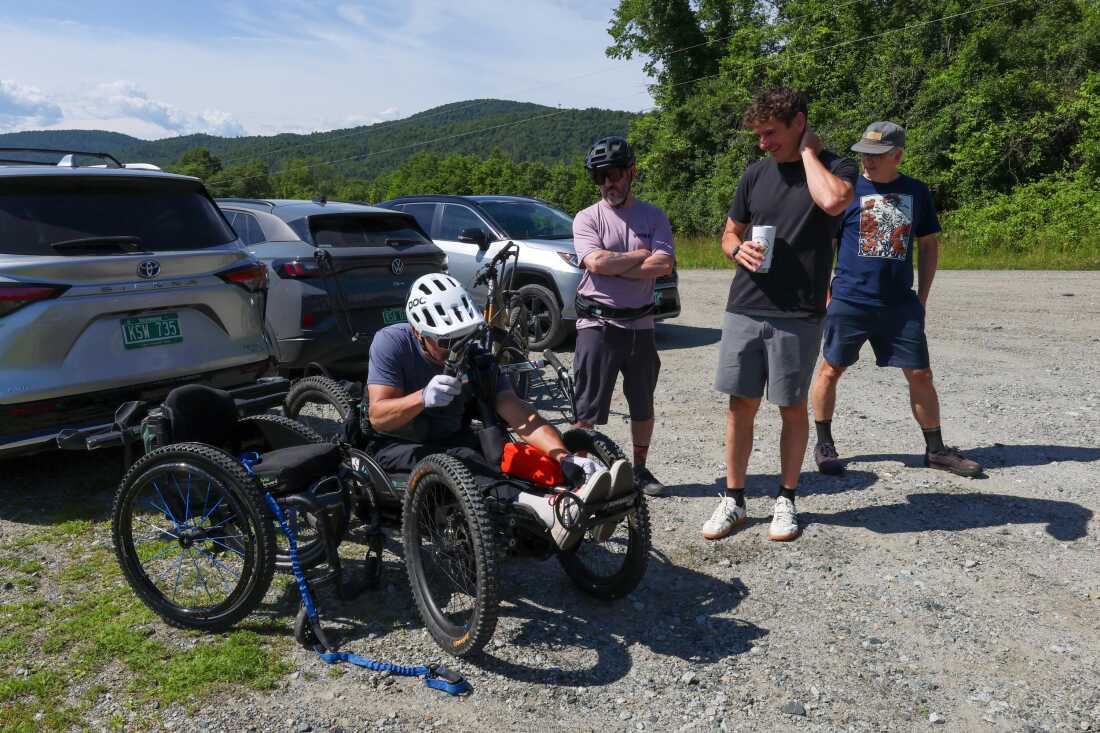
Louis Arevalo, left, straps into his adaptive mountain bike and chats with Jeff Dickson of the Vermont Mountain Bike Association, Angus McCusker with Vermont Huts and Trails, and volunteer Thatcher Hinman (all from left) ahead of a trail accessibility assessment in Randolph, Vermont, on Thursday, June 25, 2026.
Zoe McDonald/Vermont Public
hide caption
toggle caption
Zoe McDonald/Vermont Public
Louis Arevalo of Essex Junction is one of several adaptive athletes helping with that, most recently on some slightly overgrown single track trails in Randolph, a central Vermont town nestled along the eastern edge of the Green Mountains.
Arevalo pedals with his hands. He rides an electric powered recumbent-style three-wheeler that sits low to the ground. His service dog Azul chases along nearby.
“Once you realize what these bikes are capable (of) or this equipment actually opens up, it kind of blows your mind,” he said.
Arevalo was paralyzed in a skiing accident six years ago. Being able to get back on the trails has been a game changer, he said smiling.
“There’s a reason we live in the Green Mountain state. It’s because we like to get outside…you know, seeing the squirrels and chipmunks and birds… I mean, it’s life.”
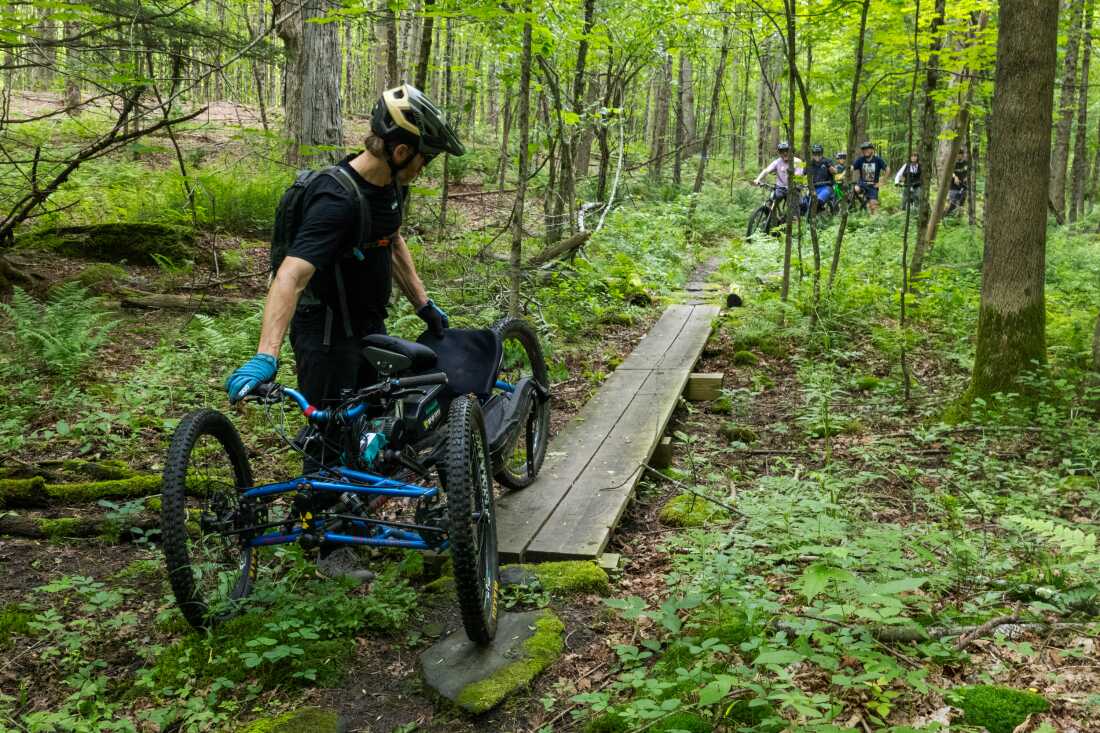
Nick Bennette, of the Vermont Mountain Biking Association, guides an adaptive bike over a narrow bridge, pointing out that other adaptive riders may have trouble getting across.
Zoe McDonald/Vermont Public
hide caption
toggle caption
Zoe McDonald/Vermont Public
But adaptive rigs like Arevalo’s are wider and heavier than regular mountain bikes, and not all trails are user-friendly.
Nick Bennette, who was testing a different type of adaptive bike, got hung up on several tight turns.
“It’s helpful to have different kinds of adaptive bikes on these tests because they all handle a little differently,” he said.
Bennette is executive director of the Vermont Mountain Bike Association, another nonprofit spearheading efforts around the Velomont. He and others involved in the assessment are taking detailed photos and notes on ways to make the trails more accessible.
“Just scalloping out a bit of material on the outside of that corner,” said Bennette, pointing to the area the bike got caught. “That will allow adaptive bikes to make that corner without really changing the way the trail rides.”
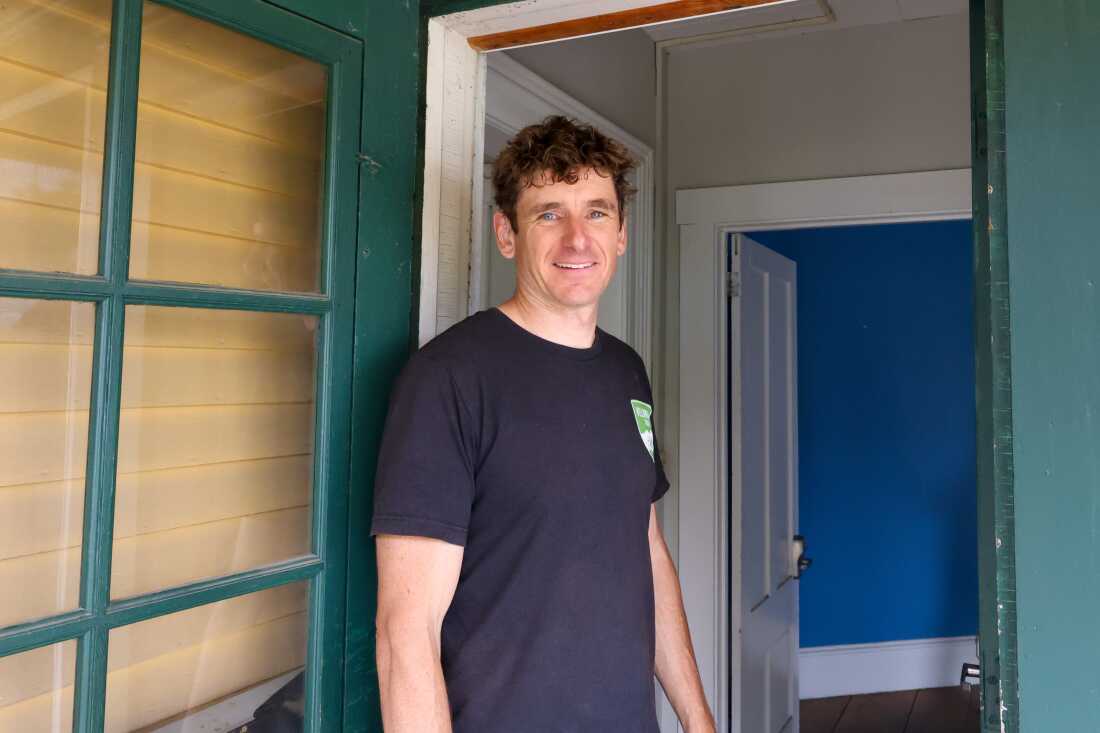
Angus McCusker with Vermont Huts and Trails is working to create accessible accommodations along the Velomont Trail, including a multi-group space in Randolph and a hut in Chittenden that has been outfitted with accessibility in mind.
Zoe McDonald/Vermont Public
hide caption
toggle caption
Zoe McDonald/Vermont Public
Contractors are also trying to reduce barriers at the trail’s overnight accommodations. This summer, contractors are building a new ADA accessible hostel in downtown Randolph.
And two remote huts along the trail will have locked sheds with off-road wheelchairs so bikers don’t have to haul their own.
At the Chittenden Brook Hut, McCusker highlighted a new ramp and wider driveway.
“So if you’re an adaptive rider, you can imagine rolling right up here and you can transfer to your chair that’s available here, and then roll down the ramp and go down to the fireplace, to the privy, to make your meal,” he said.
Louis Arevalo stayed at the hut last summer with other adaptive riders — his first camping trip since his accident.
“There was a babbling brook right there…and it was really refreshing to have easy access to a beautifully built hut that was easy to navigate, and then have these world-class trails right out the door,” he said. “And with these Velomont trails, I can actually plan a hut-to-hut trip with other people.”
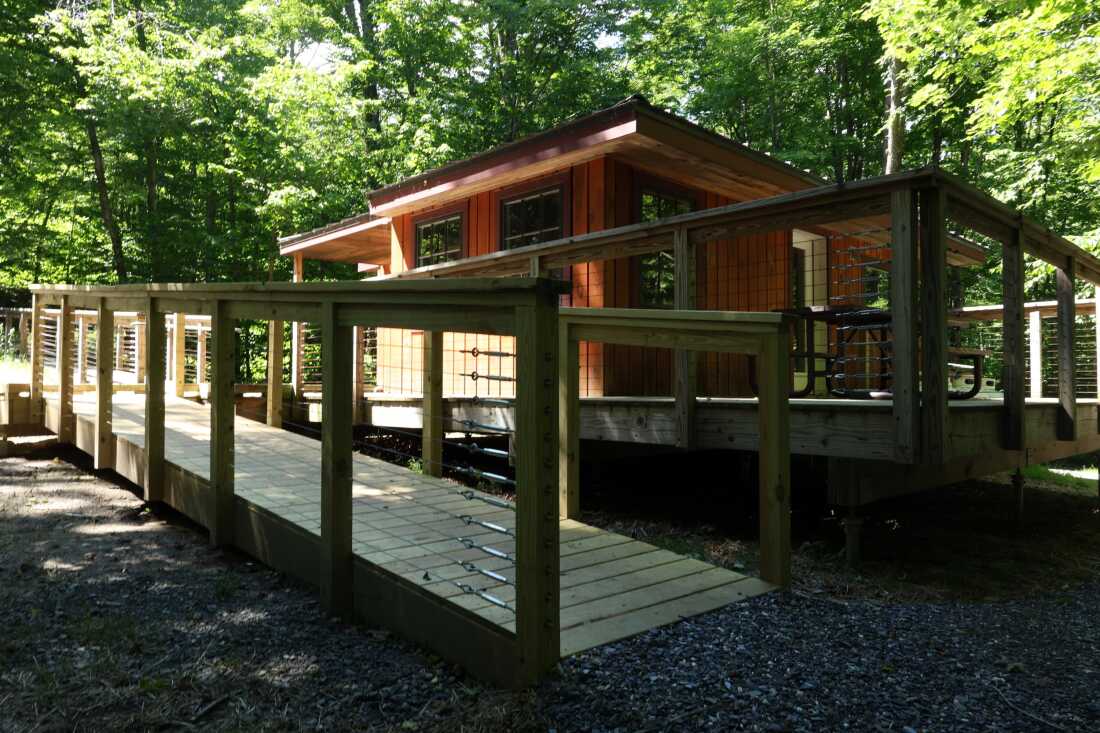
The Chittenden Brook Hut includes accessible ramps, storage for adaptive bikes and specialized off-road wheelchairs for visitors.
Zoe McDonald/Vermont Public
hide caption
toggle caption
Zoe McDonald/Vermont Public
Jeff Alexander is counting on it. He’s director of strategic partnerships with Vermont Adaptive Ski and Sports, a nonprofit that helps people with disabilities access outdoor recreation.
An economic impact analysis the group commissioned estimates their programming generated more than $10 million last year.
“So the adaptive community has money, they travel, they want to travel and they want to play with everybody,” Alexander said. “We just need to level the playing field so that everyone can play together.”
Powerball, Mega Millions jackpots: What to know in case you win
Here’s what to know in case you win the Powerball or Mega Millions jackpot.
Just the FAQs, USA TODAY
The Vermont Lottery offers several draw games for those willing to make a bet to win big.
Those who want to play can enter the MegaBucks and Lucky for Life games as well as the national Powerball and Mega Millions games. Vermont also partners with New Hampshire and Maine for the Tri-State Lottery, which includes the Mega Bucks, Gimme 5 as well as the Pick 3 and Pick 4.
Drawings are held at regular days and times, check the end of this story to see the schedule.
Here’s a look at July 8, 2026, results for each game:
Winning Powerball numbers from July 8 drawing
12-29-37-43-55, Powerball: 18, Power Play: 4
Check Powerball payouts and previous drawings here.
Winning Gimme 5 numbers from July 8 drawing
01-05-23-36-38
Check Gimme 5 payouts and previous drawings here.
Winning Pick 3 numbers from July 8 drawing
Day: 0-1-3
Evening: 2-4-0
Check Pick 3 payouts and previous drawings here.
Winning Pick 4 numbers from July 8 drawing
Day: 3-9-5-9
Evening: 9-2-0-9
Check Pick 4 payouts and previous drawings here.
Winning Megabucks Plus numbers from July 8 drawing
12-15-23-27-40, Megaball: 03
Check Megabucks Plus payouts and previous drawings here.
Winning Millionaire for Life numbers from July 8 drawing
16-18-43-48-50, Bonus: 01
Check Millionaire for Life payouts and previous drawings here.
Feeling lucky? Explore the latest lottery news & results
Are you a winner? Here’s how to claim your lottery prize
For Vermont Lottery prizes up to $499, winners can claim their prize at any authorized Vermont Lottery retailer or at the Vermont Lottery Headquarters by presenting the signed winning ticket for validation. Prizes between $500 and $5,000 can be claimed at any M&T Bank location in Vermont during the Vermont Lottery Office’s business hours, which are 8a.m.-4p.m. Monday through Friday, except state holidays.
For prizes over $5,000, claims must be made in person at the Vermont Lottery headquarters. In addition to signing your ticket, you will need to bring a government-issued photo ID, and a completed claim form.
All prize claims must be submitted within one year of the drawing date. For more information on prize claims or to download a Vermont Lottery Claim Form, visit the Vermont Lottery’s FAQ page or contact their customer service line at (802) 479-5686.
Vermont Lottery Headquarters
1311 US Route 302, Suite 100
Barre, VT
05641
When are the Vermont Lottery drawings held?
- Powerball: 10:59 p.m. Monday, Wednesday, and Saturday.
- Mega Millions: 11 p.m. Tuesday and Friday.
- Gimme 5: 6:55 p.m. Monday through Friday.
- Lucky for Life: 10:38 p.m. daily.
- Pick 3 Day: 1:10 p.m. daily.
- Pick 4 Day: 1:10 p.m. daily.
- Pick 3 Evening: 6:55 p.m. daily.
- Pick 4 Evening: 6:55 p.m. daily.
- Megabucks: 7:59 p.m. Monday, Wednesday and Saturday.
- Millionaire for Life: 11:15 p.m. daily
What is Vermont Lottery Second Chance?
Vermont’s 2nd Chance lottery lets players enter eligible non-winning instant scratch tickets into a drawing to win cash and/or other prizes. Players must register through the state’s official Lottery website or app. The drawings are held quarterly or are part of an additional promotion, and are done at Pollard Banknote Limited in Winnipeg, MB, Canada.
This results page was generated automatically using information from TinBu and a template written and reviewed by a Vermont editor. You can send feedback using this form.
Vermont
Poll: Most young Vermonters say they’re likely to leave state amid affordability concerns – VTDigger

Theo Wells-Spackman is a Report for America corps member who reports for VTDigger.
Nearly two-thirds of Vermonters ages 18 to 34 say they’re likely to leave the state within five years in search of adventure or a cheaper place to live, according to a poll from the University of New Hampshire.
Overall, the poll estimated that 86% of Vermonters find the state at least somewhat unaffordable.
“The issue of affordability has been a very important thing across New England,” said UNH political science professor Andrew Smith, who runs the institution’s survey center. The poll, released Tuesday, includes response data for five New England states, excluding Maine.
In general, the survey found, most residents say Vermont is a good place to live — or even a great one.
Nevertheless, about 40% of Vermonters of all ages want to leave the state, according to the report from Smith’s team. Housing prices and other cost-of-living concerns are the foremost drivers of the trend, researchers found, followed by tax rates. Connecticut and Rhode Island showed similar overall rates of desired departure.
Among young people, though, Vermont’s numbers stand out.
Smith’s research found that 63% percent of Vermonters between 18 and 34 say they’re somewhat or very likely to move out of the state in the next five years. That’s a much higher rate of planned departure than in any other state surveyed. Responses varied from 28% in New Hampshire to 44% in Connecticut.
But according to Smith, New England often sees a beneficial “boomerang effect”: former residents eventually returning to their home states, often as higher earners.
In a Wednesday press conference, Gov. Phil Scott said that although he hadn’t seen the poll, he wasn’t surprised by reports that many Vermonters are considering a move.
“I think there’s a lot of frustration out there,” he said. “We have a lot of work to do to make Vermont the affordable state that these folks need.”
About half of young Vermonters who said they want to move away cited the cost of living as a primary reason, while roughly as many said they were looking for a “new adventure or more excitement.” By contrast, less than a quarter of those older than 64 foresee leaving, according to the poll.
Outmigration of young people could worsen the state’s existing workforce shortage, according to Kevin Chu, who leads the research nonprofit the Vermont Futures Project. Scott’s administration has made workforce development a priority in light of what his office called a “growing demographic crisis.”
Chu added that by design, services such as public education and healthcare are supported disproportionately by working households that tend to pay higher taxes and insurance premiums. When the base of income earners shrinks, the problem can then intensify for those bearing the brunt of rising costs, he added.
“There’s a demographic reality in which the economic burden is being shouldered by a small and shrinking pool of young working-age people,” Chu said.
Tuesday’s poll also indicated that Vermonters who have completed more education say they’re less likely to leave the state. For Chu, that’s likely because such households tend to earn more — and also because they tend to be older.
Julie Lowell, deputy director of the Montpelier research nonprofit Public Assets Institute, offered a grain of salt in relation to Tuesday’s report. While migration is crucial to keep track of, Vermont’s overall population turnover tends to be about 5% or less each year, she said. And although the state does have an unusual number of young people intending to leave, that age group is always the most mobile in any study, she said.
In recent years, more of Vermont’s older population has possessed more wealth to contribute to public services, Lowell added. For example, she said, her organization has found that more Vermonters aging out of the workforce has not appeared to decrease state tax revenues in recent years.
But it’s true that many Vermonters are struggling to make ends meet, she said. The state’s lowest earners have seen low wage growth in relation to other New England states, she said, and basic needs are getting harder to cover.
“We’re seeing prices, in large part driven by housing and healthcare, really outpacing our increases in household incomes,” Lowell said. “Many people are feeling insecure.”
-

 Milwaukee, WI9 minutes ago
Milwaukee leaders condemn ICE arrests as agency ignores City mask ordinance
-

 Atlanta, GA12 minutes ago
Georgia Secretary of State opens investigation into voter registration mailers sent to deceased residents
-

 Minneapolis, MN17 minutes ago
Minneapolis chief communications officer Adam Fetcher out amid possible criminal charges
-

 Indianapolis, IN24 minutes ago
Indiana Workforce Pell Grant options limited so far
-

 Pittsburg, PA27 minutes ago
Pennsylvania leaders take new approach to cracking down on robocalls
-

 Augusta, GA32 minutes ago
Augusta domestic violence shelter faces shortfall after Georgia funding veto
-

 Washington, D.C39 minutes ago
Why Gov. Kim Reynolds turned down previous request to send National Guard to D.C.
-

 Cleveland, OH42 minutes ago
LGBTQ+ Ohio Nonprofit Guide

