Politics
San Francisco ties welfare to drug-screening, boosts police powers in stunning tough-on-crime shift

Mayor London Breed was all smiles during a packed primary party on Tuesday in Hayes Valley, a boutique neighborhood about a half mile from City Hall, stopping for selfies and congratulations as she navigated the crowded bar toward a microphone.
“Change is coming!” Breed shouted to thundering applause from the patio at the hip cocktail bar Anina.
Early results showed promise for a slate of local candidates running on a more centrist agenda, and for ballot measures that would transform downtown with new development and called on the city school board to reinstate Algebra I as an offering for middle school students.
But the focus of Breed’s excitement that evening was two ballot measures she championed to broaden police surveillance powers and impose drug treatment mandates that were garnering overwhelming voter support — a stunning rightward shift for a city known nationally for its progressive politics.
San Francisco Mayor London Breed rallies supporters during an election night party.
(Godofredo A. Vásquez / Associated Press)
The first measure, Proposition E, bolsters police powers in the city. The second, Proposition F, will require drug screening and treatment for people receiving county welfare benefits who are suspected of drug use.
The measures give teeth to efforts to address the city’s open-air drug addiction crisis — and the street crime and rampant homelessness that come with it. Taken together, they give credence to Breed’s message that San Francisco is not the bastion of lawlessness its critics love to claim.
“Enough is enough,” Breed said. “We need change.”
Breed faces a difficult reelection campaign in November as she seeks a second full term in office. Two of her opponents — Levi Strauss heir and nonprofit founder Daniel Lurie, and venture capitalist Mark Farrell, a former district supervisor and interim mayor — are considered moderates by San Francisco standards, and have blasted the mayor for the city’s street conditions and the lagging post-pandemic economic recovery.
A third opponent, Board of Supervisors President Aaron Peskin, is a well-known progressive likely to garner support among stalwart liberals concerned with the city’s recent shift toward the center.
As she navigates a middle path forward, Breed’s supporters hope the ballot victories inject her reelection bid with a jolt of energy and chart a clearer path forward for a city that has struggled to get homeless people off the streets and to rebound from the pandemic-related exodus of its downtown tech sector.
“This is a really good night for London Breed, Madam Mayor,” state Sen. Scott Wiener (D-San Francisco) told the crowd. “This city has been getting beaten up for the last few years, and San Francisco is coming back, and it’s going to be even better than ever.”
The ballot measures approved Tuesday build on several initiatives Breed has spearheaded over the past year to put teeth to the city’s efforts to stem drug addiction and overdose deaths, adding punitive components to policies that long have centered on a gentler treatment-focused approach.
Last fall, city officials announced plans for a law enforcement task force, set to launch in spring, that will investigate opioid deaths and illicit drug dealing in the city as potential homicide cases. Months before, Democratic Gov. Gavin Newsom deployed the California National Guard and California Highway Patrol to target drug-trafficking networks funneling fentanyl into the Tenderloin and South of Market neighborhoods, an operation that has led to hundreds of arrests.
Breed contends those efforts are paying off: Over the last six months, property crime has fallen by 30% and violent crime by 4%, according to the mayor’s office.
San Francisco Mayor London Breed says the ballot measures voters approved this week give needed teeth to efforts to address the city’s drug crisis.
(Godofredo A. Vásquez / Associated Press)
Breed said the drug-screening initiative will build on those efforts by compelling more people with substance-use disorder into treatment.
Proposition F, set to go into effect in January 2025, will modify the County Adult Assistance Programs, which offers cash benefits to low-income single adults 65 and under without dependent children. Recipients will now be required to undergo a drug-screening assessment if there’s “reasonable suspicion” they struggle with substance-use disorder, and to enter into treatment if warranted.
Proponents say the change will safeguard city resources against a street drug culture that’s ballooned because of San Francisco’s lenient policies and generous benefits.
The program assisted about 5,700 people monthly in the 2022-23 fiscal year, according to the city controller’s office, with some recipients receiving up to $712 per month. Between March 30, 2023, and the start of February, 141 people who were cited for public drug use were also receiving the county assistance, according to the mayor’s office. Of those, 33% did not actually live in San Francisco.
“This is just adding another level of accountability of screening, and hopefully what will lead to the kind of results we want to see: people who are in treatment and people who end up getting clean and sober,” Breed said.
Critics of Proposition F dismiss it as a poorly crafted proposal that fails to fix the roots of the city’s homeless crisis: a lack of affordable housing and quality treatment options. They echoed a popular progressive tenet that forcing people into drug treatment doesn’t work, and said the policy changes will have devastating consequences on low-income residents who rely on the assistance to for housing and other necessary expenses.
“It’s just going to make treatment less accessible for everyone in San Francisco,” said Jeannette Zanipatin, state director for the left-leaning nonprofit Drug Policy Alliance. “To sell an initiative with false promises is just really the mayor and her office choosing political convenience over really trying to roll up their sleeves and find real solutions that are actually going to have an impact on the overdose crisis.”
The measure wasn’t drafted with specific rules around how the drug screening will be administered or how treatment will be enforced. Breed has directed the city’s Human Services Agency to create an “action plan” for implementation, meaning it could be months before official guidelines are available.
Breed’s office has said the measure was intentionally designed to be flexible on the treatment component. Treatment options could range from out-patient services to a prescription for buprenorphine, a medication used to treat addiction. They noted it doesn’t include a requirement for participants to remain sober, recognizing that people often lapse in recovery and shouldn’t be kicked out of the program for a slip-up.
“I don’t think Proposition F is as bad as its critics say it is, and it’s probably not going to be a panacea as some of its more fervent supporters said it was either,” said Supervisor Matt Dorsey, a moderate Democrat who’s been candid about his own addiction recovery journey. “But I do think on balance, it’s a step in the right direction.
Wiener, one of the state Capitol’s leading progressives, didn’t support Proposition F but said he understands why people voted for it. “Only by San Francisco standards would this be considered moderate,” he said. “As in many cities right now, there is a concern about public safety and public drug use and people want their neighborhoods and their city to be as good as it can be.”
Proposition E, the measure that bolsters police powers, also passed handily. The measure weakens certain oversight authority by the Police Commission, which has been a voice for clamping down on police use of force.
The measure also eases restrictions that have been blamed for fostering a lax police response to retail and property crimes. It provides more leeway for police to pursue suspects by car and allows officers to use drones for certain pursuits. The changes also loosen requirements for documenting suspect confrontations that lead to police use-of-force and authorize body camera footage to stand in for certain paperwork.
Supporters of Proposition E said it will cut the amount of time police spend behind desks on administrative tasks and ensure they are properly equipped with technology to fight crime. Opponents see a troubling retrenchment toward reduced transparency and oversight.
“It made it easier for SFPD to hide police violence and makes it harder for the public to hold police officers accountable,” said Yoel Haile, director of the Criminal Justice Program at the ACLU of Northern California. “What we’re seeing right now happen is politicians who are offering the public these tried and failed solutions as the magic bullet to real frustrations that people have about crime and public safety.”
Breed is offering no apologies.
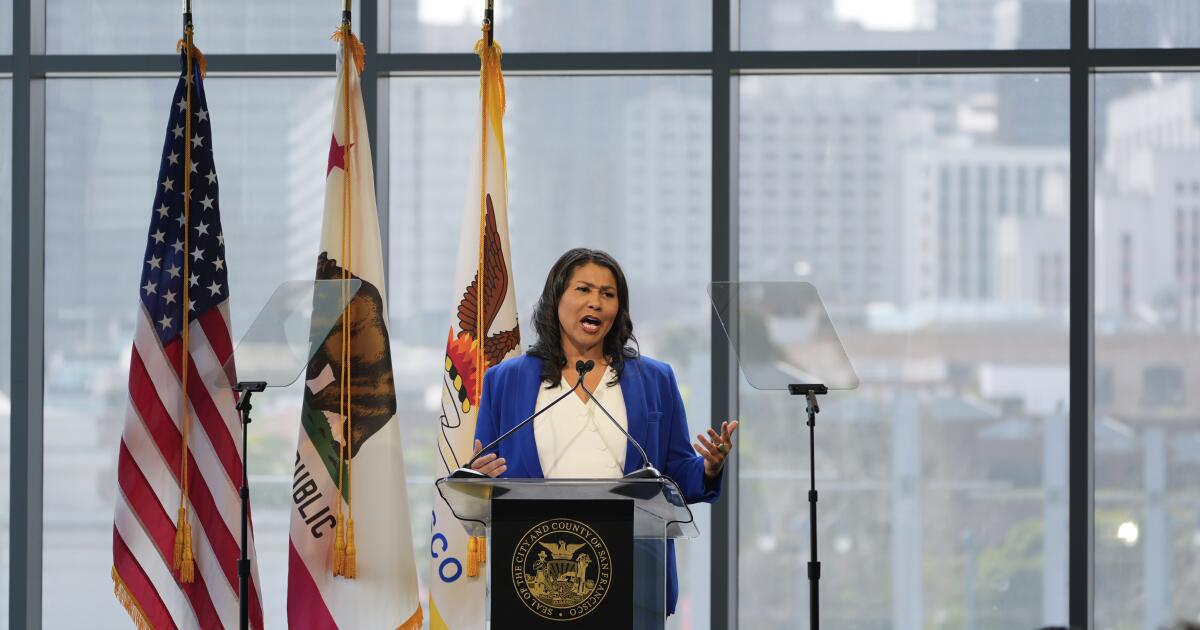
On Thursday, she delivered her State of the City address at Pier 27, a waterfront venue with a shimmering view of the city’s skyline as her backdrop. She sharply rebutted the narrative that San Francisco had lost its progressive way, instead positing that Tuesday’s election results were in alignment with the city’s liberal values to house and treat those suffering from addiction and provide communities with quality policing.
Throughout her speech, she doubled down on the message that San Francisco is turning a corner, proclaiming it a “city on the rise.”
“San Francisco is not wearing the shackles of your negativity any longer,” she said as the room echoed with applause.


NEWYou can now listen to Fox News articles!
“Two down and two to go” blared the new wanted poster targeting the two remaining fugitive sons of infamous Mexican cartel kingpin Joaquin “El Chapo” Guzman-Loera, who is serving life-plus-30-years in Colorado’s federal supermax prison.
On Monday, ICE posted a new wanted poster for two members of “Los Chapitos” — Ivan Archivaldo Guzman Salazar and Jesus Alfredo Guzman Salazar, two of El Chapo’s sons with his first wife, Alejandrina Maria Salazar-Hernandez.
After El Chapo’s final capture in 2016, control of the powerful Sinaloa Cartel shifted to Ismael “El Mayo” Zambada. Following Zambada’s arrest during the Biden administration, leadership passed to Guzman’s four sons.
MEXICAN SENATOR ACCUSES SHEINBAUM OF SHIELDING ‘NARCO-POLITICIANS’ AFTER US CARTEL INDICTMENT
Both the Trump administration in the U.S. and the Sheinbaum administration in Mexico have said they are focused on cracking down on cartel’s new leadership.
“Two down and two to go with $10 million reward,” the wanted poster read, with Xs over the faces of the already captured Joaquin Guzman Lopez and Ovidio Guzman Lopez.
The two captured Chapitos are reportedly cooperating with authorities and have not yet been sentenced, but Ivan and Jesus remain “armed and dangerous,” according to ICE.
ICE NABS ACCUSED MS-13 KILLER HIDING IN NORTHERN VIRGINIA SUBURB
El Chapo Guzman arrives in the United States after his capture in Mexico. (AP File)
The two fugitives are charged with conspiracy to distribute a controlled substance and operating a continuing criminal enterprise.
Two of Guzman’s four sons have already been captured through Operation Take Back America, an initiative seeking the “total elimination of cartels and transnational criminal organizations” in order to protect U.S. communities from violent crime.
U.S. Attorney for the Northern District of Illinois Andrew Boutros said in a recent statement that efforts to capture El Chapo’s sons are the latest steps “in our efforts to bring to justice drug lords and other dangerous criminals who poison the American public with illegal and harmful drugs and who otherwise engage in violence and corruption to carry out their and their enterprises’ wide-reaching criminal activities.”
US MILITARY KILLS TWO ALLEGED NARCO-TERRORISTS IN LATEST EASTERN PACIFIC STRIKE ON DRUG-TRAFFICKING VESSEL
Joaquin “Shorty” Guzman, center, is escorted by soldiers during a presentation at the Navy’s airstrip in Mexico City. (Reuters/Edgard Garrido)
SIGN UP TO GET THE POLITICS NEWSLETTER
In his plea agreement, Guzman Lopez admitted that he and his cartel associates committed violence against law enforcement officials, rival drug traffickers and members of their own organization to protect the Sinaloa Cartel’s trafficking operations.
CLICK HERE TO DOWNLOAD THE FOX NEWS APP
Fox News Digital reached out to ICE and DHS for additional comment and information on the mission to capture the two at-large Chapitos.

WASHINGTON — President Trump said Monday that he called the president of FIFA to dispute a red card that would have barred the American striker Folarin Balogun from playing in Monday’s elimination game with Belgium, acknowledging an extraordinary intervention by a head of state in the sport’s disciplinary process.
“I asked for a review because I didn’t think it was a foul,” Trump told reporters during an event in the Oval Office. “I am good at this stuff. I didn’t think it was a foul. I thought it was two great athletes that crashed into each other and got entangled.”
FIFA subsequently rescinded Balogun’s suspension, the first time the governing body has reversed a red-card penalty during a World Cup in 64 years. Belgium has protested the decision, and a hearing is scheduled for Monday to determine whether Balogun’s reinstatement will stand.
Trump said it would be a “stain” on the World Cup to let the penalty stand, and even called the referee who issued the card “suspect” with a questionable past, though he did not provide evidence to support the accusation.
While many in the United States joined the president in celebrating the reversal, others blasted its adverse impact on the integrity of the sport.
The Belgium team has protested the penalty reversal, with the country’s soccer federation saying it was “astonished” by the ruling.
“We are not defending the national team or federation. We are defending football,” Belgian coach Rudi Garcia said.
The episode has drawn attention to Trump’s close relationship with Gianni Infantino, the president of FIFA. In December, Infantino presented Trump with the inaugural FIFA Peace Prize, an award the governing body created after Trump was passed over for the Nobel Peace Prize. That decision is now the subject of an ethics complaint, backed by members of the European Parliament, who argue it compromised FIFA’s political neutrality.
Trump appeared to downplay the significance of his call to Infantino.
“I can’t tell him what to do, and I don’t believe he made the decision,” Trump said. “I think it was a committee that made the decision, and they made the right decision, because number one, it wasn’t a foul, and you want to see a game with your best players.”
But he said it would be “very unfair” and “terrible” to not let Balogun play. He said it would be the equivalent of barring Argentina’s Lionel Messi or Portugal’s Cristiano Ronaldo — both global superstars — because they “ran” or “bumped” into someone on the field.
“We have to have our best players, and they have to have their best players. And if we win or we lose, it’s fair,” Trump said. “Let’s say we lost [Balogun] and we lose the game — it would be a terrible thing.”

Secretary Burgum condemns vandalism targeting National Mall amid new threats
Interior Secretary Doug Burgum reacts to a disturbing pattern of vandalism targeting the National Mall, including the Lincoln Memorial Reflecting Pool, which suffered significant damage. Burgum details the restoration efforts, the deployment of security and the arrest of seven individuals involved. He stresses that such acts are an attack on the country and will be prosecuted to the full extent of the law.
NEWYou can now listen to Fox News articles!
President Donald Trump and his Interior Department are declaring an America 250 victory over algae in the Lincoln Reflecting Pool.
Trump shared photos on Truth Social on Sunday showing the pool and the reflection of the Washington Monument appearing clear and blue, and made a call out with a “Wanted” poster for vandals.
“The U.S. Park Police is seeking the public’s assistance in identifying the individual in the notice below in connection with a Destruction of Government Property investigation related to the Reflecting Pool,” Trump wrote Sunday on Truth Social.
Trump also shared an Interior Department statement crediting “advanced nanobubbler technology” and National Park Service cleanup work.
FORMER US OLYMPIAN DAVID HEARN INDICTED IN ALLEGED REFLECTING POOL VANDALISM
President Donald Trump is touting the algae cleanup and the prosecution of vandals from the Lincoln Reflecting Pool, with the water proving clear and refective in this July 3 photo. (Finn Gomez/Getty Images)
“The advanced nanobubbler technology very effectively killed the algae that has plagued every Lincoln Reflecting Pool reopening — most infamously Obama’s reopening — since 1922,” Dei Gratia Minerals founder Greg Wischer, Interior’s deputy assistant secretary for land and minerals management, wrote in a letter shared with Interior Secretary Doug Burgum and Trump.
“The Reflecting Pool water is crystal clear, and our National Park Service team is now vacuuming up the dead algae resting on the bottom of some parts of the Reflecting Pool — just like the destroyed Iranian Navy resting on the bottom of the Persian Gulf.”
The photos shared by Trump show the Reflecting Pool stretching toward the Washington Monument under blue skies. One image appears to show the pool from the Lincoln Memorial end, while a second closer view shows the Washington Monument reflected in the water.
Trump also shared a U.S. Interior Press social media post hailing the technological success, quoting that Wischer memo.
YOSEMITE, GRAND CANYON LEAD NOTABLE LIST OF NATIONAL PARK CAMPGROUNDS FOR AMERICA’S 250TH
Pete Folch carries an American flag during a morning run past the Reflecting Pool as the city prepares for July 4th festivities on July 3, 2026, in Washington, D.C. (Joe Raedle/Getty Images)
“The vacuuming is the final maintenance step after refilling the pool, and it will be complete in a few days,” his memo continued. “Already, the section of the Reflecting Pool closest to the Lincoln Memorial has been vacuumed up, and the beautiful American Flag Blue coating on the bottom of the pool can be seen clearly.”
Trump’s Interior Department has praised the technology for overcoming past challenges in keeping the pool clear, including dunking on former President Barack Obama.
“Previous administrations — most notably under Obama — failed to maintain the Reflecting Pool, and after refilling the pool, the water would quickly become murky and thick with massive clumps of algae floating on the surface,” the memo concluded.
INTERNAL EMAILS EXPOSE HOW JULY 4TH BASH IS BEING DERAILED BY DEM-RUN COUNTY: ‘OFFENSIVE’
Police said the incident happened on Friday at around 3:36 p.m. at the Reflecting Pool on the grounds of the Lincoln Memorial in the nation’s capital. (U.S. Park Police)
“The photos below show how the nanobubbler technology and vacuuming have been incredibly effective, making the water crystal clear with the American Flag Blue coating shining brightly on the bottom of the pool.
“As our National Park Service team noted, the Reflecting Pool is now so ‘blue’ that the Fake News Media, which has been staked out at the Reflecting Pool for weeks, has fled!”
The 6.75 million-gallon pool has been targeted by Trump critics and leftist anti-Trump activists for attacks both verbally and physical, Burgum discussed with ABC’s “This Week” on Sunday.
“The Reflecting Pool has been a big success,” he said. “And we’ve got 340 million people in this country that are celebrating 250. We did have a few vandals, but all that’s going to be repairable, and that’ll all be fixed in the coming weeks as we go forward.”
People look out at the Reflecting Pool and Washington Monument from the steps of the Lincoln Memorial ahead of July 4 festivities on July 03, 2026, in Washington, D.C. (Joe Raedle/Getty Images)
Burgum now believes that the pool might not require a full draining after its “multiple gashes that add up to 350 feet,” he added.
“We don’t know if we need to drain the whole thing or not because, you know, the cutting happened on the edge, and, of course, it slopes from the edge,” according to Burgum.
“We may be able to partially drain it and do the repair. To be able to fix it, we may not have to drain the whole thing, but it could go very quickly.”
CLICK HERE TO DOWNLOAD THE FOX NEWS APP
While the media and Trump critics are pointing to added costs of the reflecting pool refurbishment, Burgum pointed to the vandalism causing that.
“We weren’t expecting that we were going to have a small group of people that wanted to try to destroy effectively what is part of the Lincoln Memorial,” Burgum told ABC. “There’s plenty of cameras around the Lincoln statue and around the memorial, but the Reflecting Pool had gone for, you know, decades without vandalism.”
-
North Dakota10 minutes ago
ND ATTORNEY GENERAL TO RELEASE 2025 CRIME STATISTICS – North Dakota Attorney General
-

 Ohio13 minutes ago
Veteran Officer Among 4 Dead in Ohio Shooting
-

 Oklahoma18 minutes ago
FFA members attend Oklahoma FFA Alumni Leadership Camp
-

 Oregon25 minutes ago
Oregon’s Class Surges in Team Recruiting Rankings to No. 3
-

 Pennsylvania28 minutes ago
Pennsylvania State Police on scene of ‘active incident’ in Marysville
-

 Rhode Island33 minutes ago
Rhode Island participates in ‘New England Drive to Save Lives’ campaign
-

 South-Carolina40 minutes ago
Georgetown County Sheriff Carter Weaver named South Carolina Sheriff of the Year: SCSA
-

 South Dakota43 minutes ago
South Dakota native lived near Iranian missile & drone attacks

