Kansas
Kansas House moves abortion survey bill; draws erectile dysfunction, vasectomy amendments • Kansas Reflector


TOPEKA — The Kansas House plowed through hours of debate before advancing legislation Wednesday doubling the frequency of state health agency statistical reports on abortion and requiring more than a dozen questions be added to surveys of females contemplating termination of a pregnancy.
The dialogue about House Bill 2749 was interrupted by rare discussions about public health merits to surveying men to determine the frequency and reasoning behind decisions to undergo a vasectomy birth control procedure or to better understand prevalence of individuals seeking medical care for erectile dysfunction.
Republicans supporting the bill requiring the Kansas Department of Health and Environment to compile twice-a-year reports, weren’t thrilled with the amendments on erectile dysfunction and vasectomies. Democrats proposed both to illustrate what they believed were increasingly intrusive questions of women on the abortion survey.
GOP House members argued biannual reports on abortion would help guide the Legislature’s decisions on serving interests of pregnant women. Democrats in the House claimed the supplemental reporting would be used by anti-abortion forces interested in finding a way to ban abortion in Kansas.
“This bill was not taken lightly,” said Rep. Brenda Landwehr, a Wichita Republican and chair of the House Health and Human Services Committee. “We just want to have more information. Make sure we’re making the right decision for these women.”
In August 2022, Kansas voters overwhelmingly rejected a proposed amendment to the Kansas Constitution that would nullify a decision of the Kansas Supreme Court that declared the state’s Bill of Rights contained a fundamental right to bodily autonomy that extended to termination of a pregnancy. Anti-abortion organizations, including bill-sponsor Kansans for Life, responded the past two years with a collection of bills aimed at deterring abortion in the state. That lobbying activity occurred while Kansas became a magnet for women who sought a legal abortion but lived in states that essentially banned the procedure.
Currently, KDHE has responsibility for preparing an annual summary of abortions in Kansas. The latest report issued in June 2023 covered the 2022 calendar year. It indicated Kansas had 12,318 abortions that year, with 3,842 or 31.2% performed on Kansas residents. The report said 83.1% were unmarried, 59.6% were at less than nine weeks gestation and 99% reported they weren’t subjected to physical, mental or emotional abuse.
‘Invasive, stigmatizing’
Under the House bill advanced to final action on Thursday, the report would be published twice annually and would contain results of questions about why patients sought an abortion. The patients wouldn’t be required to answer, but supporters of the legislation said they needed insight into the following: Does the patient believe she has enough children? Is the patient unable to afford a child? Is the patient’s husband or partner abusive? Does the patient lack family support to raise a child? Is the pregnancy the result of rape or incest? Does the pregnancy threaten the patient’s physical or mental health? Is the abortion sought because the child would have a disability?
Landwehr’s committee removed from the list of questions inquiries tied to whether pregnancy interfered with the patient’s career, whether the patient was mature enough to raise a child and whether the abortion was sought to prevent people from knowing the female was sexually active.
The new questions contained in the bill would be coupled with inquiries on previous KDHE surveys regarding patient age, marital status, residency, race, education level, domestic violence as well as the method of abortion.
Rep. Lindsay Vaughn, an Overland Park Democrat, said advocates of the bill suggested the motivation was to gather information useful in shaping public policy for the behalf of women. In reality, she said, the objective was to collect “invasive data with the ultimate purpose of eliminating abortion in Kansas” while also “stigmatizing and potentially retraumatizing” women seeking abortion health services.
“In truth,” Vaughn said, “this bill is not about innocuous data collection. Patients seeking any other form of necessary health care would never be asked such intrusive and personal questions to justify why they are seeking that care. This bill is about targeting women who make the difficult and extremely personal decision to get an abortion.”
On the contrary, said Coffeyville GOP Rep. Ron Bryce. He said that as a practicing physician — he’s licensed in Texas, not Kansas — all sorts of questions were required to be asked of patients. He said the list included drug use, personal safety, guns in the home, contraception, sexual partners and inquiries about financial stress and educational attainment. The objective of those questions was to gather facts rather than make assumptions, he said.
“There is absolutely nothing in this bill that is different or intrusive compared to the status quo,” said Bryce, who introduced the bill on behalf of Kansans for Life. “These questions do serve a purpose. They provide data on the underlying factors that drive young women into these difficult situations.”

The vasectomy question
Rep. Melissa Oropeza, a Democrat from Kansas City, Kansas, said she was convinced the scope of questions to be raised with women seeking an abortion was inhumane. She said the extensive line of inquiry in the bill resembled a university or government research project that neglected to proactively secure informed consent of patients.
She said it occurred to her the bill was another gender-specific intrusion into relationships between doctor and patient. Along that line, she said it could be useful for the state of Kansas to gather information about incidence of vasectomies in wake of the U.S. Supreme Court striking down the landmark Roe v. Wade decision guaranteeing abortion rights throughout the country.
“I agree there are things we do need to know about reproductive care,” Oropeza said.
Her amendment tied to reasons behind a potential rise in vasectomies was determined by a House panel to not be germane to a bill mandating an abortion survey of Kansans.
Rep. Stephanie Sawyer Clayton, D-Overland Park, offered an amendment requiring KDHE to collected from physicians and clinics information on the sexual health of Kansas men seeking professional health care for erectile dysfunction. In particular, her amendment would delve into questions about erosion of self-confidence among people experiencing erectile dysfunction and what the patients considered the reasons for seeking treatment.
“I do think erectile dysfunction is a scourge on the state of Kansas,” Sawyer Clayton said. “I think it causes issues when it comes to our very important birth rate.”
Landwehr, chair of the House health committee, said Sawyer Clayton’s amendment was not suitable for an abortion regulation bill and had nothing to do with male body parts. The Sawyer Clayton amendment was withdrawn before it could be put to a vote in the House.
The bill was endorsed by Kansans for Life, Alliance Defending Freedom, Kansas Family Voice and the Kansas Catholic Conference. Objections were raised by Planned Parenthood Great Plains Votes, Trust Women Foundation, Loud Light Civic Action and the Mainstream Coalition.



WICHITA, Kan. (KSNW) — Colorado-based chicken restaurant Birdcall is expanding into Kansas.
The company announced Friday its plans to expand into Kansas and five other Midwestern states over the next five years. Birdcall plans to add six to eight fast-casual restaurants in Wichita and Topeka.
“The Midwest represents a tremendous opportunity for Birdcall,” CEO Mark Lohmann said. “From our award-winning chicken sandwiches and other handcrafted menu offerings to our commitment to innovation and community, we believe Birdcall offers an experience that resonates with today’s guests and is a natural fit for the region.”
Other locations announced are:
- Indiana – 10 to 15 restaurants across Indianapolis, Bloomington, Evansville and Fort Wayne
- Missouri – Up to 18 restaurants across St. Louis, Columbia, and Kansas City
- Nebraska – Seven to 10 restaurants across Omaha and Lincoln
- Ohio – Up to 20 restaurants across Cleveland, Cincinnati, Columbus and Toledo
- Wisconsin – 10 to 15 restaurants across Milwaukee, Madison and Appleton
Birdcall’s menu features a variety of chicken sandwiches, chicken fingers and nuggets, salads, tater tots, fries, and more. The restaurant also makes its own in-house sauces and serves up draft beer and house-made margaritas, with happy hour specials.
The company said each restaurant will use self-service kiosks and occupy about 2,300 square feet, with indoor and outdoor seating that can serve up to 150 people.
Birdcall currently operates 17 restaurants across Colorado, Arizona and Texas.
For more Kansas news, click here. Keep up with the latest breaking news by downloading our mobile app and signing up for our news email alerts. Sign up for our Storm Track 3 Weather app by clicking here. To watch our shows live on our website, click here.

KSHB 41 reporter Ryan Gamboa covers Miami County in Kansas and Cass County in Missouri. He also covers agricultural topics. Share your story idea with Ryan.
—
A video shared by a viewer, shows a resident speaking at the Osawatomie, Kansas City Council meeting being escorted out by police on Thursday evening.
The video shows a man holding a “Hell No Alcove” sign, while commenting about a blighted property, which according to public records is owned by Pacific Apartments, LLC, operating out of the same address as Alcove Development in Lawrence, Kansas.
KSHB 41
Alcove Development is behind the effort to build a $1 billion, 283-acre data center development in Osawatomie’s northland property.
The video, shared by a viewer, goes on the show two law enforcement officers approaching the individual, who is Lee Brewer, at the podium, after he begins to yell, while the crowd joins in behind him. Lee Brewer reached out to KSHB 41 late Thursday night, identifying himself as the person who was escorted out.
Osawatomie, Kansas Police Chief Dave Stutteville is seen in the video also approaching the man.
Fabian Rosales/KSHB
KSHB 41 Miami County Reporter Ryan Gamboa reached out to the Police Chief, City Manager, and Mayor Nick Hampson for comment late on Thursday night and is waiting on a response.
Residents in contact with Gamboa attending the meeting shared the meeting was still in session after 9:30 p.m.
Thursday night’s meeting was the city and Alcove Development’s attempt at sharing potential benefits of a data center for the community.
Gamboa has long covered the data center project in Osawatomie, Kansas — and neighbors to the project have voiced their opposition to the proposed development.
Brian Luton/KSHB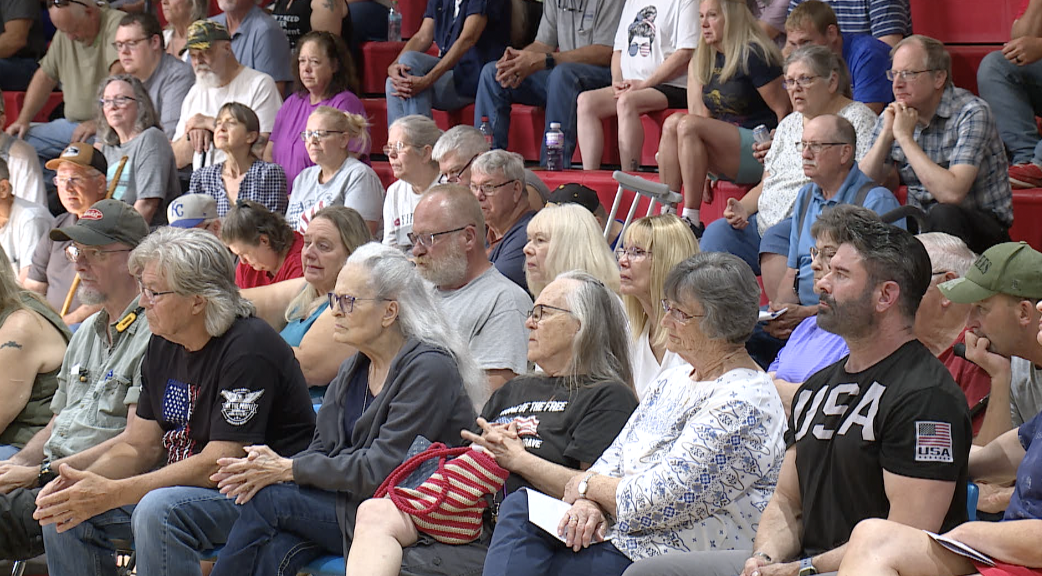
This is the first time Alcove Development has approached the public, but not the first time it has worked with the city of Osawatomie.
In late 2025, Alcove Development approached the city with the project and weeks later, a pre-development agreement was signed giving Alcove exclusive rights to the development for three years.
But city council meeting records from 2023 show, the city of Osawatomie entered into a pre-development agreement with Alcove Development to redevelop a property known as Old Swenson School.
Alcove Development had six months to asses the condition of the property and determine a course of action for redevelopment, and the overall agreement would last 18 months, according to public records.
Will Shaw/KSHB
The pre-development agreements states, Alcove would consider asking for tax breaks on the project, including utilizing the Low-Income Housing Tax Credit.
At the time, the property had sat in disrepair since 2016, according to the records, and was frequently found in violation of city code.
If the re-development were to fall through, the city would be on the hook to purchase the property from the developer for $25,000, with unclear total costs for infrastructure improvements.
KSHB 41

KSHB 41 will follow up on the status on this project at a later date.
Earlier this week, Miami County Reporter Ryan Gamboa, sat down with Donna Ingram who doesn’t live far from the data center site.
Ingram expressed her concerns about the amount of infrastructure that would be built to operate a data center, and how it might overtake the land around her home.
Ryan Gamboa/KSHB

She expressed concerns because the City of Osawtomie changed the public comment guidelines of a promise town hall with the developer.
“Watching this process play out is disheartening,” Ingram said in an interview on Monday. “A town hall was promised that didn’t come to fruition… I don’t believe it’s the definition. This is a city council meeting. We’re the ones that are gonna live next to it. We’re the ones that live in the path of the infrastructure.”
The city told KSHB 41 on Monday in a statement, they changed the format to prioritize the voices of city taxpayers, as county taxpayers have dominated the public comment periods over the past couple of months.
Brian Luton/KSHB

Mayor Nick Hampson also told Gamboa in an earlier interview he was hoping to have a productive “town hall” — instead, the first meeting with the public and the developer of the project was during a formal and regularly scheduled city council meeting.
The city also required residents to submit questions ahead of time, and the city would filter questions to the developer, while limiting public comment to three minutes.
“We have been and will continue to hear from the residents that are in the county and closest to this project,” Hampson told KSHB 41 in an email on Monday.

Miami County, Kansas
Residents shared a record to KSHB 41, submitted to the city for a formal investigation into 1009 Pacific Avenue in Osawatomie, which is owned by a company operating out of Alcove Development’s address.
The dilapidated property is the a former school house, that sits with broken windows, and other parts of the building breaking down.
The Miami County Republic reporting on Thursday, the city launched an investigation into the building.
Ryan Gamboa/KSHB
Residents cite the buildings deteriorating condition and potential danger to the public, and lack of property maintenance.
Lee Brewer issued a comment regarding the incident at Thursday night’s meeting, stating he was escorted out after the Mayor closed public comment, and he was not on the list.
Brewer told KSHB 41, he has a time -stamped email of pre-submitted questions ahead of the meeting. KSHB 41 asked Brewer to review the email, and is waiting for an answer.
I am severely disappointed in our Mayor and the city council. They told us we were required to send in an email with our questions and our address to prove we were citizens of the town by Wednesday the 24th at noon. I have my email which is timestamped at 10:26 a.m. Wednesday the 24th. They shut me down and first told me I didn’t put the email in and then once I was kicked out of there I was told by people coming out that they were told I turned in my email too late. I’m not a math teacher but last time I looked at my clock 10:26 a.m. falls just over an hour and a half before noon. I mean correct me if I’m wrong. I thought because the mayor and I were having decent conversations on Facebook Messenger, whereas I would ask him questions and he would answer to the best of his ability. And I would thank him I thought we were pretty cordial. So to basically call me a liar in front of the entire town on video recording, take away my freedom of speech My first amendment right, and have me removed from a public building was completely wrong I am very disappointed in our city council and mayor. When I approached the podium all I was trying to do was point out that resolution number 1169 in Osawatomie Kansas refers to Alcove development LLC being the owner of the old Swenson School at 1009 Pacific. As I pointed out in these earlier messages to you Alcove has left this building dilapidated in ruins and a danger to our community. Our great city council and mayor seem to have other plans for me being able to speak though.
Lee Brew, via Facebook to KSHB 41 News
KSHB 41 reached out to Alcove Development late on Thursday night, and is waiting on a response.
—


Editor’s note: This article has been updated to clarify information about cleanup information.
WICHITA, Kan. (KSNW) — A tanker transporting 8,000 gallons of ethanol crashed in El Dorado on Thursday.
It happened at the intersection of Kansas Avenue and South Main Street.
According to dispatch, the vehicle overturned, causing the fluid to leak out and spill into the storm sewer system.
City Manager David Dillner said traffic is being diverted in the area while crews work to clean up the ethanol.
Nearby residents have been evacuated to the El Dorado Civic Center due to the pungent smell of the fuel, Dillner said.
No injuries have been reported.
This is a developing story.
For more Kansas news, click here. Keep up with the latest breaking news by downloading our mobile app and signing up for our news email alerts. Sign up for our Storm Track 3 Weather app by clicking here. To watch our shows live on our website, click here.
-

 Pennsylvania57 seconds ago
Federal government sues Pennsylvania, others over SNAP data
-

 Rhode Island4 minutes ago
Target 12: State of RI’s fire hoses
-

 South-Carolina9 minutes ago
Mississippi State baseball lands Will Craddock, South Carolina transfer infielder
-

 South Dakota16 minutes ago
South Dakota Republicans reject censuring John Thune over stalled SAVE America Act
-

 Tennessee19 minutes ago
Flood watch in effect for Middle Tennessee: 2-3″ of rain expected Saturday
-

 Texas24 minutes ago
Texas state school board approves mandated reading list including Bible passages
-

 Utah31 minutes ago
Utah, Salt Lake County awarded grants for community cleanup
-

 Vermont34 minutes ago
West Rutland man dies in hit-and-run, police seek vehicle

