Politics
Race, gender debate brewing after Fani Willis' hearing testimony: 'High-profile Black woman'


A conversation about race and gender is beginning to brew as Georgia prosecutor Fani Willis attempts to maintain her post as the lead prosecutor in the election racketeering case against former President Trump.
Willis, the district attorney for Fulton County, Georgia, previously said the allegations brought against her of having an “improper” romantic relationship with special prosecutor Nathan Wade were made because she is Black.
Now, a little more than a month after making that claim, a handful of Willis’ proponents are echoing her position.
Bishop Reginald T. Jackson, the presiding prelate of the Sixth Episcopal District of the African Methodist Episcopal Church in Georgia, told the New York Times he believes Willis wouldn’t be facing the allegations of misconduct if she were “not a woman and Black.”
BIGGEST TAKEAWAYS AFTER WILD 2-DAY HEARING ON FANI WILLIS AFFAIR: ‘WHAT’S DONE IS DONE’
Willis, the district attorney for Fulton County, Georgia, previously said the allegations brought against her of having an “improper” romantic relationship with special prosecutor Nathan Wade were made because she is Black. (Getty Images)
“If she was not a woman and Black, I don’t think she would have gone through this,” said Jackson, whom the outlet noted has prayed with and counseled Willis in private in recent weeks.
“What this was all about was distraction and delay,” he added. “I think it’s time to move on.”
Kamina Pinder, a law professor at Emory University, told the outlet she knows Black women face “unique challenges” when holding positions of power.
“Everything she does is going to be scrutinized, so for her to do this is just bizarre,” Pinder told the outlet. “As a Black woman, I know there are unique challenges when you’re in a position of power, but that doesn’t excuse behavior that was dubious and unethical.”
Similarly, former Illinois Sen. Carol Moseley Braun, a Democrat who was the first Black woman elected to the U.S. Senate, suggested Willis is a “bigger target” for opponents because she is a “high-profile Black woman.”
FANI WILLIS RAISES EYEBROWS WITH WINK ON THE STAND, LABELS FORMER LOVER NATHAN WADE A ‘SOUTHERN GENTLEMAN’
“Obviously, it was in somebody’s interest to bring her down,” Braun told the Times earlier this week. “The fact that she’s a high-profile Black woman just means that she’s a bigger target.”
“The fact that she’s a high-profile Black woman just means that she’s a bigger target,” former Sen. Carol Moseley Braun, D-Ill., said of Willis. (Bridget Bennett for The Washington Post via Getty Images)
An article from the Associated Press this week also pointed out the narrative that Willis is facing political turmoil due to her race.
“It absolutely feels familiar. There is no secret that the common sentiment among Black women in positions of power (is that they) must over-perform to be seen as equals to their counterparts,” Jessica T. Ornsby, a family litigation attorney in the Washington, D.C., area, told the outlet.
“Here, Ms. Willis is being scrutinized for things that are not directly related to her job performance, in ways we see other Black women regularly picked apart.”
Court documents filed last month claimed Willis hired Wade, her alleged partner, to prosecute Trump and benefited financially from the relationship in the form of lavish vacations the two went on using funds his firm received for working the case.
After the allegations were made, Willis spoke on the matter at the Big Bethel AME Church in Atlanta, where she said the claims against her were based on her race.
Fulton County District Attorney Fani Willis speaks in the Fulton County Government Center during a news conference Aug. 14, 2023, in Atlanta. (AP Photo/John Bazemore)
“They only attacked one,” she said at the time. “First thing they say, ‘Oh, she’s gonna play the race card now.’ … But no, God, isn’t it them that’s playing the race card when they only question one?”
Fulton County records show Wade has been paid nearly $654,000 in legal fees since January 2022, an amount authorized by the district attorney, or Willis in this case.
The filing also calls for the entire district attorney’s office, including Willis and Wade, to be disqualified from prosecuting the case.
FANI WILLIS HEARING TESTIMONY ‘JARRING,’ ‘PURE COMEDY GOLD,’ SOCIAL MEDIA DECLARES
Willis said last month that John Floyd and Anna Green Cross, both prosecutors assigned to the case, are both white and were not targeted.
“Isn’t it them playing the race card when they constantly think I need someone from some other jurisdiction in some other state to tell me how to do a job I’ve been doing almost 30 years,” Willis questioned.
Earlier this week, Willis took to the witness stand at an evidentiary hearing regarding her relationship with Wade.
Fani Willis testifies at the Fulton County Courthouse in Atlanta Feb. 15, 2024. (Alyssa Pointer)
Willis’ testimony was marked with notable hostility on Thursday, with the prosecutor calling some of the allegations “dishonest” and “extremely offensive.” At one point, Willis held up a printed copy of the allegations against her in both hands and turned to the judge, yelling, “This is a lie!”
Willis also called defense attorney Ashleigh Merchant’s interests “contrary to democracy.”
Trump was indicted by Willis in August and pleaded not guilty to charges related to allegedly attempting to subvert the results of the 2020 presidential election in Georgia, including violation of Georgia’s anti-racketeering law.
Fox News’ Lindsay Kornick, Brianna Herlihy and Greg Wehner contributed to this report.


Britain’s culture minister may challenge Paramount Skydance’s takeover of Warner Bros. Discovery — presenting a potential speed-bump to David Ellison’s plan to wrap up his $111-billion deal by September.
Earlier this month, Paramount secured the U.S. Justice Department’s blessing to buy the Warner assets, which include CNN, HBO, Cartoon Network, Animal Planet and the Warner Bros. film and TV studios in Burbank.
Paramount also must win the approval of British and European regulators, who are known for drilling deeply into media matters because of their influence on society.
Britain’s Competition and Markets Authority took a preliminary step this month by opening an investigation into Ellison’s proposed merger.
On Tuesday, Lisa Nandy, Britain’s Secretary of State for Culture, Media and Sport, notified Parliament that she was inclined to intervene in the blockbuster deal.
In a written statement, Nandy cited her ability to weigh in on “public interest grounds,” due to concerns about maintaining a competitive media market in Britain.
“The UK’s move to intervene in the Paramount–WBD deal confirms what we’ve been saying for months. The real regulatory risk was never in the US — it’s in Europe,” Forrester VP Research Director Mike Proulx said Tuesday in a statement.
While Nandy cautioned she has not made “a final decision on intervention at this stage,” she has invited Paramount and Warner Bros. to respond to her concerns by July 6.
June 2026 photo of Culture, Media and Sport Secretary Lisa Nandy arriving at Downing Street for the weekly Government cabinet meeting in London.
(Alishia Abodunde/Getty Images)
Paramount did not offer immediate comment.
The company owns CBS News, children’s channel Nickelodeon and Channel 5, one of the largest over-the-air television broadcasters in the United Kingdom.
Warner Bros. Discovery owns CNN, Cartoon Network and TNT Sports, which broadcasts the Olympics, Champions League and Premier League soccer matches.
“I am conscious that the proposed acquisition is global in nature,” Nandy wrote in her statement. “In reaching this decision, my focus has been, and will remain, on the UK public interest and the range of services available to UK audiences, including Channel 5, TNT Sports, Cartoon Network, Nickelodeon, and CNN International, as well as Paramount+ and HBO Max.”
If Nandy decides to intervene, the Office of Communications, known as Ofcom, would launch an assessment of the deal. Britain’s Competition and Markets Authority also would determine how the merger might reshape the competitive landscape.
Teams from the two companies have been huddling for months to plan for the melding of the two operations as soon as Paramount receives all of its regulatory approvals.
Australia, New Zealand, China, Saudi Arabia, Ukraine, Serbia, France and Italy have already given their approvals to the deal.
Saudi Arabia’s Public Investment Fund is planning to contribute $10 billion to help the billionaire Ellison family pull off the merger, which would make the Saudi royal family a significant, although passive, equity owner. In addition, the royal families of Qatar and Abu Dhabi have agreed to each contribute $7 billion in equity financing.
The Federal Communications Commission must evaluate the foreign ownership stakes due to Paramount’s holding of CBS broadcast licenses. U.S. antitrust regulators already have concluded the combination would not violate federal anticompetition laws.
Approval had been expected because President Trump — who has friendly ties with Ellison and his father, tech billionaire Larry Ellison — favors the deal.
Trump has been eager for changes at CNN.
The U.S. government stopped short of asking Paramount to make concessions or divestitures. Many expect that Paramount may have to reconfigure its children’s television holdings abroad due to the proposed combination of two large players — Nickelodeon and Cartoon Network.
Nandy suggested that Britain also should scrutinize the impact of combining two major streaming services HBO Max, a Warner property, with Paramount+.
HBO programming, including “Game of Thrones,” “Boardwalk Empire,” and “Succession,” has long been popular in Britain.
A coalition of state attorneys general, led by California Atty. Gen. Rob Bonta, also is expected to challenge the deal, in part, due to concerns about news media consolidation. Bonta’s office has said the matter remains under review.
Opposition to the deal has been building in the U.S. for months. A group of Hollywood activists — led by actors Jane Fonda and Mark Ruffalo — have spearheaded a “block the merger” campaign that now has support from more than 5,000 entertainment workers.
The group’s open letter calls on Bonta to take action to thwart the Ellison expansion effort. Paramount’s Chief Legal Officer Makan Delrahim has blasted the campaign, calling it “fear-mongering” and a partisan distortion of antitrust law.
Forrester’s Proulx noted differences in attitudes toward the deal among the various constituencies.
“For US consumers, this merger has become a proxy fight about political influence and control of media,” Proulx said. “In the UK, it’s being treated as a structural competition issue where regulators, not consumers, will decide how this deal plays out and how long it takes.”
Politics
Fetterman unleashes on ‘dirtbag’ wing of Dems after far-left victories: ‘Orgy of socialism’

NEWYou can now listen to Fox News articles!
Sen. John Fetterman, D-Pa., unloaded on his own party on Sunday evening, blasting a series of victories for progressives he called “anti-America.”
“Big night for the dirtbag left,” Fetterman said, referring to New York’s recent primaries, where two members of the Democratic Socialists of America (DSA) won primaries.
“I’ve said the party is becoming an orgy of socialism. Clearly anti-America, anti-Western Civilization,” Fetterman said.
Fetterman’s striking calls give a rare look at how some moderates may view the developments on their far-left flank that have dominated the party’s momentum in recent months, sparking concern that their high visibility is dragging the party further and further left.
FETTERMAN WARNS DEMOCRATS ‘DRIFTING FIRMLY INTO COMMUNISM’ AFTER SOCIALIST PRIMARY WINS
Sen. John Fetterman, D-Pa., speaks to reporters outside the Senate Chamber during votes on Nov. 10, 2025, on Capitol Hill in Washington, D.C. (Andrew Harnik/Getty Images)
His comments come on the heels of a handful of key progressive victories.
In Maine, Graham Platner, a controversial Democratic candidate for U.S. Senate, has attracted controversy for denying knowledge of the meaning behind a Nazi-linked tattoo, for off-color comments about race and calling himself a “communist” in a deleted Reddit post.
In New York, one DSA member, Claire Valdez, won a primary on a platform of abolishing ICE and a Green New Deal-style approach to climate change. Similarly, Darializa Avila-Chevalier, another DSA candidate, beat out incumbent Rep. Adriano Espillat, D-N.Y., a high-ranking Democrat and the chair of the Congressional Hispanic Caucus.
WINNERS AND LOSERS EMERGE AFTER SOCIALIST EARTHQUAKE ROCKS NYC PRIMARIES
Graham Platner, Democratic Senate candidate for Maine, speaks at a primary election night event at the Blue Hill YMCA in Blue Hill, Maine, on June 9, 2026. Platner won the party’s Senate primary after a campaign marked by accusations of past misbehavior and voter concerns. (Graeme Sloan/Bloomberg via Getty Images)
Both Chevalier and Valdez had the backing of New York Mayor Zohran Mamdani, himself a socialist.
The wins have captured national attention and drawn criticisms from Republicans who have pointed to their success as emblematic of the direction of the Democratic Party.
Fetterman, who has not shied away from confrontations, has been one of the few Democrats to express alarm about the kind of candidates carrying the party’s banner.
“I mean, you look at some of the things that people have said. Abolish prison, abolish the border, abolish ICE, I mean these crazy people — I have colleagues in my caucus that refuse to even call this out,” Fetterman said.
FETTERMAN REACTS TO MAMDANI’S REFUSAL TO ACCEPT SUPREME COURT’S IMMIGRATION RULING
U.S. Sen. John Fetterman, D-Pa., walks through the Senate Subway during the Senate War Powers vote on April 22, 2026, in Washington, D.C. (Heather Diehl/Getty Images)
CLICK HERE TO DOWNLOAD THE FOX NEWS APP
“Between P-hustle in Maine and some of the other winners in New York, they should form their own party and run on all the things that they’ve had to delete on social media,” Fetterman said, referring to Platner.
“That’s where our party has moved,” he added.
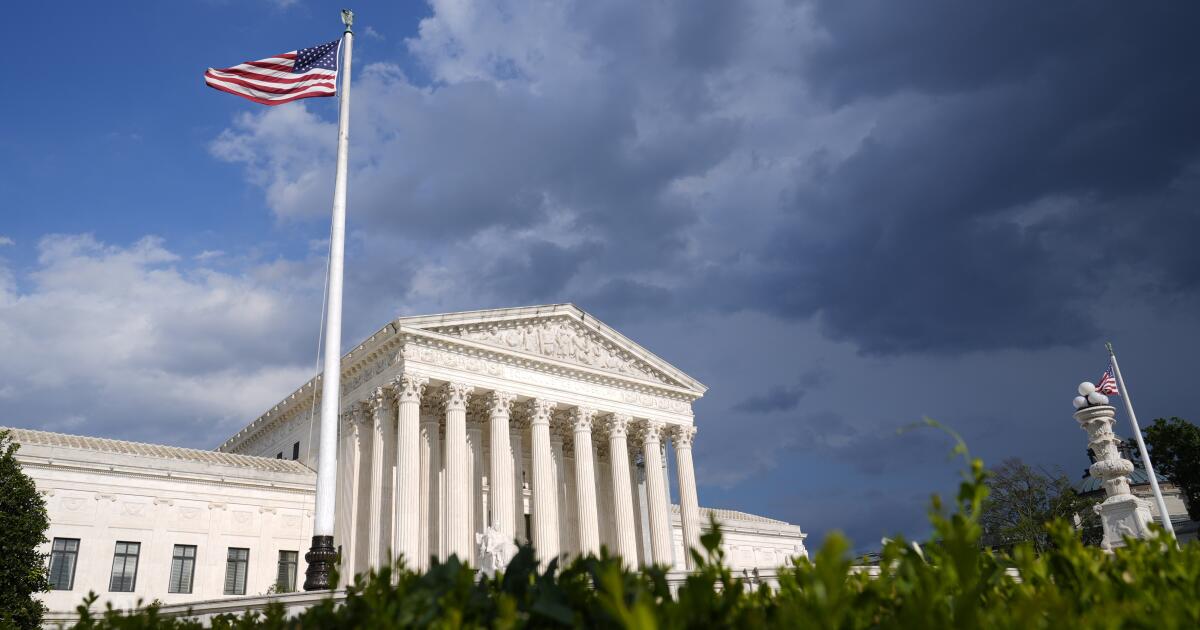
WASHINGTON — The Supreme Court cast doubt Monday on whether police may obtain cellphone data to find crime suspects.
In a 6-3 decision, the justices said this location information showing where a cellphone user has traveled is personal and private and subject to the protection of the 4th Amendment’s ban on unreasonable searches.
Justice Elena Kagan said these “records serve as a personal journal of a user’s movements.”
She said the information “resembles other private materials — think of emails, documents, photographs, or calendars—that even if stored on Google’s servers, a user reasonably views as his own…and reasonably expects to be shielded from the inquisitive eyes of the government.”
Because an “individual has a legitimate expectation of privacy in his cellphone location data,” she said police investigators need a valid search warrant from a magistrate.
The court stopped short of deciding the proper basis for a search warrant in such cases. Instead, the justices sent the case back to judges in Virginia.
But the outcome casts doubt on “geofence warrants.”
In recent years, police have gone to Google and cellphone companies seeking tracking data on cellphones that were at a crime scene. Sometimes, they have had a warrant from a magistrate.
Civil libertarians say the use of this tracking data raises the specter of mass surveillance on innocent people.
Police and government lawyers say no one has a reasonable right to privacy when they are walking on a sidewalk or driving down the street.
The case before the court arose from the armed robbery conviction of a Virginia man who stole $195,000 from a credit union in a small town near Richmond.
By the time police arrived, the robber had fled. But surveillance cameras showed he was carrying a gun and a cellphone.
Lacking other leads, detective Joshua Hilton asked a judge to issue a special type of warrant seeking information from Google.
Referred to as a “geofence warrant,” it seeks data from phones in a particular area at a particular time.
The detective sought data on phones that were within 150 yards of the credit union within one hour of the late afternoon robbery.
After examining and paring down the data, the detective asked for the phone records of Okello Chatrie. Then, with a search warrant of his home, investigators found two robbery-style demand notes, a semi-automatic pistol and about $100,000 in cash.
A judge refused to suppress the evidence from an allegedly unconstitutional search, and Chatrie entered a conditional guilty plea.
The full 4th Circuit Court of Appeals split evenly on the legality of the geofence warrant, and the Supreme Court agreed to decide the issue in Chatrie vs. U.S.
Usually investigators obtain warrants to search the home or vehicle of a known crime suspect.
The new and disputed geofence warrants seek to find a suspect by examining data on the cellphones that were at the scene of a crime.
The FBI used this cellphone data in 2021 to identify suspects who broke through police barricades on Jan. 6, 2021, and pushed their way into the Capitol to disrupt the official counting of electoral votes.
Chief Justice John G. Roberts Jr. and Justices Sonia Sotomayor, Neil M. Gorsuch, Brett M. Kavanaugh and Ketanji Brown Jackson agreed on the outcome in Chatrie vs. U.S.
In a 21-page dissent, Justice Samuel A. Alito Jr. said the court had “carefully set the stage for its planned performance: striking a pose as a great champion of privacy in the digital age. I cannot support this irresponsible escapade.”
Justice Clarence Thomas agreed.
Justice Amy Coney Barrett agreed in a one-paragraph dissent. “Chatrie had no reasonable expectation of privacy in data about his public movements that he voluntarily disclosed to Google,” she said.
-
 Entertainment2 minutes ago
’47 Ronin’ director Carl Erik Rinsch sentenced to 30 months in prison for Netflix fraud case
-
 Lifestyle5 minutes ago
At Mindful Archery, L.A. women take aim at their exes, toxic jobs and Donald Trump
-
Politics10 minutes ago
British regulator may challenge Paramount takeover of Warner Bros. Discovery
-
 Science17 minutes ago
Hospital visits for smoke inhalation spiked during Boyle Heights warehouse fire
-
 Sports20 minutes ago
Contributor: U.S.-born Brian Gutiérrez and Obed Vargas signal a new era for Mexico’s national team
-
World32 minutes ago
‘No MiGs for Ukraine’: Polish defence minister claims Kyiv backed out of deal with Warsaw
-
 News1 hour ago
Rep. Tom Kean returns to Congress, says depression is why he went missing for months
-

 Los Angeles, Ca2 hours ago
LeBron James informs Lakers he will play elsewhere next year

