News
How ageism against Biden and Trump puts older folks at risk


What would you do if I told you there’s a whole demographic group that can’t be trusted to work because they’re unreliable, bad with technology, slow learners, and most likely not a good “culture fit”? What if I said that group probably shouldn’t even be incorporated into the rest of society – that they should live in their own, separate communities where the rest of us don’t have to see or interact with them unless we choose to?
Would your hackles be raised? Would that language have you dialing up the ACLU?
It probably should. It’s called stereotyping. (Heard of it?) And while many of us — OK, some of us — have trained ourselves to notice how stereotypes work when it comes to things like ethnicity or gender, there are other categories where the practice goes painfully unnoticed — like age.
President Biden delivers remarks Thursday at the White House. Biden addressed the special counsel’s report on his handling of classified material, and the status of the war in Gaza.
Nathan Howard/Getty Images
hide caption
toggle caption
Nathan Howard/Getty Images
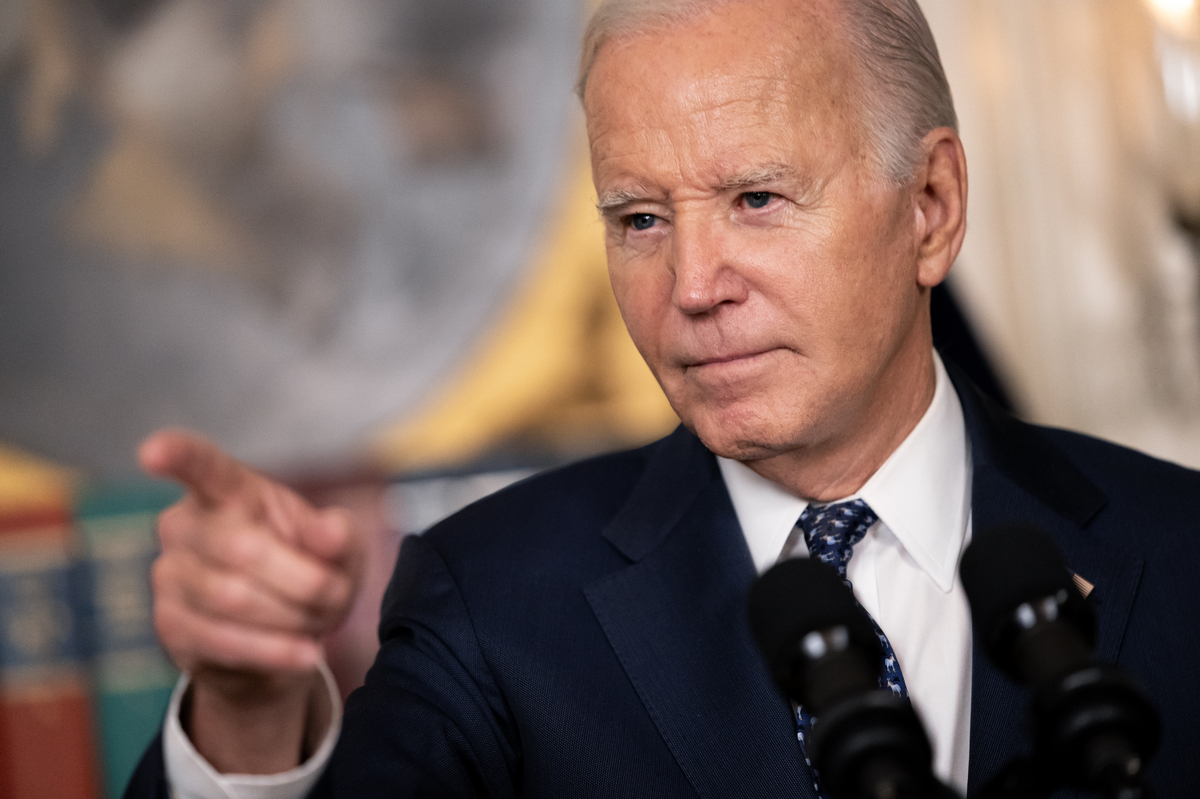
President Biden delivers remarks Thursday at the White House. Biden addressed the special counsel’s report on his handling of classified material, and the status of the war in Gaza.
Nathan Howard/Getty Images
As it becomes increasingly inevitable that our next presidential election will be a contest between Joe Biden and Donald Trump, everyone from comedians to competitors to journalists to doctors to the candidates themselves has had something to say about how old these two men are, and (in some cases,) why that proves that they’re unfit for office. Recently, those conversations have gotten to a fever pitch.
[Editor’s note: This is an excerpt of Code Switch’s Up All Night newsletter. You can sign up here.]
That’s a big problem. Tracey Gendron is a gerontologist and the author of the book Ageism Unmasked. She says that like many other giant identity categories, “age in and of itself does not tell you what somebody’s experiences are, what somebody’s values are, what somebody’s health status is, what somebody’s cognitive status is.” But because many people are taught to fear or demean older people, Gendron says age becomes an easy proxy for other concerns, “like, what is your ideology? What are the actual issues at hand? What are your voting records? What are, you know, the actual things that should make me support a candidate?”

These conversations about age have consequences outside of our immediate political circumstances. As it turns out, fixating on someone’s age can actually put them at higher risk for exhibiting negative behaviors associated with that age. It’s called stereotype threat. For instance, when people are told that members of their age group are likely to struggle with things like memory and word recall, they perform worse on memory tests than people who are primed with information about the vast cognitive capabilities of people their age. Similar studies have been done with gender, race, and many other categories, and guess what? Being told you’re going to be bad at something is a remarkably consistent self-fulfilling prophecy.
So, look: Next time you feel tempted to criticize someone, try to focus on the specifics. There are so many nuanced, individualized, intricate reasons to hate on someone — or at least, find them unqualified for office. Defaulting to age is just lazy. (Who are you, a millennial?)


Members of the National Guard stand in front of a large image of U.S. President Donald Trump that hangs from the the Robert F. Kennedy Department of Justice Building on May 18, 2026 in Washington, D.C.
Andrew Harnik/Getty Images North America
hide caption
toggle caption
Andrew Harnik/Getty Images North America
WASHINGTON, D.C. — In a strongly worded letter to the head of Michigan’s National Guard, Gov. Gretchen Whitmer reiterated troops from her state are only to be used for operations surrounding America 250 celebrations in Washington, D.C., and not for President Trump’s long-running — and controversial — joint task force to fight crime. She said that she would pull her troops from the city if that is not the case, in the letter obtained by NPR.
“Please take all necessary measures to ensure the Michigan National Guard is only supporting the narrow and limited America 250 Mission and is in no way supporting the D.C. Safe and Beautiful Mission,” wrote Gov. Whitmer, referencing the official name for the federal task force.
Trump deployed hundreds of troops to Washington, D.C., in August of 2025, in what experts said was a stunning departure from governing norms. He said he did so to address rampant crime, despite declining crime rates at the time. The number of troops in the city has increased over time to more than 4,800 from Washington, D.C. and almost two dozen states, which until recently were exclusively Republican-led.
Michigan — which has 161 guard members currently in the city — is one of four Democratic-led states that sent members of their National Guard to D.C. in recent weeks, ahead of an influx of tourists for America 250 celebrations. North Carolina and Kentucky each sent one member of their guard, while Minnesota sent more than a hundred last week.
Kentucky confirmed to NPR Monday that it had recalled its one guard member over the weekend, after that member was “diverted to the task force by the federal government without the knowledge or consent of Gov. Beshear of the Kentucky Guard,” Scottie Ellis, a spokesperson for Gov. Beshear, wrote to NPR in an email.
When contacted by NPR, spokespeople for each respective Democratic governor’s office made it clear that their guard members were sent to help specifically with America 250, not for law enforcement purposes as part of the larger ongoing federal joint task force operation. All four states have been clear about their opposition to the Trump administration’s ongoing deployment of National Guard troops to D.C., filing an amicus brief in support of litigation challenging it as recently as May.
But in recent days, a video of troops identifying themselves as Michigan National Guard members patrolling the Georgetown waterfront — an upscale neighborhood more than a mile away from any official America 250 celebrations — began circulating on social media. NPR has authenticated the video. Whitmer’s office did not immediately respond to NPR’s request to verify that the troops were Michigan members.
All state guard members are currently in D.C. under Title 32 status, which essentially means that the federal government pays for the deployment, but the state governors maintain control and command of their troops. But former National Guard officials say it’s impractical for states to play a role in day-to-day activities in a complex national mission like what’s happening in D.C.
“If the National Guard has defined the America 250 Mission to extend beyond direct support for events celebrating the nation’s 250th anniversary, please let me know so we can ensure the Michigan National Guard’s efforts are carefully limited,” Gov. Whitmer’s letter reads.
It goes on to say that if that can’t be ensured, then Gov. Whitmer will “end Michigan’s support for the America 250 mission.”
Legal experts, like those at the Brennan Center for Justice who have closely been watching Trump’s ongoing deployment to D.C., worry that drawing a distinction between the America 250 celebration and the general mission of the joint task force in the city will prove difficult. The joint task force is largely carrying out high visibility presence patrols in residential neighborhoods, public parks and metro stations.
Troops from all four Democratic-led states are listed as part of the official federal joint task force numbers released to the public. Gov. Whitmer said the Michigan troops should not be included in that count.
The offices for other Democratic governors NPR reached out to about that list also said their guard members shouldn’t be included.
When asked about the confusion, a spokesperson for the joint task force told NPR that it is overseeing all guard members in D.C. for organizational purposes, but being on the list “does not change their specific mission.” The joint task force did not immediately respond to NPR’s request for comment as to why Michigan guard members were apparently in Georgetown, and if that was part of the America 250 operations.

Sen. Ruben Gallego, D-Ariz., walks out of the Senate chamber on Oct. 1, 2025.
Andrew Harnik/Getty Images
hide caption
toggle caption
Andrew Harnik/Getty Images
The Senate Ethics Committee has dismissed a complaint brought against Sen. Ruben Gallego involving allegations of campaign finance violations and potential sexual misconduct.
The allegations against the Arizona Democrat were brought to the committee in April by a fellow member of Congress, Rep. Anna Paulina Luna, R-Fla. But in a letter to Gallego dated June 26, the committee said it had uncovered no wrongdoing.
“Based on the investigation of the Committee, the Committee did not find evidence that your actions violated Federal law, Senate rules, or related standards of conduct,” the panel wrote.
The panel also said it appreciated Gallego’s “full cooperation” throughout the investigation.
Gallego welcomed the findings, saying in a statement that the dismissal “reaffirms what I have said about these accusations from the beginning: they were right-wing conspiracies peddled by far-right activists like Anna Paulina Luna, the White House, and their allies.”

“I look forward to an apology from Rep. Luna for weaponizing the ethics process while refusing to investigate historic corruption that’s making life harder for families,” he continued.
Whispers about potential misconduct by Gallego began to circulate in April following the resignation of Rep. Eric Swalwell, D-Calif. Swalwell stepped down in response to a swell of sexual assault and misconduct allegations. NPR has not independently verified the allegations against Swalwell, but he has adamantly denied them.
Swalwell and Gallego were close friends, and during Swalwell’s short-lived 2020 presidential campaign, it was Gallego who served as campaign chair.
In the immediate aftermath of Swalwell’s resignation, Gallego denied knowledge of any alleged history of sexual misconduct, though he acknowledged to reporters that their close friendship may have made it difficult for him to accept rumors about Swalwell and his behavior toward women.
“My friendship with him, our family’s friendship together with him, clouded my judgment, and I was wrong — I deeply, deeply regret that,” Gallego said.
Within days of the resignation, a cryptic post on social media by Luna sparked speculation about Gallego.
“It’s seems like the Senate has its own trash to take out. @LeaderJohnThune You need to look into the allegations against one of your Senators, it’s very disturbing. My chief will be contacting your chief,” she wrote.
The following day, Luna confirmed to CBS News she was referring specifically to Gallego.
Despite the dismissal by the ethics panel, Luna shot back at Gallego on Monday, writing on social media, “These are not conspiracy theories.”
“The good news about DC is everyone talks, and eventually the reporters come forward with your texts,” she said.
The allegations against Swalwell earlier this year brought on a fresh reckoning in Congress over the behavior of some of its male members — some 10 years after the #MeToo movement reshaped the conversation around sexual assault. Shortly after Swalwell resigned, so too did Rep. Tony Gonzales, R-Texas, who had previously admitted to an affair with a former staffer who later died by suicide.

Horse mounted riders circle atop a hill at the Battle of Little Bighorn National Monument, near Last Stand Hill, on June 25.
Kadin Mills/NPR
hide caption
toggle caption
Kadin Mills/NPR
CROW AGENCY, Mont. — Under the expansive Montana sky, hundreds of members and descendants of 19 tribal nations gather at one of America’s most famous battlefields. They’re here to watch as Native American riders on horseback charge onto the same land their ancestors did 150 years ago when they defeated the U.S. Army’s 7th Cavalry under the command of Lt. Col. George Armstrong Custer.
The riders race across the dry landscape — kicking up clouds of dust before circling at the top of a hill at Little Bighorn Battlefield National Monument. Some of them are wearing headdresses and regalia, others are wearing tank tops and T-shirts. Many of them are carrying their tribal flags in a show of unity — the same unity that made possible their swift victory on June 25, 1876.
“It was so important then, 150 years ago. … It’s important today still,” said Gaby Strong, who is Sisseton-Wahpeton and Mdewakanton. “Our victories are still possible.”

Custer’s goal was to force Native Americans onto reservations. After the 1874 discovery of gold in the Black Hills, Indigenous peoples living off reservations were directed to report to their U.S. field offices, called Indian Agencies, or be deemed hostile.
Native American leaders, including Crazy Horse and Sitting Bull, organized villages and tribes together in a resistance effort.
Several battles broke out in what is now Montana and South Dakota as military forces attempted to push remaining groups onto reservations.
“Crazy Horse, he went from band to band, leader to leader, to tell them about this idea of our relatives coming together for a much greater cause than themselves,” said Christopher Eagle Bear. He is Sicunga Lakota from the Rosebud Sioux Tribe.
In 1876, Custer was tracking a nomadic village of various peoples, including the Oceti Sakowin (Sioux), Cheyenne and Arapaho. Custer was tracking that camp with the help of about three dozen Arikara and Crow scouts. Scouting for the U.S. government was a common practice among many tribes.
Custer divided his forces of around 700 men into three columns, hoping to surround the village.
By June 25, the village had swelled to an estimated 8,000 people. Custer decided to attack early out of fear the allied tribes would disband and escape — a decision which proved to be a fatal mistake.
“It was early morning, they were camped. Then all of a sudden they’d seen Custer’s platoon coming over the ridge,” Eagle Bear said, recounting the battle known to the Lakota as the Battle of Greasy Grass.

Christopher Eagle Bear, 27, is the youngest tribal council member for the Rosebud Sioux Tribe. He said the commemoration was about reclaiming and celebrating their identity.
Jessica Plance for NPR
hide caption
toggle caption
Jessica Plance for NPR
“They say the battle lasted as long as it took you to make a cup of coffee and drink it,” he said.
Custer was outnumbered. By the battle’s end, 268 of Custer’s forces were killed, mostly U.S. soldiers. Custer was among those killed. On the other side, fewer than 100 Native Americans were killed, including women and children.
Custer’s crushing defeat sparked fear and outrage nationwide. The U.S. government responded by changing its approach to Indian policy, shifting to forced assimilation. Just three years after the battle, the first off-reservation federal Indian Boarding School opened in Carlisle, Pa. Hundreds more followed, beginning a century of abuse that attempted to erase Native ways of life.
“They realized that they couldn’t destroy us head on. … So after that, they did the next best thing that you could do to tear apart a nation, and that was take away the children,” said Eagle Bear.
Youth leaders hope to inspire the next generation

People are taking down tipis at an encampment along the Little Bighorn River during the 150th anniversary commemoration of the Battle of the Little Bighorn near Little Bighorn Battlefield National Monument. The encampment brought together tribal members from across the Plains for ceremonies, storytelling and remembrance.
Jessica Plance for NPR
hide caption
toggle caption
Jessica Plance for NPR
Eagle Bear is camping at the site of that historic village. To commemorate their victory, people from various tribal nations have set up their tipis here, and there is a council lodge in the middle of the camp.
Eagle Bear is here as one of the coordinators for the Rosebud Sioux Tribe’s camp, and he said he wants to set an example for the next generation.
“Someday from now, you know, the kids that are here today, they’re going to come together during the 200th anniversary and they’re going to talk about what they witnessed as kids,” he said. “My prayers are being answered every single day with the fact that these kids are here.”

Just feet away, a group of children are playing lacrosse with traditional sticks to the sound of drumming. And cooking for the camp are members of the Sicunga Youth Council.
“We’ve been planning this for roughly eight months now. So it’s very heartwarming to see everyone that actually showed up and that’s here,” said Ashlen Bonshirt, a member of the youth council.
“We did plan the lacrosse, and there’s yoga, and there are all these different amazing things for our youth,” she said. “But on the other side of it is the garbage, the showers — everything that is here, we had to plan for it.”
The camp is full of young people. School groups, youth councils and kids with their families are staying in tipis all around. Many of them are learning things about the battle that weren’t covered in school.
“I feel like a lot of it is whitewashed,” said 13-year-old Gianna Larocque-Mahto. She’s Dakota, of the Sisseton-Wahpeton Oyate, and she’s here with her grandmother.
“We didn’t get to learn about the Native people’s side, like the Dakota people’s side. We only got to learn from one perspective,” she said. “And I feel like that’s not fair. … I think it’s important that we learn from all different people’s perspectives and not just one person.”

Champion Marquez and his friend Elijah Wallowing pose in front of a tipi in the encampment.
Jessica Plance for NPR
hide caption
toggle caption
Jessica Plance for NPR

Gianna Larocque-Mahto rode her horse to the camp from nearby Busby, Mont., joining a group of other riders. They started their “Victory Ride” in Ashland, Mont., roughly 60 miles away.
Kadin Mills/NPR
hide caption
toggle caption
Kadin Mills/NPR
Eighteen-year-old Champion Marquez is Cheyenne. He’s also staying at the camp, and he’s been volunteering here this week — working security, helping elders and setting up tipis.
Marquez said the commemoration gives him hope for the future. “Hope that a bunch of new generations are going to learn about what happened at the Battle of Little Bighorn. Seeing all these kids having fun, playing with each other, all these events for them happening.”
“Seeing all this here just [reassures] that … we’re still here.”

A group of children from different tribal nations play lacrosse together using traditional equipment.
Kadin Mills/NPR
hide caption
toggle caption
Kadin Mills/NPR
-
News2 minutes ago
Michigan governor threatens to pull troops from D.C. if used for Trump task force
-

 New York1 hour ago
Metropolitan Diary Challenge Day 2: How to Write Your N.Y. Story
-

 Los Angeles, Ca1 hour ago
Company has weeks to complete cleanup of Boyle Heights warehouse fire, officials announce
-

 Detroit, MI2 hours ago
18 New Kid-Friendly Places That Opened in Metro Detroit in 2026 (So Far!)
-

 San Francisco, CA2 hours ago
Anza expedition celebrates 250th anniversary in San Francisco
-

 Dallas, TX2 hours ago
Preston Hollow residents oppose proposed $800 million mixed-use development in Dallas, survey reveals
-

 Miami, FL2 hours ago
Bradley Beal to Miami Heat rumors draw skepticism
-

 Boston, MA2 hours ago
Boston Pops surprise travelers at Logan Airport with July 4th preview performance

