Southwest
New Mexico faces opposition to governor's water recycling initiative over concerns of increased fracking

- Environmental activists have opposed Gov. Michelle Lujan Grisham’s initiative in New Mexico aimed at financing the treatment and recycling of oil-industry wastewater.
- Critics say that the plan relies on unproven technologies and may lead to more water-intensive fracking for oil and natural gas.
- Grisham seeks legislative and regulatory changes to allow the state to develop a new source of water by buying and selling treated water.
Environmental activists pushed back Monday against an initiative from the governor of New Mexico that would finance the treatment and recycling of oil-industry wastewater, warning that the plan relies on unproven technologies and might propel more water-intensive fracking for oil and natural gas.
Democratic Gov. Michelle Lujan Grisham is seeking legislation and regulatory changes that would allow the state to finance development of a strategic new source of water by buying and selling treated water that originates from the used, salty byproducts of oil and natural gas drilling or from underground saltwater aquifers.
The aim is to help preserve freshwater sources by providing a new source of recycled water for industrial uses, at the same time helping an arid state attract businesses ranging from microchip manufacturers to hydrogen fuel producers.
NEW MEXICO OFFICIALS PROPOSE REGULATIONS FOR REUSE OF FRACKING WASTEWATER
An array of environmental and social-justice groups gathered outside the Statehouse to denounce the governor’s plan as a handout to the oil and natural gas industry that won’t necessarily decrease pressure on the state’s ancient underground aquifers.
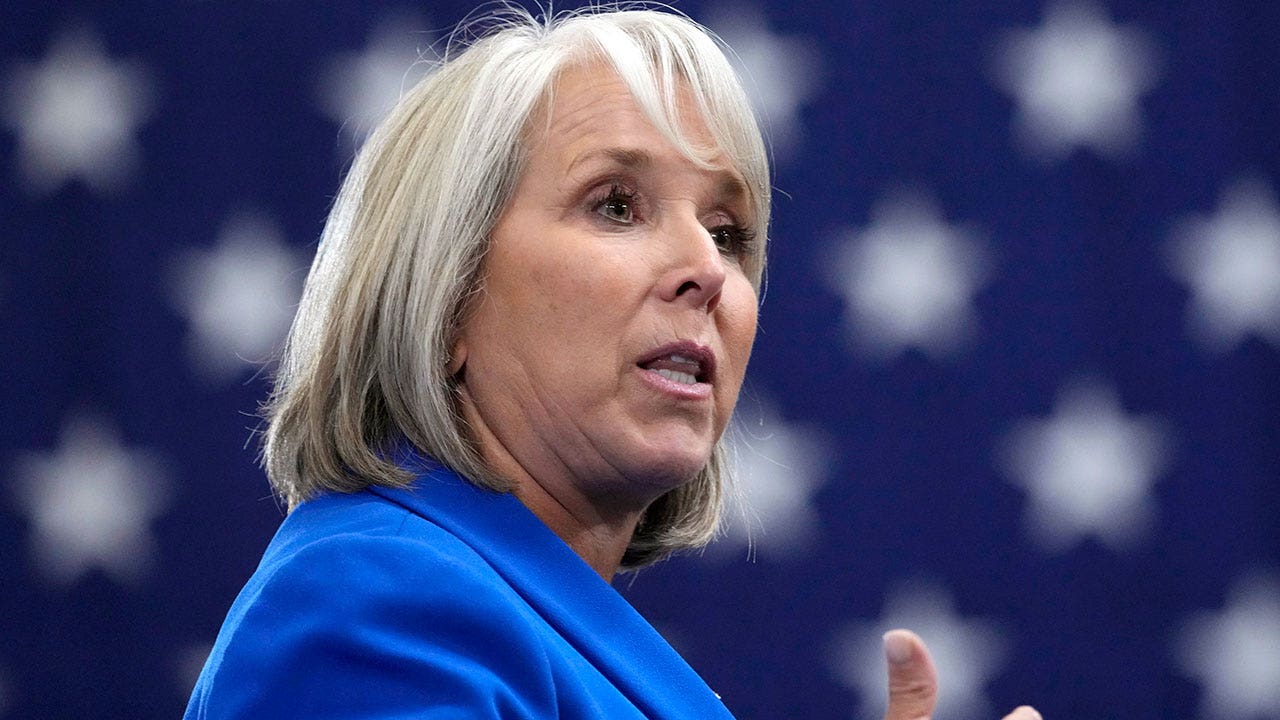
Democratic New Mexico Gov. Michelle Lujan Grisham speaks on Aug. 9, 2023, in Belen, New Mexico. Grisham’s proposal underwrite the treatment and recycling of oil-industry wastewater is being denounced by environmentalists. (AP Photo/Alex Brandon, File)
“It’s intended to help oil and gas producers, particularly in the Permian Basin, to resolve their enormous problem with wastewater disposal and allow for continued extraction” of petroleum, said Mariel Nanasi, executive director of the environmental and consumer protection group New Energy Economy.
Julia Bernal, executive director of the environmental justice group Pueblo Action Alliance, sees the initiative as an attempt to secure more water supplies for the production of hydrogen.
Hydrogen can be made by splitting water with solar, wind, nuclear or geothermal electricity yielding little if any planet-warming greenhouse gases. But most hydrogen today is not made this way and does contribute to climate change because it is made from natural gas.
“We would like to see more investment in wind and solar, more community based projects,” said Bernal, a tribal member of Sandia Pueblo.
NEW MEXICO GOV. GRISHAM PROPOSES PLAN TO TURN OILFIELD WASTE INTO CLEAN WATER SUPPLY
Inside the Capitol, state Environment Department Secretary James Kenney briefed a state Senate budget-writing on the administration’s plan to underwrite the project with up to $500 million in bonds over a two-year period, to spur private investment in water-treatment and desalination infrastructure.
Approval from the Legislature is necessary under a construction-spending bill that has not yet been introduced. The state’s annual legislative session ends on Feb. 15.
The Environment Department is proposing a new regulatory framework for reusing oil-industry wastewater and desalination of naturally occurring brine. On Monday, it also announced a related request for technical and economic briefings by people in business, academia, government agencies — or other interested individuals.
New Mexico has extensive underground reservoirs of salty water that have been of limited use. That brackish water is a crucial component in hydraulic fracturing, or fracking, and advanced drilling techniques that have helped turn New Mexico into the No. 2 oil production state in the U.S.
Read the full article from Here


A woman was hospitalized with serious injuries after she was violently attacked by a robber in downtown Long Beach. On June 18, Jennifer Silva, 34, was attending a World Cup watch party at a Hooters restaurant at 90 Aquarium Way. After the game ended, she left the restaurant just before 11 p.m. As she walked […]

Jurors deliberating the fate of the man accused of starting the Palisades Fire, one of the most destructive wildfires in California’s history, failed to reach a verdict Thursday afternoon, telling the judge they were deadlocked.
A spokesperson from the United States Attorney’s Office told KTLA that jurors will continue to deliberate until they reach a verdict or give up.
Jonathan Rinderknecht, 30, a former Uber driver and one-time Pacific Palisades resident, is accused of starting the Lachman Fire on New Year’s Eve. The fire continued to smolder underground for about a week, even after Los Angeles firefighters believed it had been extinguished.
Flames reignited on Jan. 7, erupting into the deadly Palisades Fire that killed 12 people and destroyed thousands of homes in the upscale community, authorities said.
-

A courtroom sketch of Jonathan Rinderknecht, 29, during his initial court appearance on Oct. 23, 2025. (Bill Robles) -
The U.S. Dept. of Justice booking photo of Jonathan Rinderknecht over the Palisades Fire devastation in Malibu, California in January 2025 (AP).


Prosecutors argued that Rinderknecht deliberately set the fire, claiming he had grown increasingly resentful of wealthy residents and viewed Pacific Palisades as a symbol of that frustration.
“Their case, though circumstantial, is strong,” KTLA legal analyst Alison Triessl said. “The defense is relying on, can they (prosecutors) show beyond a reasonable doubt that Mr. Rinderknecht actually started this fire and it wasn’t the result of fireworks or some intervening cause.”
The defense argued there is no direct physical evidence tying Rinderknecht to the fire and said the prosecution’s case relies entirely on circumstantial evidence. Rinderknecht did not testify during the trial.
Defense attorney Steve Haney spoke outside the courthouse Wednesday about why he believes it will be difficult for prosecutors to prove how the fire started.
“The lack of scene preservation. The fact that they got there after a lot of the evidence was missing. Not a lot of direct evidence. This is a circumstantial case, which is always difficult as a prosecutor to prove,” Haney said.
Rinderknecht, who was arrested and indicted last October, faces up to 45 years in prison if found guilty of three arson counts, including destruction of property by means of fire, arson affecting property used in interstate commerce and timber set afire.
Tony Kurzweil contributed to this report
Los Angeles, Ca
Boyle Heights warehouse cleanup begins as crews face 85 million pounds of spoiled food

Cleanup efforts are underway Thursday at the Boyle Heights cold-storage warehouse that burned for eight days after firefighters officially declared the massive blaze knocked down Wednesday evening. Los Angeles Fire Department crews remain at the Lineage warehouse near Union Pacific Avenue and South La Puente Street as they transition into the overhaul phase, searching for […]
-

 Los Angeles, Ca17 minutes ago
Woman ambushed, violently attacked by robber in downtown Long Beach
-

 Detroit, MI35 minutes ago
Where to watch Houston Astros vs Detroit Tigers: TV channel, start time, streaming for June 26
-
San Francisco, CA47 minutes ago
I own a Turkish Restaurant in San Francisco. Turkey’s World Cup match here has changed my business.
-

 Dallas, TX49 minutes ago
Australia advances at World Cup, how to buy Australia soccer tickets
-

 Miami, FL55 minutes ago
2 detained after police pursuit ends with bailout, neighborhood search in NW Miami-Dade – WSVN 7News | Miami News, Weather, Sports | Fort Lauderdale
-

 Boston, MA1 hour ago
Delta flight returns to Logan after smoke scare in cockpit – Boston News, Weather, Sports | WHDH 7News
-

 Denver, CO1 hour ago
Pat Surtain II Gets More Bad News Amid Broncos’ Uncertainty
-

 Seattle, WA1 hour ago
The World Cup 2026 Pride Match between Egypt and Iran that Seattle hopes can ‘unite football community’


