Science
Column: Meet the most dangerous quack in America

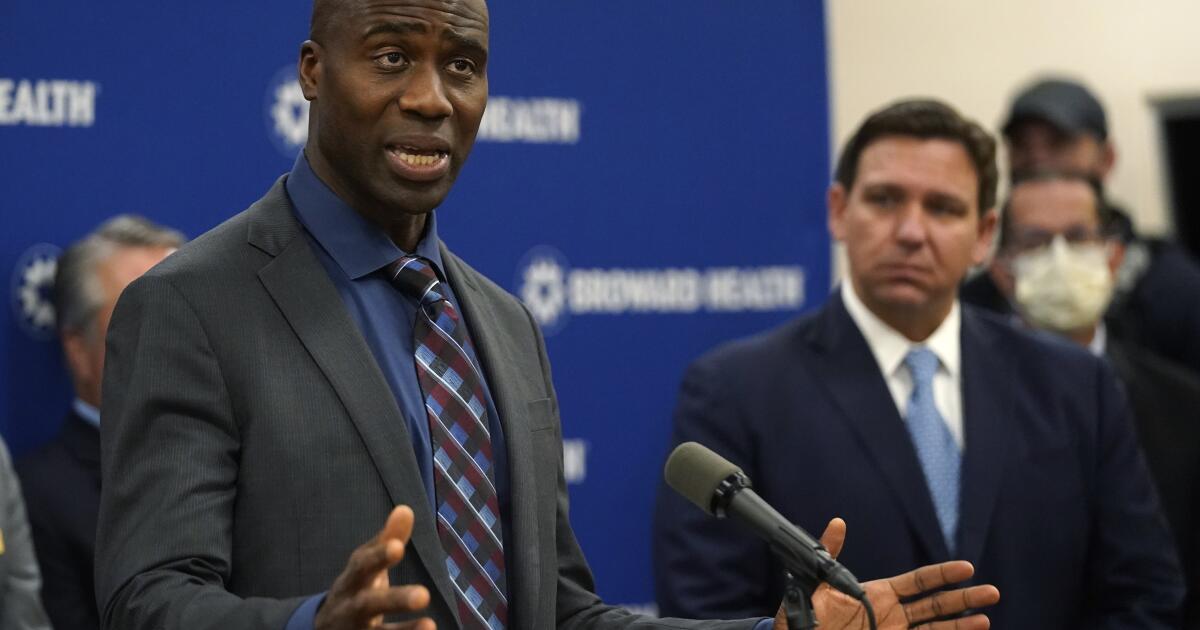
It used to be fairly easy to dismiss Florida’s surgeon general, Dr. Joseph A. Ladapo, as a clownish anti-vaccine quack posing a danger mostly to residents of his home state.
That has become harder to do as time goes on, as Ladapo has moved from promoting useless treatments for COVID-19, such as the drugs hydroxychloroquine and ivermectin, to waging an ever-expanding fact-free campaign against the leading COVID vaccines.
This month, Ladapo established a new low for himself. In a public advisory issued Wednesday by the Florida Department of Health, he declared the vaccines “not appropriate for use in human beings” and counseled doctors to steer patients to other treatments. He explicitly called for a “halt in the use of COVID-19 mRNA vaccines.”
Scaring people unnecessarily like this has been hard to watch. … It is hard to believe that Dr. Ladapo actually issued that statement.
— Vaccine authority Paul Offit
For several reasons, this advisory ranks as the single most dangerous statement by a government health agency since the start of the pandemic, if not for all time.
First and foremost, it’s based on a claim in a paper co-authored by known anti-vaccine activists that was almost instantaneously debunked upon its publication in October.
Then there’s the public health context: As COVID infections have been surging coast to coast, advisories from public health authorities to resume masking and take other protective measures, such as making sure you’re up to date on vaccinations, are almost invisible.
Even more worrisome, the incidence of other vaccine-preventable diseases may be rising. As many as nine cases of measles have been reported in Philadelphia, some associated with an infection started at a daycare center with a family that violated quarantine rules.
Among the victims, according to the Philadelphia Inquirer, are “an infant who was too young to get vaccinated, an unvaccinated older child and the older child’s unvaccinated parent.”
Nine cases may not sound like a lot — 41 were reported nationwide in 2023 — but they could be a harbinger of worse to come, in clusters in which anti-vaccine propaganda has taken hold.
Finally, one must consider the source. Despite his state post and a tenured position as a professor of medicine at the University of Florida — courtesy of his patron Ron DeSantis, the extremist anti-vaccine Republican governor — Ladapo has zero credibility within the medical establishment. Taking medical advice from Ladapo makes about as much sense as taking investment advice from Sam Bankman-Fried or your view of academic integrity from Christopher Rufo.
Ladapo has become a card-carrying member of the anti-vaccine mafia. Just before Christmas, he appeared on a podcast hosted by anti-vax agitator Del Bigtree, who stirs up his audiences with hysterical rants against vaccines and who was recently appointed communications director for the presidential campaign of notorious anti-vax figure Robert F. Kennedy Jr.
Last January, a faculty committee at the University of Florida medical school found that Ladapo engaged in “careless, irregular and contentious” research practices that may have violated university rules. The committee referred its findings to the university’s research integrity officer, but that officer ruled that since the behavior at issue was performed in Ladapo’s role as surgeon general, not as a UF professor, he had no grounds to take action.
The accusations pertained to Ladapo’s recommendation that males aged 18 to 39 avoid the mRNA vaccines. He claimed that research indicated that for men in that age group, the vaccines presented a heightened risk of cardiac-related death.
In fact, the research indicated no such thing; rather, it showed that the risk of cardiac death from the vaccines was statistically nonexistent and, in any case, was lower than the risk of cardiac death resulting from catching COVID-19. In fact, Ladapo had personally edited the state-sponsored analysis he cited in his recommendation to remove language in earlier drafts stating that there was “little suggestion of any [cardiac] effect immediately following vaccination.”
The Food and Drug Administration has been pushing back against Ladapo’s fire hose of misinformation and disinformation for the better part of a year. Last March, the agency informed him by letter that “overstating the risks, or emphasizing the risks without acknowledging the overwhelming benefits” of the vaccines — as Ladapo had done in his cardiac death warning — “puts people at risk of death or serious illness that could have been prevented by timely vaccination.”
That brings us to Ladapo’s latest adventure in medical quackery, his claim that no one should take the mRNA vaccines. Let’s take a look.
Ladapo’s advice is based on what he says is research that the Pfizer and Moderna mRNA COVID vaccines contain fragments of DNA that are injected into human cells, which they can contaminate and turn into cancer cells.
In a Dec. 6 letter to the FDA and in the Florida Department of Health advisory, Ladapo raised “concerns regarding nucleic acid contaminants in the approved … vaccines, particularly in the presence of lipid nanoparticle complexes, and Simian Virus 40 (SV40) promoter/enhancer DNA. … The presence of SV40 promoter/enhancer DNA may also pose a unique and heightened risk of DNA integration into human cells.”
Followers of anti-vaccine propaganda will find familiar features in this statement. For one thing, it sounds science-y as hell, filled to bursting with abstruse terms and jargon. One would have to be an expert in the field to identify it as total balderdash. The statement also bristles with scary references to DNA contamination and cancer and to “billions of fragments [of DNA] per dose.”
The same goes for Ladapo’s hand-wringing in his statements about the FDA’s 2007 standards for DNA in vaccines and his implication that the COVID vaccines violate those standards.
Fortunately, scientific and medical professionals have weighed in. One is Paul Offit, a vaccine expert at Children’s Hospital of Philadelphia. Offit explains that it’s true that “small amounts of fragmented DNA” are injected into the body with the vaccines.
It’s also irrelevant. For those fragments to affect your DNA, he explains, “things would have to occur, all of which are for the most part impossible.”
The human cell has a panoply of mechanisms to destroy foreign DNA. Even if the fragments managed to penetrate the cell nucleus, which can’t happen, they would have to cut up the existing DNA, which would require a mechanism the fragments don’t have.
“So the chance that DNA could affect your DNA is zero,” Offit said in a video interview with Medpage Today.
As for the Florida statement’s scary references to DNA contamination and cancer and to “billions of fragments [of DNA] per dose,” the vaccines don’t contaminate patients’ DNA, the fragments have no cancer-causing abilities, and that “billions” is, in the context of the vaccines, an incredibly tiny number.
The research paper on which Ladapo based his intimation that the vaccines breach the FDA’s DNA contamination standard is self-refuting. The paper, which was based on an analysis of 24 vials of the mRNA vaccines, actually found that in all cases the fragments were well below the concentration limits set by the FDA.
The FDA, in responding to Ladapo’s Dec. 6 letter, told him that studies of the vaccines showed “no evidence” that the shots damaged recipients’ DNA and that the experience of “hundreds of millions of individuals” who received the vaccines “indicate no evidence indicative of genotoxicity.”
On the other hand, “the challenge we continue to face is the ongoing proliferation of misinformation and disinformation about these vaccines which results in vaccine hesitancy that lowers vaccine uptake,” the FDA lectured Ladapo. “Given the dramatic reduction in the risk of death, hospitalization and serious illness afforded by the vaccines, lower vaccine uptake is contributing to the continued death and serious illness toll of COVID-19.”
In the words of the veteran pseudoscience debunker David Gorski, disinformation like Ladapo’s output is “not about science. It’s about fear-mongering about vaccines.”
Ladapo’s words and actions have surely contributed to his state’s pathetic performance in getting its citizens vaccinated against COVID. With 11.6% of its population fully vaccinated with a booster as of last May, Florida had a rate among the lowest in the nation. (California’s rate was 20.6%.) Among those 65 and older — purportedly the population that Florida strives to protect — only 31.2% were fully vaccinated. (California: 48.3%.)
Florida’s death rate from COVID of 375 per 100,000 people is among the worst in the country. (California: 283.) You can ignore the defense that the difference is due to Florida’s relatively older population; states with even older median ages have done much better: Vermont (170), New Hampshire (245) and Maine (252). The difference is the indifference of Ladapo and DeSantis to their own residents’ health.
Ladapo’s colleagues in science and medicine face the challenge of understanding what drives someone with Ladapo’s credentials — a Harvard education and a stint on the medical faculty at UCLA — to descend so deeply into professional irresponsibility.
“It is hard to believe that Dr. Ladapo actually issued that statement,” Offit said of Ladapo’s advice to avoid the vaccines. “Scaring people unnecessarily like this has been hard to watch.”


new video loaded: NASA Announces Artemis III Crew
transcript
transcript
NASA Announces Artemis III Crew
NASA announced the crew of Artemis III mission, which will fly to low-Earth orbit to test rendezvous and docking maneuvers with one or two lunar landers.
-
“I am excited to welcome you as the next crew in the Artemis journey to successfully return to the moon — this time to stay.” “I’m honored by the role that I’ve been given. I’m also very humbled by the task in front of us. But first and foremost, I’m grateful.” “So with that, the Artemis II crew, comrade, hands you the baton. You got the controls.” “As you know, we had a significant anomaly at our Launch Complex 36A on May 28. We’ve redoubled our efforts and are moving forward.”
By Alisa Shodiyev Kaff
June 9, 2026
Science
Santa Monica Mountains’ last steelhead trout survived the Palisades fire — and even had babies

Scientists feared the Santa Monica Mountains’ last remaining steelhead trout were dead, smothered by debris flows unleashed by the Palisades fire.
But the endangered fish surprised them: A team of biologists recently spotted 30 of the rare trout — and 21 babies — in Topanga Creek.
“There was a lot of happy dancing in the creek,” said Rosi Dagit, principal conservation biologist for the Resource Conservation District of the Santa Monica Mountains, which works with public and private landowners to conserve natural resources.
That’s because the steelhead here are endangered, at both the state and federal levels. Once, they swam in most streams of the Santa Monicas, but their numbers plummeted amid overfishing and coastal development. Increasingly frequent wildfire has further stressed their habitat. Topanga Creek, a biodiversity hot spot, is home to their last known population in the mountains that stretch from the Hollywood Hills to Point Mugu in Ventura County.
The trout that were spotted, including this one, are part of a distinct Southern California population that’s listed as endangered at the state and federal levels.
(RCDSMM Stream Team)
The California Department of Fish and Wildlife spearheaded a complex mission to rescue trout threatened by the Palisades fire that sparked in January 2025.
Time was of the essence. The fire hadn’t yet been fully contained. But rain was on the way, which would sweep massive amounts of sediment from the denuded hillsides into the water. Fish are often killed this way.
Crews stunned the fish with electricity, scooped them up in buckets, trucked them to a hatchery and ultimately moved them to Arroyo Hondo Creek in Santa Barbara County.
Within days, Topanga Creek was choked with mud. Some assumed the fish left behind were goners.
But in March, the conservation district’s team found four. The following month, when water conditions were clearer, they saw more.
“These fish continue to amaze me,” said Kyle Evans, environmental program manager for the state Department of Fish and Wildlife, who had seen the damage to the creek. “I had seen populations get wiped out in similar situations. So when I heard, I was thrilled.”
Evans surmises the fish that survived were in an area of the creek where less charred material and sediment were swept in.
“These fish likely hunkered down, were hiding under some rocks or places to try to get away from the main concentration of flow,” he said. “And luckily they weren’t buried.”
The ones that were spotted were fairly small, around 6 to 14 inches. Rainbow trout and steelhead trout are the same species, but with different lifestyles. If the fish remain in freshwater, they’ll be considered rainbows. However, they can migrate to the ocean and become steelhead, where they typically grow larger before returning to their natal waters to spawn.
Topanga Creek hasn’t fully recovered from the damage it sustained, but scientists say it’s looking better. Surveys last year were “so depressing,” Dagit said, with very few animals, and stretches that were essentially transformed into flat roads from all the sediment buildup. Some of the riparian canopy burned right down to the creek.
Then came 32 inches of rain over the last nine months, scouring out and moving sediment, creating deeper pools. Dagit said they recently found newt egg masses for the first time in years, as well as a few adult newts and many frogs. Plants that provide cover are starting to recover.
She provided photos comparing certain pools last year and this year, some dramatically transformed. In September 2025, the Shrine Pool could have been an overgrown hiking trail. This April, it was filled with shallow water.

The Shrine Pool in September 2025, left, and the same location in April 2026, right, with RCDSMM’s Isaac Yelchin donning a wetsuit.
(RCDSMM Stream Team)
Topanga Creek is home to another endangered fish, the small but hardy northern tidewater goby, often described as cute. Not long before the trout operation, Dagit led a rescue of hundreds of these fish too. Many were repatriated to the lagoon at the mouth of the creek in a moving ceremony last June.
There’s still the matter of what to do with the trout that were moved to Santa Barbara County last year. Evans would like to bring them home to the Santa Monicas at some point, but isn’t sure if it will happen. On one hand, they could bolster the small, genetically isolated surviving population. On the other, they might inadvertently bring in a disease or bacteria. There is some time to decide. Evans estimates the creek still needs to recover for two to three more years.
For now, the fish are functioning fine in their adopted creek. Experts worried the trauma wrought by the move would disrupt their spawning process, but they had babies that spring. This year, they spawned again.

The Pacifica Municipal Pier was shut down and taped off Thursday after city workers noticed cracks running through the landmark structure and concrete chunks falling into the ocean.
It’s just one of many coastal California structures that have recently crumbled under pressure from a rising and relentless ocean.
Officials from the small, beach city south of San Francisco said the pier was closed due to “cracking, separation, and displacement of the concrete walkway and structural elements.”
It will stay closed while structural engineers asses its safety.
Photos taken by city employees show a wide crack that runs from top to bottom and across the structure as well. Other photos show a large horizontal crack under the foundation of a small restaurant on the pier, the Chit Chat Cafe.
The cafe was also shut down.
This is not the first time the 53-year-old pier has shown signs of stress. In 2021, part of it was shut down after handrails along the edge collapsed. And in 2023, after a series of storms pummeled the Central California coast, damaging parts of the pier, the structure was partially closed for more than year.
Those same storms caused extensive damage in Aptos and Capitola, 70 miles south, where piers and waterfront infrastructure were swept away or damaged.
In 2024, a 150- to 180- foot section of the Santa Cruz wharf was ripped off by powerful waves.
At least 10 of the state’s dozens of coastal public piers were closed for part or all of 2024 due to structural damage sustained in winter storms since 2022. At least five others have longer-term upgrades planned to address structural issues.
“These things are costly to maintain,” said Zach Plopper, senior environmental director at Surfrider. “They are a part of our California coastal culture in many ways, but we’re going to need to reckon with, one, the state that they’re in, and two, the continuous and worsening threats they’re going to experience,”
He said most of the piers were constructed in the early 1900s, and they weren’t built to withstand decades of rough seas, storms and rising sea level.
“With this incoming El Niño, which is forecasted to be significant, and this marine heat wave we’re in the midst of, we’re kind of in uncharted waters as far as what this winter could bring in terms of storms and swells to the California coast, and we’re likely going to see a lot more damage,” he said. “Not just piers, but roads and other coastal infrastructure up and down the state.”
There was no storm in Pacifica earlier this week, so no single event could be blamed for the destruction.
However, a 2025 report from an outside engineering firm, GHD, found that several sections of the pier were in “poor” or “serious” condition, and they recommended closure before anticipated storms or events that could “subject the piles to high winds, swells and large waves.”
The firm found several areas of the pier where concrete was missing and rebar was exposed and corroding.
“The pier has continued to experience high winds and large waves in a harsh marine environment,” the engineers wrote in the report, noting that continuous exposure to seawater or marine spray was “detrimental” to the structure.
A 2023 city report estimated it would cost $19 million to repair.
That same year, a state law was enacted to require local governments along the California coast to plan for sea level rise in the coming decades.
Sea level has risen some 8 inches, on average, along the coast in the past 150 years, Plopper said, and researchers anticipate another foot in the next 25 years.
“We’re going to see profound shifts on our coastline, none that we have ever experienced before, and building static structures on the coast just doesn’t work all that well,” he said. “We’re going to have to make some really hard decisions.”
-

 Augusta, GA4 minutes ago
ARC’s Beman headlines CSRA field at Georgia Amateur
-

 Washington, D.C7 minutes ago
Croatia arrives in Northern Virginia as World Cup excitement builds
-

 Cleveland, OH12 minutes ago
Yankees Take Another in Cleveland
-

 Austin, TX19 minutes ago
CMRA Brings Inaugural Moto-Texas Superbike Challenge to COTA Fourth of July Weekend
-

 Alabama22 minutes ago
Federal judge orders stop to nitrogen gas execution in Alabama
-
 Alaska27 minutes ago
DFFP Responds to Yenlo Fire North of Skwentna
-

 Arizona34 minutes ago
Arizona budget pauses tax exemptions for new data centers
-

 Arkansas37 minutes ago
Free food, programs and more at NWA libraries this summer

