World
Russia and Ukraine pummel each other’s defence industry amid land stalemate


Russia launched a relentless barrage of missiles and drones into Ukraine during the last few days of 2023 and into the new year, revealing weaknesses in Ukrainian air defences that allowed dozens of people to be killed and hundreds wounded.
Russia’s Ministry of Defence said it was targeting military industry and infrastructure, something Ukrainian commander-in-chief Valery Zaluzhny confirmed; but many of the missiles landed on apartment buildings, shopping centres and a maternity hospital in city centres.
Even as Ukraine’s allies called for reinforcements in air defence, Ukraine responded punitively, launching drones into the Russian city of Belgorod that killed at least 26 people.
Overall, Russia was able to deliver greater volumes than Ukraine and attack more often, demonstrating the industrial might it has quietly nurtured under a barrage of Western sanctions.
Frustrating war on the ground
This aerial war played out against a static front line, where Russia now seems to have taken the initiative in assaulting Ukrainian positions – a reversal of the situation during last summer’s Ukrainian counteroffensive.
The slight changes on the military map were in Russia’s favour. Russian forces advanced north and south of Bakhmut, overrunning Bohdanivka and parts of Klishchiivka, villages Ukrainian troops won during weeks of bloody battles last summer, and from which they hoped to surround the occupied city.
But despite repeated assaults, Russian forces were unable to dislodge a Ukrainian bridgehead from the village of Krynky on the east bank of the Dnipro in Kherson.
Here, Ukrainian special forces have stolen a march on the Russians in recent weeks, occupying islands in the Dnipro delta along with a chunk of the riverbank, from where they have conducted counter-battery fire. Russian forces have lost 143 units of military equipment trying to pierce Ukrainian defences. Russian commanders have become so frustrated that they have reportedly ordered their troops to walk across Ukrainian minefields – a suicidal tactic known as the “Zhukov manoeuvre”.
Battle of missile factories
Even as these desperate battles played out on the flatlands of Europe’s most fertile country, Russia opened a new chapter in the air war on December 29.
Under cover of darkness, it unleashed a combination of at least 156 drones and missiles against Kyiv, Odesa, Lviv and Kharkiv. Ukraine’s armed forces said it was the largest single aerial attack on Kyiv. Military analysts said it was the largest series of missile and drone strikes against Ukraine in almost two years of full-scale war.
The Ukrainian Air Force shot down 114 of the missiles and drones, but could not prevent Russia from killing 39 people and injuring 159.
Twenty-four hours earlier, The New York Times had published an op-ed by a member of its editorial board, calling for Ukraine to negotiate. “Regaining territory is the wrong way to imagine the best outcome,” wrote Serge Schmemann.
Ukrainian Foreign Minister Dmytro Kuleba responded on X: “Today, millions of Ukrainians woke up to the loud sounds of explosions. I would like the whole world to hear these sounds of explosions … in all editorial offices that write about ‘fatigue’ or that Russia is allegedly ready for ‘negotiations’.”
US President Joe Biden, urging Congress anew to pass $61bn in military funding for Ukraine, said, “It is a stark reminder to the world that, after nearly two years of this devastating war, [Russian President Vladimir] Putin’s objective remains unchanged. He seeks to obliterate Ukraine and subjugate its people. He must be stopped.”
The attack appeared “to be a culmination of several months of Russian experimentation with various drone and missile combinations and efforts to test Ukrainian air defenses”, wrote the Institute for the Study of War (ISW), a Washington, DC-based think tank.
Until December 29, Russia had mainly or exclusively used drones, the ISW said, sacrificing these relatively cheap tools to probe aerial defences and figure out optimal flight paths. On this occasion, Russia used just 36 Shahed-type drones and 120 missiles of various types.
The experiment was a success, the ISW said, as Ukrainian forces failed to intercept a wide array of missiles.
The experiment was also the culmination of months of preparation in ramping up missile production. Ukraine’s military intelligence had estimated in November that Russia was able to produce about 100 missiles a month despite sanctions. This meant that Russia spent about a month’s worth of production capacity in a single night, making that scale of barrage unsustainable. It was also economically unsustainable. Ekonomichna Pravda, a Ukrainian business newspaper, estimated the cost to Russia of the drones and missiles at $1.27bn, using Forbes data. Russia’s entire 2024 defence and security budget is $157bn.
Revenge and counter-revenge
The next day, Ukraine said it launched more than 70 drones against Russian military infrastructure and defence industrial facilities near Moscow, Belgorod, Tula, Tver, and Bryansk cities. Russia’s Defence Ministry said it downed 32 drones, suggesting that many made it through.
Twenty-five people were reported killed in Belgorod. Geolocated footage showed smoke over Bryansk city the next day, suggesting Ukraine may have succeeded in hitting the Kremniy EL factory, Russia’s second-largest producer of microelectronics, most of whose output reportedly goes to the military.
Russia responded. On December 31, Ukraine said it shot down 21 out of 49 drones launched by Russia – an unusually small number, possibly because many were directed at Ukrainian front lines rather than civilian areas, Russia’s usual tactic. It also launched six S-300 missiles into central Kharkiv, injuring 28 people, and again attacked at 1am with drones, causing further damage to shops and cafes but not more casualties.
On January 1, Ukraine’s air force said it shot down 87 out of 90 Shahed drones launched from Crimea and Russia, targeting Odesa, Lviv and Dnipro. Later in the day, six Russian missiles hit Kharkiv, Ukraine’s second-largest city, injuring 28 people.
Many of Ukraine’s allies called for more air defence systems to be provided, but only the United Kingdom pledged any, saying it was sending Ukraine 200 air-launched air defence missiles. “Putin is testing Ukraine’s defences and the West’s resolve, hoping that he can clutch victory from the jaws of defeat. But he is wrong,” British Defence Secretary Grant Shapps said.
Ukraine said it destroyed nine out of 10 Shahed drones launched by Russia overnight on January 1.
Another wave of drones and missiles came overnight on January 2, including 35 Shahed drones and 99 missiles of various types. Ukraine said it shot down all the drones and 72 of the missiles. In an important victory, it managed to shoot down all 10 Kh-47 Kinzhal hypersonic missiles using US-made Patriot air defence systems.
Ukraine responded with another air attack on Belgorod – launching at least 17 missiles and drones, killing one person – on January 2, and launched a dozen missiles and several drones into Belgorod the following day.
If nothing else, the pattern of Russian attacks confirmed Ukraine’s oft-stated position that if left in Russian hands, Crimea would remain a security threat to its southern regions. Many of the drones and missiles that hit Ukraine were launched from the occupied Crimea Peninsula.
“The costs and challenges of Ukraine’s defense vary dramatically if Crimea returns to Ukraine or remains in Russia’s hands,” wrote the ISW in a strategy paper. “If Ukraine liberates the peninsula along with Russian-occupied lines in the south … then the imminent threat to Kherson, Mykolaiv, and Odesa vanishes and the threat to Melitopol is dramatically reduced,” it said.



Published on •Updated
At Frankfurt am Main’s central station, Deutsche Bahn also warns passengers on board the trains about pickpockets. Travellers leaving the station are confronted with the misery of drug addicts who congregate in Kaiserstrasse and the surrounding streets, whether they like it or not. Police are usually on the scene, but from the outside little seems to have changed in recent years.
ADVERTISEMENT

ADVERTISEMENT
And the figures on violence at Germany’s railway stations are causing headaches for many officials. Since this weekend the federal police have stepped up their presence at stations in ten major German cities. Yet when it comes to crime at stations, Frankfurt does not sit at the top of the list.
The stations particularly affected by crime in 2025 were the central station in Leipzig, with 859 violent offences, the central station in Dortmund with 735 and the central station in Berlin with 654.
Most recently, the fatal attack on a conductor on a regional train in Rhineland-Palatinate last February caused widespread shock. It was followed by a debate about the scale of attacks on Deutsche Bahn staff.
Expert: “No railway station in Germany is a no-go area”
In total, according to police statistics, 27,800 violent offences were committed at railway stations last year. These included 980 recorded knife attacks and more than 2,200 registered sexual offences. Some 5,660 acts of violence were directed against federal police officers. According to the police, the suspected perpetrators were significantly more often non-Germans than Germans.
Criminologist Dirk Baier does describe stations as “hotspots of crime”. But in an interview with WELT the expert also explains that violence at stations is particularly visible precisely because the police presence there is higher and because it is reported on more frequently. “From my point of view there is no major station in Germany that is a no-go area.”
Indeed, directly opposite Frankfurt’s central station many people – including families and women – have no difficulty doing their shopping in the chemists and the supermarket.
Police officers at stations instead of at border controls
The deputy leader of the CDU group in the Bundestag, Günter Krings, wants to improve public safety at stations through technical measures such as more cameras, while at the same time relieving pressure on police officers. Discussions on this are currently taking place within the coalition parties.
The AfD describes Germany’s railway stations as “spaces of fear” and is calling for tougher sentences, more consistent deportations and an increased police presence.
However, the Greens’ domestic policy spokesman, Marcel Emmerich, believes that while video surveillance can be useful, it cannot replace officers on the ground. The government, he says, is deploying thousands of federal police officers for “expensive, pointless and unlawful border controls” instead of strengthening their presence at stations.
Weapons and alcohol bans at stations
As the Süddeutsche Zeitung reports, weapons bans now apply from Friday to Sunday at Munich’s central station and the Ostbahnhof in the Bavarian capital, as well as at the main stations in Nuremberg, Regensburg and Rosenheim. This means that knives and dangerous tools may not be carried there at weekends. According to SZ, officers can stop, question and search people even without a specific reason.
An alcohol ban has been in force at Cologne’s central station (Hbf) since April; it now also applies to the stations in Bonn, Düsseldorf, Duisburg, Essen, Dortmund and Münster.
Deutsche Bahn has domiciliary rights at its stations and can therefore enforce its own rules there, such as an alcohol ban.
Violence at railway stations is by no means solely a German phenomenon, as the recent knife attack in Winterthur in Switzerland shows.


NEWYou can now listen to Fox News articles!
English police are facing mounting scrutiny after officers handcuffed an 18-year-old university student as he bled to death following a fatal stabbing, allegedly after believing the attacker’s false claim that he had been the victim of a racist assault.
The case has sparked outrage across Britain, fueled political debate over policing and prompted calls for the release of body-worn camera footage from the responding officers.
Alan Mendoza, executive director and co-founder of the London-based Henry Jackson Society think tank, told Fox News Digital that the case reflected broader failures in British policing culture. “The killing of Henry Nowak shows how far the rot of political correctness has set into the British policing mentality,” Mendoza said.
“The reflex attitude today appears to be to believe any and every claim that mentions racism,” he added. “It clearly trumped actual murder in this case as a dying Mr. Nowak was arrested on the say-so of his Sikh assailant without any facts being established by the officers attending.”
BRITISH POLICE RELEASE DETAILS ON SUSPECTS AFTER ‘SHOCKING’ TRAIN ATTACK, UPDATE ON VICTIMS
Freshman student Henry Nowak was stabbed many times by Vikram Digwa who used an eight inch ceremonial knife in December 2025. Digwa was found guilty of murder last week. (Hampshire police handout.)
Vickrum Digwa, 23, was convicted Thursday at Southampton Crown Court of murdering Henry Nowak, an 18-year-old finance student at the University of Southampton, during a confrontation on Dec. 3, 2025.
Officers arriving at the chaotic scene initially treated Nowak as the suspect after Digwa allegedly claimed he had been racially abused and attacked. Officers handcuffed Nowak before realizing the severity of his injuries. He later collapsed and died at the scene despite attempts to administer first aid, according to Sky News.
Following the verdict, Hampshire Constabulary publicly apologized and referred the case to the Independent Office for Police Conduct (IOPC), England and Wales’ police watchdog, for investigation. “I’m sorry that he was handcuffed and arrested in the moments before he lost consciousness,” Temporary Deputy Chief Constable Robert France said in a statement reported by Sky News.
Prosecutors told jurors Digwa stabbed Nowak multiple times using a 21-centimeter blade described in court as a Sikh kirpan-style weapon. Digwa claimed he acted in self-defense after being racially abused, but jurors rejected that argument and found him guilty of murder.
The case has since ignited fierce public debate online and in British media over whether police prioritized allegations of racism over basic investigative and medical procedures.
TEXAS PRESS CONFERENCE IN AUSTIN METCALF KILLING DEVOLVES INTO CHAOS OVER TRACK MEET STABBING
Handout photo issued by Hampshire Police of Vickrum Digwa who has been found guilty at Southampton Crown Court of the murder of university student Henry Nowak, who he stabbed to death with a Sikh kirpan ceremonial knife. Digwa told police a “wicked lie” that he was the victim of a racist attack after he stabbed finance student Henry Nowak, from Chafford Hundred, Essex, five times in the incident in Belmont Road, Southampton, on Dec. 3 2025. Issue date: Thursday, May 28, 2026. (Press Association via AP Images)
Speaking on GB News on Friday, Reform UK Member of Parliament Robert Jenrick called for the release of body-worn camera footage if the Nowak family consents.
“The officers chose to prioritize the accusation of racial abuse over saving the life of this young man,” Jenrick said. “I think that was a terrible mistake.”
Jenrick also criticized what he described as a muted response from Britain’s political establishment compared to reactions following the 2020 death of George Floyd in the United States.
“The Prime Minister says absolutely nothing. The Home Secretary says absolutely nothing.”
The killing has also raised concerns about hostility toward Britain’s Sikh community, which Sikh organizations have sought to distance from the crime.
In a public statement issued following the verdict, Sikh community organizations condemned the killing and stressed that the case should not be viewed as representative of Sikhism.
2 JEWISH MEN STABBED IN LONDON ATTACK CLASSIFIED AS TERRORISM
File of a police car in Derbyshire, England. (Derbyshire Constabulary via Facebook)
“Henry’s life has tragically been cut short by a moment of madness by an individual for which there can be no excuses,” the statement said.
The organizations also acknowledged that “the actions of police officers who handcuffed the victim just before he died” had intensified criticism of police and “unnecessarily stirred up community hatred.”
The statement further emphasized that legal protections allowing Sikhs in Britain to carry ceremonial kirpans for religious purposes do not apply if the blade is used violently.
“We understand in this case the weapon that may have been used was not the normal Kirpan worn by fully practicing Sikhs,” the statement read.
Mendoza stressed that Britain’s Sikh community broadly condemned the murder and supported the investigation.
“It’s legal for Sikhs to carry ceremonial knives in the U.K. but they are almost always tiny ones that religious authorities have ordained are sufficient to fulfil the obligation,” Mendoza told Fox News Digital. “He had one of those, plus his [8 inch] blade.”
CLICK HERE TO DOWNLOAD THE FOX NEWS APP
A member of the London Met Police stands guard outside Westminster Abbey. (BEN STANSALL/AFP via Getty Images)
He also described Digwa as “a weapons nut,” referencing evidence presented during the trial that prosecutors said showed the defendant had a fascination with knives and weapons.
The IOPC investigation into the officers’ actions remains ongoing. Fox News Digital reached out to Hampshire & Isle of Wight Constabulary for comment but did not receive a response before publication.
-

 Sports10 seconds ago
Roman Reigns domesticates Jacob Fatu to retain World Heavyweight Championship at WWE Clash in Italy
-

 Technology5 minutes ago
QR code email scam targets employee reviews
-
 Business12 minutes ago
Move over, Grogu. Internet culture soars as ‘Backrooms’ and ‘Obsession’ top the box office
-
 Entertainment15 minutes ago
Reality star Matt Brown of ‘Alaskan Bush People’ is found dead, family confirms
-
 Politics30 minutes ago
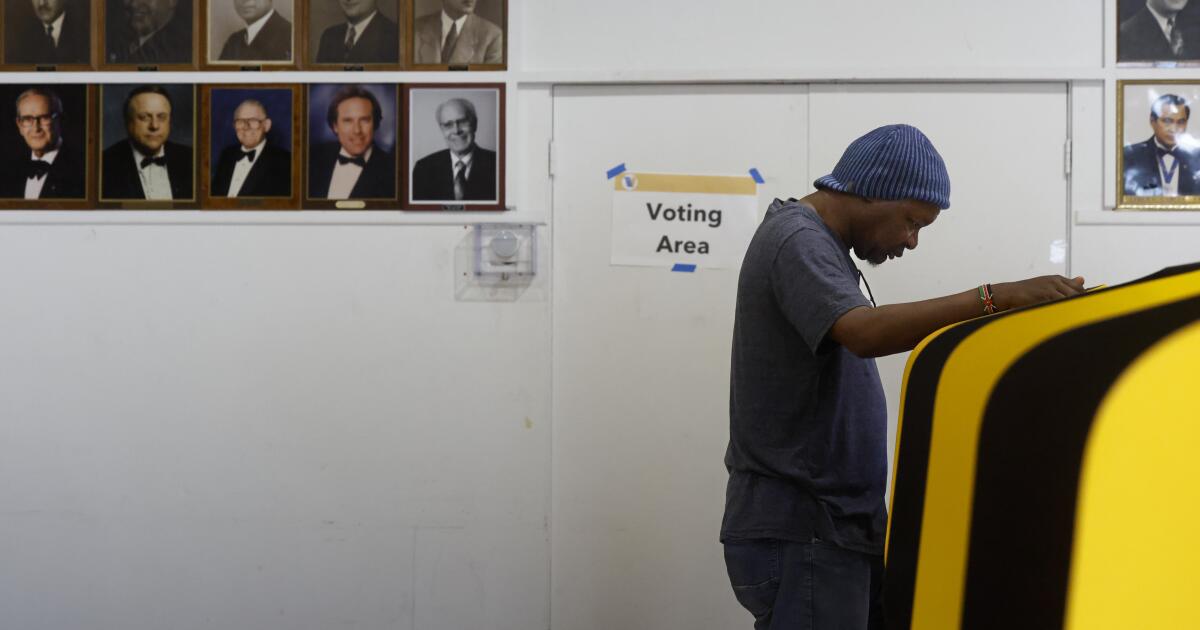
Despite Trump’s recent insistence, in-person voting does exist in Los Angeles
-
 Sports42 minutes ago
Yoshinobu Yamamoto helps Dodgers deliver a birthday win for Dave Roberts
-

 World50 minutes ago
“Crime hotspots”: Why violence at German stations
-

 News1 hour ago
Family visitation partly restored at New Jersey ICE facility after week of protests

